

147
esis of wholeness defines a generative process where there is always a sequence, an order, and a
morphogenetic process that drives the organic unfolding of a place (Alexander, Schmidt, Alexander,
Hanson, & Mehaffy, 2005, pp. 2–3). Linking to natural systems, this hypothesis of wholeness is also
evident in both McHarg’s (1992 [1969]) and Lyle’s (1991) arguments that support a new living systems, ecological worldview.
According this premise of the ecological systems worldview, the radical changes required for the
earth to remain fit for human and other species’ habitation cannot happen without the transition from
a ‘mechanical’ to an ‘ecological’ worldview (Du Plessis, 2009, 2012; Metzner, 1999). Du Plessis
(2012) describes that the regenerative sustainability paradigm emerges from this transition, and takes
hold as the new ecological systems worldview, which becomes embedded across fields of knowledge
and across disciplines. Regenerative approaches started with descriptions, concepts and design theories such as Lyle’s Design for Human Ecosystems (1991 [1985]), and Regenerative Design (Lyle,
1994), and through the adoption of this ecological worldview in the built environment professional
practice early regenerative practitioners evolved this worldview complex. This was accepted by various practitioners in the design fields of architecture, landscape architecture and planning (Kuhn, 1962;
Sanford & Mang, 1992).
Exploring a regenerative methodology as an example of how consciously a worldview shapes new
practice in ecological design, Mang and Reed (2012) summarise a ‘Regenerative Development and
Design Methodology’ based on the experience and application of this methodology in the professional practice of architecture, planning and design. The premises of the regenerative development
and design methodology involves the role of humans and nature, working together in a developmental
process that improves the value of the whole, and operates to take integrated systems to the next level,
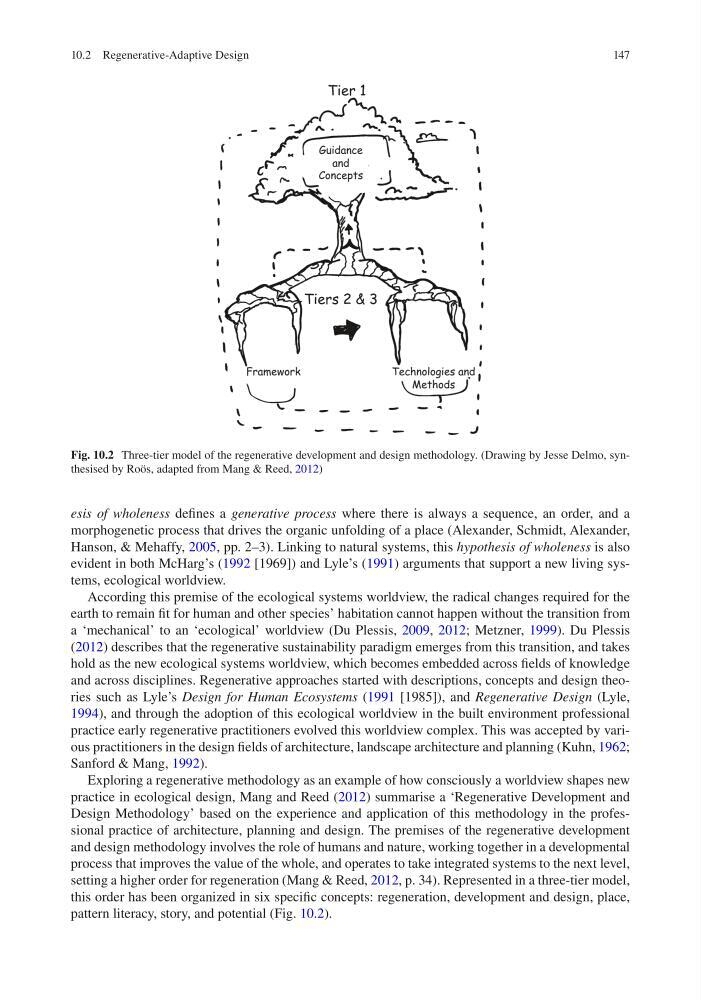
setting a higher order for regeneration (Mang & Reed, 2012, p. 34). Represented in a three-tier model,
this order has been organized in six specific concepts: regeneration, development and design, place,
pattern literacy, story, and potential (Fig. 10.2).
Fig. 10.2 Three-tier model of the regenerative development and design methodology. (Drawing by Jesse Delmo, synthesised by Roös, adapted from Mang & Reed, 2012)
10.2 Regenerative-Adaptive Design
esis of wholeness defines a generative process where there is always a sequence, an order, and a
morphogenetic process that drives the organic unfolding of a place (Alexander, Schmidt, Alexander,
Hanson, & Mehaffy, 2005, pp. 2–3). Linking to natural systems, this hypothesis of wholeness is also
evident in both McHarg’s (1992 [1969]) and Lyle’s (1991) arguments that support a new living systems, ecological worldview.
According this premise of the ecological systems worldview, the radical changes required for the
earth to remain fit for human and other species’ habitation cannot happen without the transition from
a ‘mechanical’ to an ‘ecological’ worldview (Du Plessis, 2009, 2012; Metzner, 1999). Du Plessis
(2012) describes that the regenerative sustainability paradigm emerges from this transition, and takes
hold as the new ecological systems worldview, which becomes embedded across fields of knowledge
and across disciplines. Regenerative approaches started with descriptions, concepts and design theories such as Lyle’s Design for Human Ecosystems (1991 [1985]), and Regenerative Design (Lyle,
1994), and through the adoption of this ecological worldview in the built environment professional
practice early regenerative practitioners evolved this worldview complex. This was accepted by various practitioners in the design fields of architecture, landscape architecture and planning (Kuhn, 1962;
Sanford & Mang, 1992).
Exploring a regenerative methodology as an example of how consciously a worldview shapes new
practice in ecological design, Mang and Reed (2012) summarise a ‘Regenerative Development and
Design Methodology’ based on the experience and application of this methodology in the professional practice of architecture, planning and design. The premises of the regenerative development
and design methodology involves the role of humans and nature, working together in a developmental
process that improves the value of the whole, and operates to take integrated systems to the next level,
setting a higher order for regeneration (Mang & Reed, 2012, p. 34). Represented in a three-tier model,
this order has been organized in six specific concepts: regeneration, development and design, place,
pattern literacy, story, and potential (Fig. 10.2).
Fig. 10.2 Three-tier model of the regenerative development and design methodology. (Drawing by Jesse Delmo, synthesised by Roös, adapted from Mang & Reed, 2012)
10.2 Regenerative-Adaptive Design