

146
10.1 Introduction
An environment of community will not come to life unless [each environment], each place, each building, each
street, each room, becomes unique, as a result of careful and piecemeal processes of adaptation (Alexander, Neis,
& Moore Alexander, 2012, p. 19).
Undeniably, the identification of the nature of planning and design problems sets the foundation for
what Alexander calls a ‘pattern language’ and potential methods of a generative process that can create
sustainable form. Logical structures formed the order of the theories of McHarg (1992 [1969]), Lyle (1994),
Alexander (2001–2005a, 2005b, 2005c, 2005d, 1979), and Alexander et al. (1977). As we have seen in
Chap. 10, the rationale behind Alexander’s method is the use of logical order or logical structures, similar
to what was used in the creation of form by unselfconscious cultures (Indigenous cultures) (Alexander,
1964, p. 31). Further, we need to consider the issues of climate change adaptation, the establishment of
sustainable communities and the achievement of resilience for both natural and human systems. Expanding
on this, in this chapter I further explore the principles and the evolution of a Regenerative-Adaptive Pattern
Language theory. The proposed theory informs a regenerative- adaptive design model, which bring together
the various parts of adaptation, indigenous knowledge, pattern language, and regenerative design as a
coherent whole, tested in application to a specific place, and documented in the next chapter, Chap. 11. But
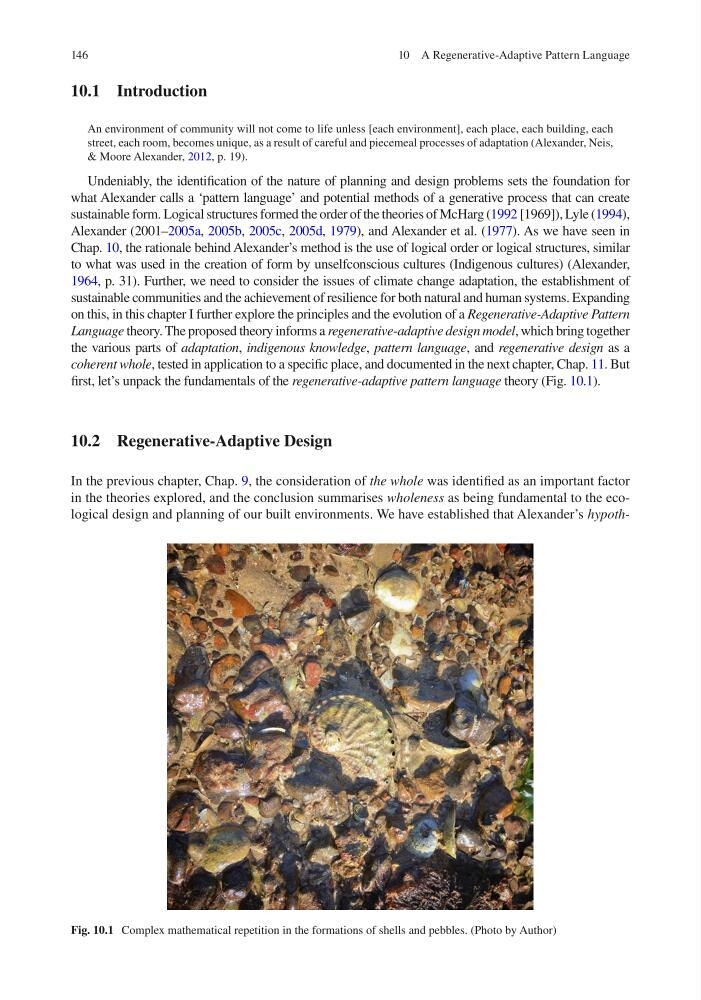
first, let’s unpack the fundamentals of the regenerative- adaptive pattern language theory (Fig. 10.1).
10.2 Regenerative-Adaptive Design
In the previous chapter, Chap. 9, the consideration of the whole was identified as an important factor
in the theories explored, and the conclusion summarises wholeness as being fundamental to the ecological design and planning of our built environments. We have established that Alexander’s hypothFig. 10.1 Complex mathematical repetition in the formations of shells and pebbles. (Photo by Author)
10 A Regenerative-Adaptive Pattern Language
10.1 Introduction
An environment of community will not come to life unless [each environment], each place, each building, each
street, each room, becomes unique, as a result of careful and piecemeal processes of adaptation (Alexander, Neis,
& Moore Alexander, 2012, p. 19).
Undeniably, the identification of the nature of planning and design problems sets the foundation for
what Alexander calls a ‘pattern language’ and potential methods of a generative process that can create
sustainable form. Logical structures formed the order of the theories of McHarg (1992 [1969]), Lyle (1994),
Alexander (2001–2005a, 2005b, 2005c, 2005d, 1979), and Alexander et al. (1977). As we have seen in
Chap. 10, the rationale behind Alexander’s method is the use of logical order or logical structures, similar
to what was used in the creation of form by unselfconscious cultures (Indigenous cultures) (Alexander,
1964, p. 31). Further, we need to consider the issues of climate change adaptation, the establishment of
sustainable communities and the achievement of resilience for both natural and human systems. Expanding
on this, in this chapter I further explore the principles and the evolution of a Regenerative-Adaptive Pattern
Language theory. The proposed theory informs a regenerative- adaptive design model, which bring together
the various parts of adaptation, indigenous knowledge, pattern language, and regenerative design as a
coherent whole, tested in application to a specific place, and documented in the next chapter, Chap. 11. But
first, let’s unpack the fundamentals of the regenerative- adaptive pattern language theory (Fig. 10.1).
10.2 Regenerative-Adaptive Design
In the previous chapter, Chap. 9, the consideration of the whole was identified as an important factor
in the theories explored, and the conclusion summarises wholeness as being fundamental to the ecological design and planning of our built environments. We have established that Alexander’s hypothFig. 10.1 Complex mathematical repetition in the formations of shells and pebbles. (Photo by Author)
10 A Regenerative-Adaptive Pattern Language