

137
9.7 Generative Process and the Generative Code
Every object, matter, or form is the outcome of a generative process. A frog grows from a fertilised
egg into a tadpole and then into an adult; matter creation results from the conversion of massless particles to massive particles known as pair production; a city develops from a small settlement to a
metropolis, and a piece of art is created from rock to sculpture according to the artist’s design. The
patterns and morphological processes described earlier in this chapter, and contended by Alexander,
McHarg, Lyle, Van der Ryn and Cowan, are in essence different observations of a generative approach.
These generative approaches argue that an object, form or phenomenon that we ‘see’ in nature or in
the built form is the result of an underlying process. This is a recognizable one, with patterns that
occur over and over again, which produces complex objects. The promise of generative processes is
productive and supported in biology by Thompson (1961), and in physics and computer science by
Wolfram (2002). Generative processes in biological formations, and similarly in physics, are underpinned by a specific code (Thompson, 1961; Wolfram, 2002). The basic foundation of Wolfram’s
‘new kind of science’ is the simple abstract rule of an elementary programming language, a generative
code that is very similar to the principles of A Pattern Language. However, generative codes are not
a new concept; they are used as the codes of a biological system that helps the generative process to
unfold a plant from its seed into the finest detail, listed in the genetic information of its DNA
(Alexander et al., 2005, p. 3).
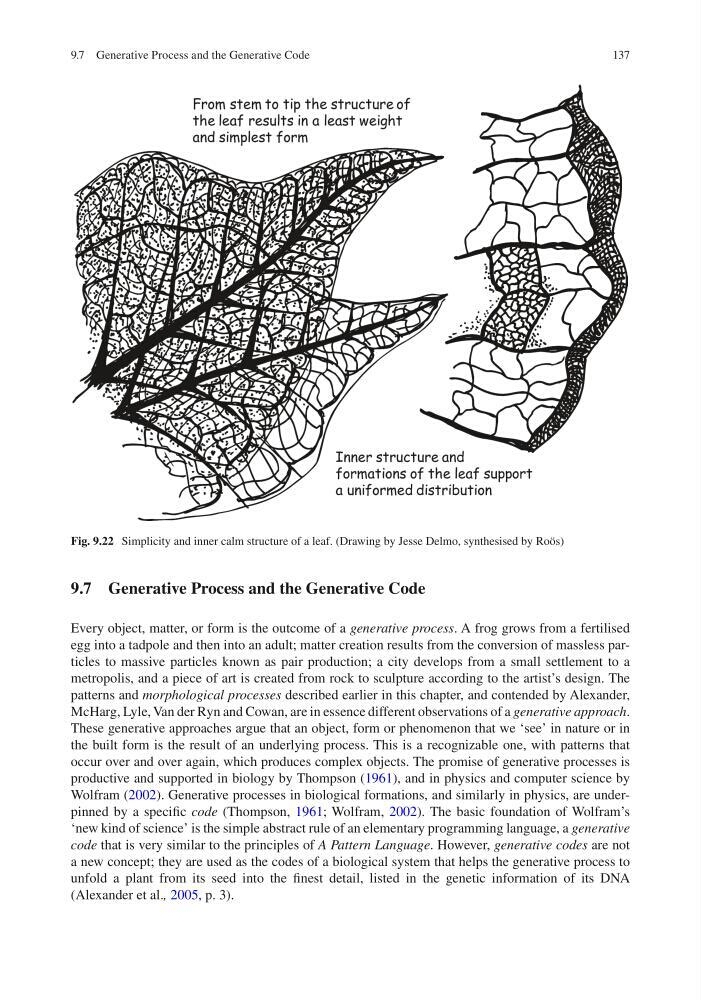
Fig. 9.22 Simplicity and inner calm structure of a leaf. (Drawing by Jesse Delmo, synthesised by Roös)
9.7 Generative Process and the Generative Code
9.7 Generative Process and the Generative Code
Every object, matter, or form is the outcome of a generative process. A frog grows from a fertilised
egg into a tadpole and then into an adult; matter creation results from the conversion of massless particles to massive particles known as pair production; a city develops from a small settlement to a
metropolis, and a piece of art is created from rock to sculpture according to the artist’s design. The
patterns and morphological processes described earlier in this chapter, and contended by Alexander,
McHarg, Lyle, Van der Ryn and Cowan, are in essence different observations of a generative approach.
These generative approaches argue that an object, form or phenomenon that we ‘see’ in nature or in
the built form is the result of an underlying process. This is a recognizable one, with patterns that
occur over and over again, which produces complex objects. The promise of generative processes is
productive and supported in biology by Thompson (1961), and in physics and computer science by
Wolfram (2002). Generative processes in biological formations, and similarly in physics, are underpinned by a specific code (Thompson, 1961; Wolfram, 2002). The basic foundation of Wolfram’s
‘new kind of science’ is the simple abstract rule of an elementary programming language, a generative
code that is very similar to the principles of A Pattern Language. However, generative codes are not
a new concept; they are used as the codes of a biological system that helps the generative process to
unfold a plant from its seed into the finest detail, listed in the genetic information of its DNA
(Alexander et al., 2005, p. 3).
Fig. 9.22 Simplicity and inner calm structure of a leaf. (Drawing by Jesse Delmo, synthesised by Roös)
9.7 Generative Process and the Generative Code