

129
9.6.7 Local Symmetries
Symmetries are evident and persistent throughout nature. We can see this in the shapes of trees where
symmetry is evident around the tree trunk; in the human body we find major bilateral symmetry, as
well as symmetry in its parts such as the finger around its length, the eye, the finger nail, the knee and
the woman’s breast. The different types of patterns in nature result in a widespread beautiful harmony
of repetitive symmetries, as depicted in Fig. 9.14. Symmetry is apparent in all living things; in the
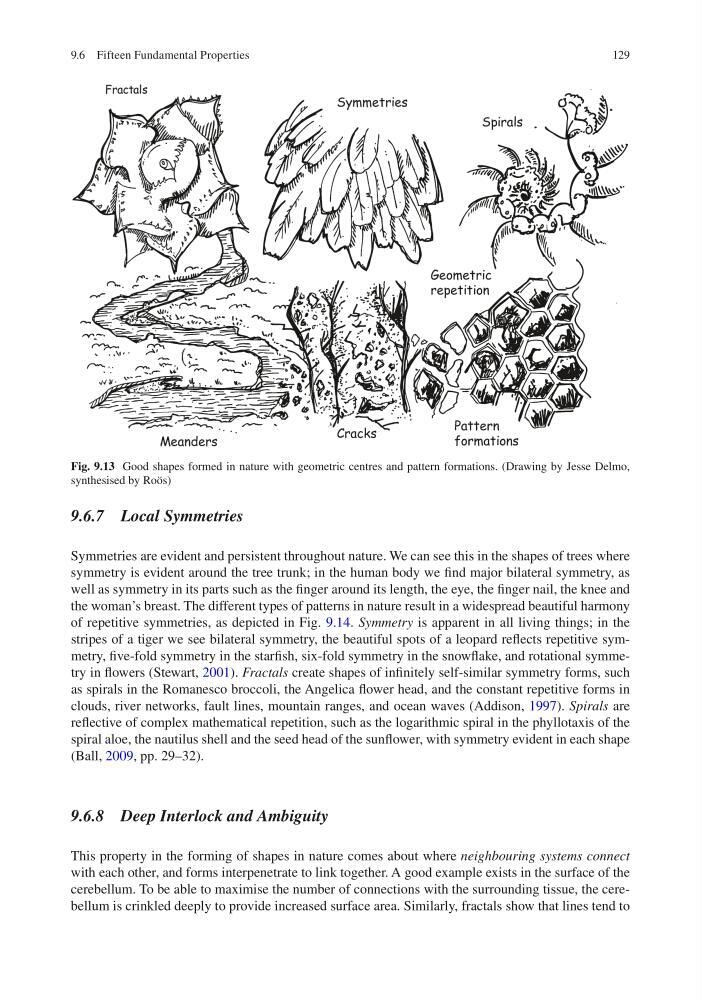
stripes of a tiger we see bilateral symmetry, the beautiful spots of a leopard reflects repetitive symmetry, five-fold symmetry in the starfish, six-fold symmetry in the snowflake, and rotational symmetry in flowers (Stewart, 2001). Fractals create shapes of infinitely self-similar symmetry forms, such
as spirals in the Romanesco broccoli, the Angelica flower head, and the constant repetitive forms in
clouds, river networks, fault lines, mountain ranges, and ocean waves (Addison, 1997). Spirals are
reflective of complex mathematical repetition, such as the logarithmic spiral in the phyllotaxis of the
spiral aloe, the nautilus shell and the seed head of the sunflower, with symmetry evident in each shape
(Ball, 2009, pp. 29–32).
9.6.8 Deep Interlock and Ambiguity
This property in the forming of shapes in nature comes about where neighbouring systems connect
with each other, and forms interpenetrate to link together. A good example exists in the surface of the
cerebellum. To be able to maximise the number of connections with the surrounding tissue, the cerebellum is crinkled deeply to provide increased surface area. Similarly, fractals show that lines tend to
Fig. 9.13 Good shapes formed in nature with geometric centres and pattern formations. (Drawing by Jesse Delmo,
synthesised by Roös)
9.6 Fifteen Fundamental Properties
9.6.7 Local Symmetries
Symmetries are evident and persistent throughout nature. We can see this in the shapes of trees where
symmetry is evident around the tree trunk; in the human body we find major bilateral symmetry, as
well as symmetry in its parts such as the finger around its length, the eye, the finger nail, the knee and
the woman’s breast. The different types of patterns in nature result in a widespread beautiful harmony
of repetitive symmetries, as depicted in Fig. 9.14. Symmetry is apparent in all living things; in the
stripes of a tiger we see bilateral symmetry, the beautiful spots of a leopard reflects repetitive symmetry, five-fold symmetry in the starfish, six-fold symmetry in the snowflake, and rotational symmetry in flowers (Stewart, 2001). Fractals create shapes of infinitely self-similar symmetry forms, such
as spirals in the Romanesco broccoli, the Angelica flower head, and the constant repetitive forms in
clouds, river networks, fault lines, mountain ranges, and ocean waves (Addison, 1997). Spirals are
reflective of complex mathematical repetition, such as the logarithmic spiral in the phyllotaxis of the
spiral aloe, the nautilus shell and the seed head of the sunflower, with symmetry evident in each shape
(Ball, 2009, pp. 29–32).
9.6.8 Deep Interlock and Ambiguity
This property in the forming of shapes in nature comes about where neighbouring systems connect
with each other, and forms interpenetrate to link together. A good example exists in the surface of the
cerebellum. To be able to maximise the number of connections with the surrounding tissue, the cerebellum is crinkled deeply to provide increased surface area. Similarly, fractals show that lines tend to
Fig. 9.13 Good shapes formed in nature with geometric centres and pattern formations. (Drawing by Jesse Delmo,
synthesised by Roös)
9.6 Fifteen Fundamental Properties