

119
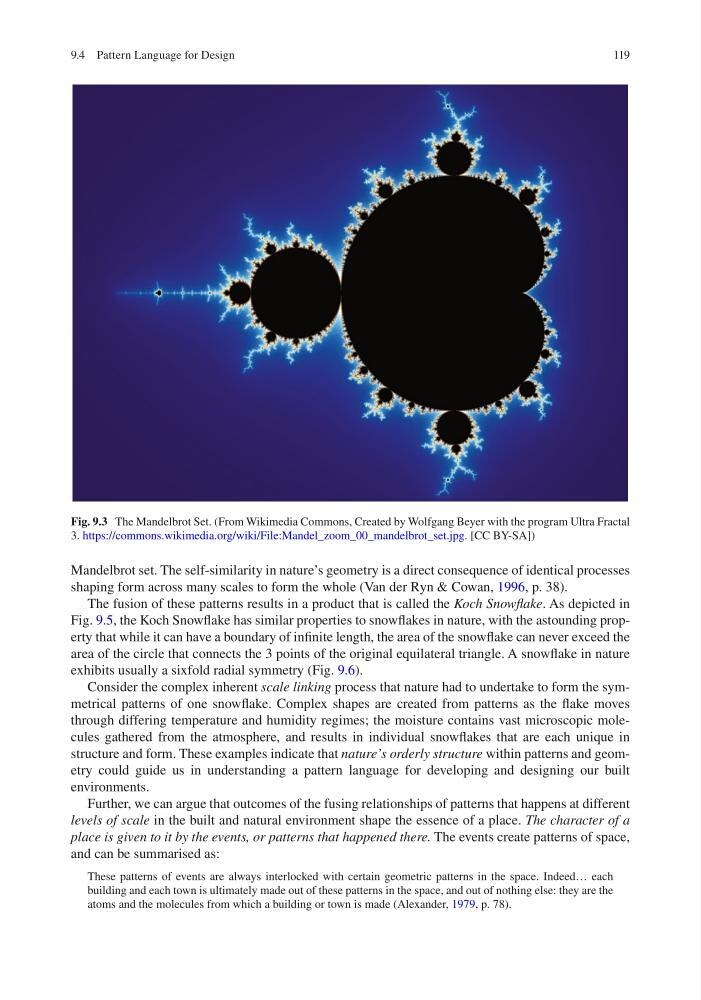
Mandelbrot set. The self-similarity in nature’s geometry is a direct consequence of identical processes
shaping form across many scales to form the whole (Van der Ryn & Cowan, 1996, p. 38).
The fusion of these patterns results in a product that is called the Koch Snowflake. As depicted in
Fig. 9.5, the Koch Snowflake has similar properties to snowflakes in nature, with the astounding property that while it can have a boundary of infinite length, the area of the snowflake can never exceed the
area of the circle that connects the 3 points of the original equilateral triangle. A snowflake in nature
exhibits usually a sixfold radial symmetry (Fig. 9.6).
Consider the complex inherent scale linking process that nature had to undertake to form the symmetrical patterns of one snowflake. Complex shapes are created from patterns as the flake moves
through differing temperature and humidity regimes; the moisture contains vast microscopic molecules gathered from the atmosphere, and results in individual snowflakes that are each unique in
structure and form. These examples indicate that nature’s orderly structure within patterns and geometry could guide us in understanding a pattern language for developing and designing our built
environments.
Further, we can argue that outcomes of the fusing relationships of patterns that happens at different
levels of scale in the built and natural environment shape the essence of a place. The character of a
place is given to it by the events, or patterns that happened there. The events create patterns of space,
and can be summarised as:
These patterns of events are always interlocked with certain geometric patterns in the space. Indeed… each
building and each town is ultimately made out of these patterns in the space, and out of nothing else: they are the
atoms and the molecules from which a building or town is made (Alexander, 1979, p. 78).
Fig. 9.3 The Mandelbrot Set. (From Wikimedia Commons, Created by Wolfgang Beyer with the program Ultra Fractal
3. https://commons.wikimedia.org/wiki/File:Mandel_zoom_00_mandelbrot_set.jpg. [CC BY-SA])
9.4 Pattern Language for Design
Mandelbrot set. The self-similarity in nature’s geometry is a direct consequence of identical processes
shaping form across many scales to form the whole (Van der Ryn & Cowan, 1996, p. 38).
The fusion of these patterns results in a product that is called the Koch Snowflake. As depicted in
Fig. 9.5, the Koch Snowflake has similar properties to snowflakes in nature, with the astounding property that while it can have a boundary of infinite length, the area of the snowflake can never exceed the
area of the circle that connects the 3 points of the original equilateral triangle. A snowflake in nature
exhibits usually a sixfold radial symmetry (Fig. 9.6).
Consider the complex inherent scale linking process that nature had to undertake to form the symmetrical patterns of one snowflake. Complex shapes are created from patterns as the flake moves
through differing temperature and humidity regimes; the moisture contains vast microscopic molecules gathered from the atmosphere, and results in individual snowflakes that are each unique in
structure and form. These examples indicate that nature’s orderly structure within patterns and geometry could guide us in understanding a pattern language for developing and designing our built
environments.
Further, we can argue that outcomes of the fusing relationships of patterns that happens at different
levels of scale in the built and natural environment shape the essence of a place. The character of a
place is given to it by the events, or patterns that happened there. The events create patterns of space,
and can be summarised as:
These patterns of events are always interlocked with certain geometric patterns in the space. Indeed… each
building and each town is ultimately made out of these patterns in the space, and out of nothing else: they are the
atoms and the molecules from which a building or town is made (Alexander, 1979, p. 78).
Fig. 9.3 The Mandelbrot Set. (From Wikimedia Commons, Created by Wolfgang Beyer with the program Ultra Fractal
3. https://commons.wikimedia.org/wiki/File:Mandel_zoom_00_mandelbrot_set.jpg. [CC BY-SA])
9.4 Pattern Language for Design