

118
complexity is also evident in complexity science,
2
where simple processes can generate the complex
structures of the natural world through adaptive iteration (Mehaffy, 2009a). Improvisional patterns
therefore have built-in dynamics of repetitive principles and solutions combined with extreme variability, and the complex fusing relationships that can be found in fractal geometry (Stark, 2012). The
Mandelbrot Set, indicated in Fig. 9.3, is a good example of patterns at self- similarity at all scales.
What Mandelbrot discovered is that many natural systems and entities have an underlying geometric
order that results from these self-similarity patterns, which can be either spatial or temporal.
The cycles that connect phenomena in nature at very different scales are named by Van der Ryn as
scale linking. Van der Ryn and Cowan (1996) further provide a comparison of nature’s geometric
forms and cycles with a description of the Koch curve. Taking a single line segment and dividing it
into three segments of equal length, as shown in Fig. 9.4, the repetition constructs a curve. Then an
equilateral triangle is drawn from the middle segment from segment n1, erasing the base, which result
in segment n2. This process can then be applied to each line segment as shown in segment n3.
Continuing this process of pattern shaping to the segments n4 and n5, the Koch curve has infinite
length because each time step n3 is undertaken for each line segment, the number of line segments are
generated 4 times. At each stage the new line segments are one-third the length of those in the preceding stage, resulting in symmetry of self-similarity. The symmetry in the curve is built up by sub-forms
that echo the whole. The self-similarity replications are named fractals, similar to those in the
2 Complexity Science is the scientific study of complex systems, systems with many parts that interact to produce global
behaviour that cannot easily be explained in terms of interactions between the individual constituent elements.
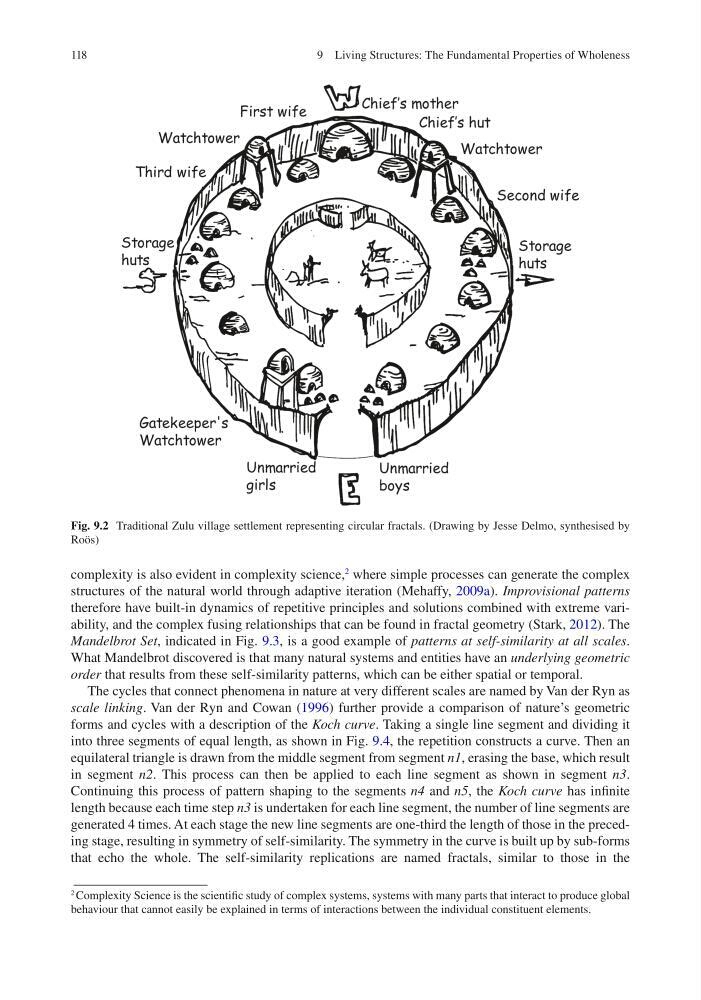
Fig. 9.2 Traditional Zulu village settlement representing circular fractals. (Drawing by Jesse Delmo, synthesised by
Roös)
9 Living Structures: The Fundamental Properties of Wholeness
complexity is also evident in complexity science,
2
where simple processes can generate the complex
structures of the natural world through adaptive iteration (Mehaffy, 2009a). Improvisional patterns
therefore have built-in dynamics of repetitive principles and solutions combined with extreme variability, and the complex fusing relationships that can be found in fractal geometry (Stark, 2012). The
Mandelbrot Set, indicated in Fig. 9.3, is a good example of patterns at self- similarity at all scales.
What Mandelbrot discovered is that many natural systems and entities have an underlying geometric
order that results from these self-similarity patterns, which can be either spatial or temporal.
The cycles that connect phenomena in nature at very different scales are named by Van der Ryn as
scale linking. Van der Ryn and Cowan (1996) further provide a comparison of nature’s geometric
forms and cycles with a description of the Koch curve. Taking a single line segment and dividing it
into three segments of equal length, as shown in Fig. 9.4, the repetition constructs a curve. Then an
equilateral triangle is drawn from the middle segment from segment n1, erasing the base, which result
in segment n2. This process can then be applied to each line segment as shown in segment n3.
Continuing this process of pattern shaping to the segments n4 and n5, the Koch curve has infinite
length because each time step n3 is undertaken for each line segment, the number of line segments are
generated 4 times. At each stage the new line segments are one-third the length of those in the preceding stage, resulting in symmetry of self-similarity. The symmetry in the curve is built up by sub-forms
that echo the whole. The self-similarity replications are named fractals, similar to those in the
2 Complexity Science is the scientific study of complex systems, systems with many parts that interact to produce global
behaviour that cannot easily be explained in terms of interactions between the individual constituent elements.
Fig. 9.2 Traditional Zulu village settlement representing circular fractals. (Drawing by Jesse Delmo, synthesised by
Roös)
9 Living Structures: The Fundamental Properties of Wholeness