

105
2012). To achieve this balance, a consideration of cultural, social, economic and environmental aspirations is required. To do this, the ‘uniqueness of place’ needs to be understood and valued, and ideas
about any changes in a locality need to be worked through with different people, representing different interests, over a period of time (Cole, 2012, p. 40).
The fundamentals in understanding ‘the uniqueness of place’ (where there is the unique, multilayered network of living systems within a specific geographic region that results from the complex
interactions of the natural ecology and human culture), are described in Lyle’s (1991) article “Can
floating seeds make deep forms?”. In this work, Lyle asks landscape architects to think of creating
form as floating seeds that disperse, lodge, and sometimes take root, resulting in shallow or deep
forms. This reflects fundamentally the three basic modes of ecological order combining to create
form. What a person visually experiences in the landscape is the direct expression of the latter’s structural, functional and locational order, as they exist in that particular moment in time (Swaffield, 2002,
p. 188; Lyle, 1991b). Lyle further adds human settlements into the mix of ecological order, and terms
the full integrated system as ‘human ecosystems’. An important aspect of ‘human ecosystems’ is to
take into account that when human settlements intervene in the existing ecological systems, processes
should be put in place to regenerate the resources used from nature. While McHarg’s ‘ecological
method’ helps to identify and map the ecological systems and land use patterns of a place, as noted in
Design with Nature (McHarg, 1992 [1969]), Lyle’s approach to regenerate ecosystems for achieving
future sustainability is a strong expression of a more adaptive design approach (Swaffield, 2002,
p. 171), as demonstrated in Design for Human Ecosystems (Lyle, 1991a [1985]). Various regenerative
design methodologies developed later from Lyle’s work, but essentially they are just different versions
of the fundamental concept that regenerative design denotes the integration of human aspirations with
the evolution of natural systems – essentially, the co-evolution of both (Mang & Reed, 2012, p. 26).
This chapter thus investigates the principles and methods of regenerative design, but more specifically
reviewing its connection to ‘place’, as well as the context of adaptation.
8.2 Design for Human Ecosystems
When introducing the concept of ‘design for human ecosystems’, Lyle reflected on a case study of the
San Elijo Lagoon located in the coastal plains north of San Diego. The Lagoon is a narrow tangle of
marches, mudflats, and shallow channels that push out of the Pacific Ocean into the coastal plain. Lyle
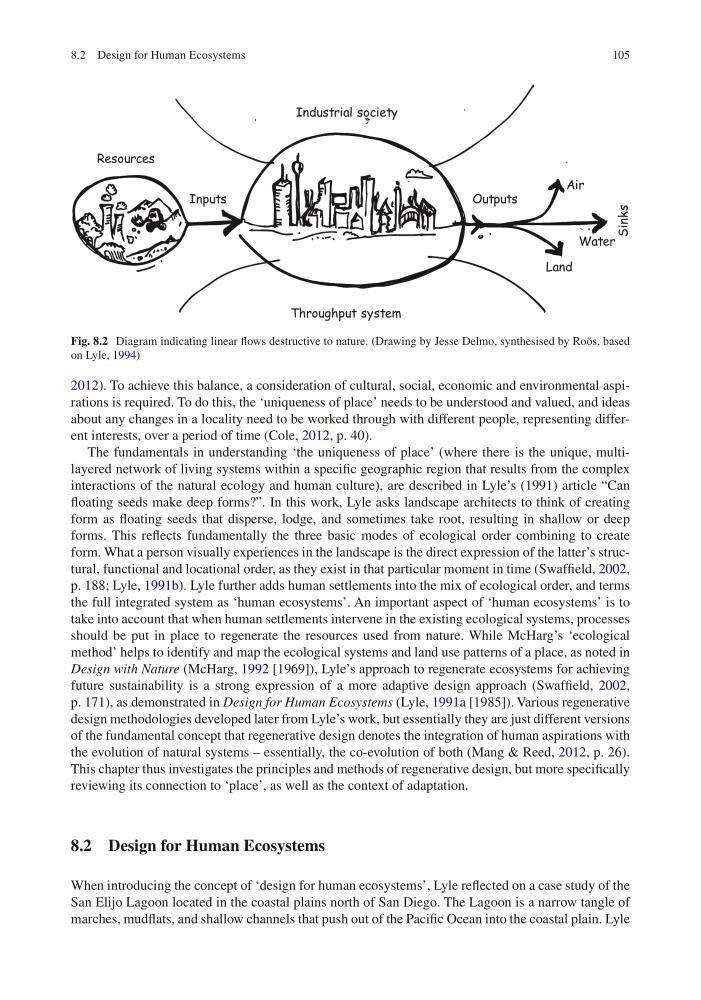
Fig. 8.2 Diagram indicating linear flows destructive to nature. (Drawing by Jesse Delmo, synthesised by Roös, based
on Lyle, 1994)
8.2 Design for Human Ecosystems
2012). To achieve this balance, a consideration of cultural, social, economic and environmental aspirations is required. To do this, the ‘uniqueness of place’ needs to be understood and valued, and ideas
about any changes in a locality need to be worked through with different people, representing different interests, over a period of time (Cole, 2012, p. 40).
The fundamentals in understanding ‘the uniqueness of place’ (where there is the unique, multilayered network of living systems within a specific geographic region that results from the complex
interactions of the natural ecology and human culture), are described in Lyle’s (1991) article “Can
floating seeds make deep forms?”. In this work, Lyle asks landscape architects to think of creating
form as floating seeds that disperse, lodge, and sometimes take root, resulting in shallow or deep
forms. This reflects fundamentally the three basic modes of ecological order combining to create
form. What a person visually experiences in the landscape is the direct expression of the latter’s structural, functional and locational order, as they exist in that particular moment in time (Swaffield, 2002,
p. 188; Lyle, 1991b). Lyle further adds human settlements into the mix of ecological order, and terms
the full integrated system as ‘human ecosystems’. An important aspect of ‘human ecosystems’ is to
take into account that when human settlements intervene in the existing ecological systems, processes
should be put in place to regenerate the resources used from nature. While McHarg’s ‘ecological
method’ helps to identify and map the ecological systems and land use patterns of a place, as noted in
Design with Nature (McHarg, 1992 [1969]), Lyle’s approach to regenerate ecosystems for achieving
future sustainability is a strong expression of a more adaptive design approach (Swaffield, 2002,
p. 171), as demonstrated in Design for Human Ecosystems (Lyle, 1991a [1985]). Various regenerative
design methodologies developed later from Lyle’s work, but essentially they are just different versions
of the fundamental concept that regenerative design denotes the integration of human aspirations with
the evolution of natural systems – essentially, the co-evolution of both (Mang & Reed, 2012, p. 26).
This chapter thus investigates the principles and methods of regenerative design, but more specifically
reviewing its connection to ‘place’, as well as the context of adaptation.
8.2 Design for Human Ecosystems
When introducing the concept of ‘design for human ecosystems’, Lyle reflected on a case study of the
San Elijo Lagoon located in the coastal plains north of San Diego. The Lagoon is a narrow tangle of
marches, mudflats, and shallow channels that push out of the Pacific Ocean into the coastal plain. Lyle
Fig. 8.2 Diagram indicating linear flows destructive to nature. (Drawing by Jesse Delmo, synthesised by Roös, based
on Lyle, 1994)
8.2 Design for Human Ecosystems