

98
McHarg’s analysis and recommendations still stand today, and ecologists will support this argument. Unfortunately, if we go through this list, we quickly realise that our human settlements of the
past as well as in our current time, ignore these simple rules and we develop built environments
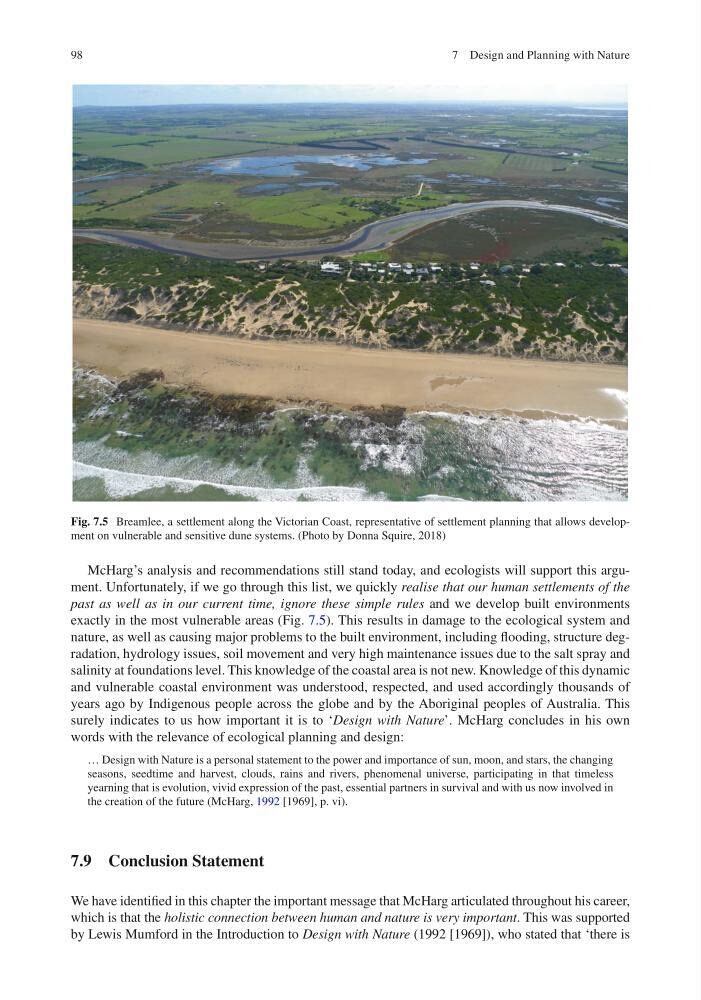
exactly in the most vulnerable areas (Fig. 7.5). This results in damage to the ecological system and
nature, as well as causing major problems to the built environment, including flooding, structure degradation, hydrology issues, soil movement and very high maintenance issues due to the salt spray and
salinity at foundations level. This knowledge of the coastal area is not new. Knowledge of this dynamic
and vulnerable coastal environment was understood, respected, and used accordingly thousands of
years ago by Indigenous people across the globe and by the Aboriginal peoples of Australia. This
surely indicates to us how important it is to ‘Design with Nature’. McHarg concludes in his own
words with the relevance of ecological planning and design:
… Design with Nature is a personal statement to the power and importance of sun, moon, and stars, the changing
seasons, seedtime and harvest, clouds, rains and rivers, phenomenal universe, participating in that timeless
yearning that is evolution, vivid expression of the past, essential partners in survival and with us now involved in
the creation of the future (McHarg, 1992 [1969], p. vi).
7.9 Conclusion Statement
We have identified in this chapter the important message that McHarg articulated throughout his career,
which is that the holistic connection between human and nature is very important. This was supported
by Lewis Mumford in the Introduction to Design with Nature (1992 [1969]), who stated that ‘there is
Fig. 7.5 Breamlee, a settlement along the Victorian Coast, representative of settlement planning that allows development on vulnerable and sensitive dune systems. (Photo by Donna Squire, 2018)
7 Design and Planning with Nature
McHarg’s analysis and recommendations still stand today, and ecologists will support this argument. Unfortunately, if we go through this list, we quickly realise that our human settlements of the
past as well as in our current time, ignore these simple rules and we develop built environments
exactly in the most vulnerable areas (Fig. 7.5). This results in damage to the ecological system and
nature, as well as causing major problems to the built environment, including flooding, structure degradation, hydrology issues, soil movement and very high maintenance issues due to the salt spray and
salinity at foundations level. This knowledge of the coastal area is not new. Knowledge of this dynamic
and vulnerable coastal environment was understood, respected, and used accordingly thousands of
years ago by Indigenous people across the globe and by the Aboriginal peoples of Australia. This
surely indicates to us how important it is to ‘Design with Nature’. McHarg concludes in his own
words with the relevance of ecological planning and design:
… Design with Nature is a personal statement to the power and importance of sun, moon, and stars, the changing
seasons, seedtime and harvest, clouds, rains and rivers, phenomenal universe, participating in that timeless
yearning that is evolution, vivid expression of the past, essential partners in survival and with us now involved in
the creation of the future (McHarg, 1992 [1969], p. vi).
7.9 Conclusion Statement
We have identified in this chapter the important message that McHarg articulated throughout his career,
which is that the holistic connection between human and nature is very important. This was supported
by Lewis Mumford in the Introduction to Design with Nature (1992 [1969]), who stated that ‘there is
Fig. 7.5 Breamlee, a settlement along the Victorian Coast, representative of settlement planning that allows development on vulnerable and sensitive dune systems. (Photo by Donna Squire, 2018)
7 Design and Planning with Nature