

84
plex order of abiotic and biotic systems that results in us being nature, or being part of the whole
(Roös, 2017). The second level of connection is the biophilic effect, which is more than what we can
see on the surface; it is what is underneath, the psychological phenomenon where we are part of a
natural attraction, a sensory language that is formulated in a nature language.
Therefore:
Our biophilic design agenda thus needs to include the characteristics of a complex order and the
complexity of the traditional ornament make- up (Salingaros, 2015), inclusive of the rules of living
structures (Alexander, 2001–2005). Rules for how ornament make-up contributes to a healing environment can be derived from understanding how our brain is wired to respond to our surroundings.
These rules are part of deep interaction patterns. Both the physical perspective of biophilic design, as
well as the ecopsychology perspective of natural attraction and sensory responses of a nature language embedded in biophilia, needs to be applied to design and planning practice. This nature language is fundamental to enhance and strengthen our love for nature.
6.6 Fundamental Pattern 6
Love For Nature [6]
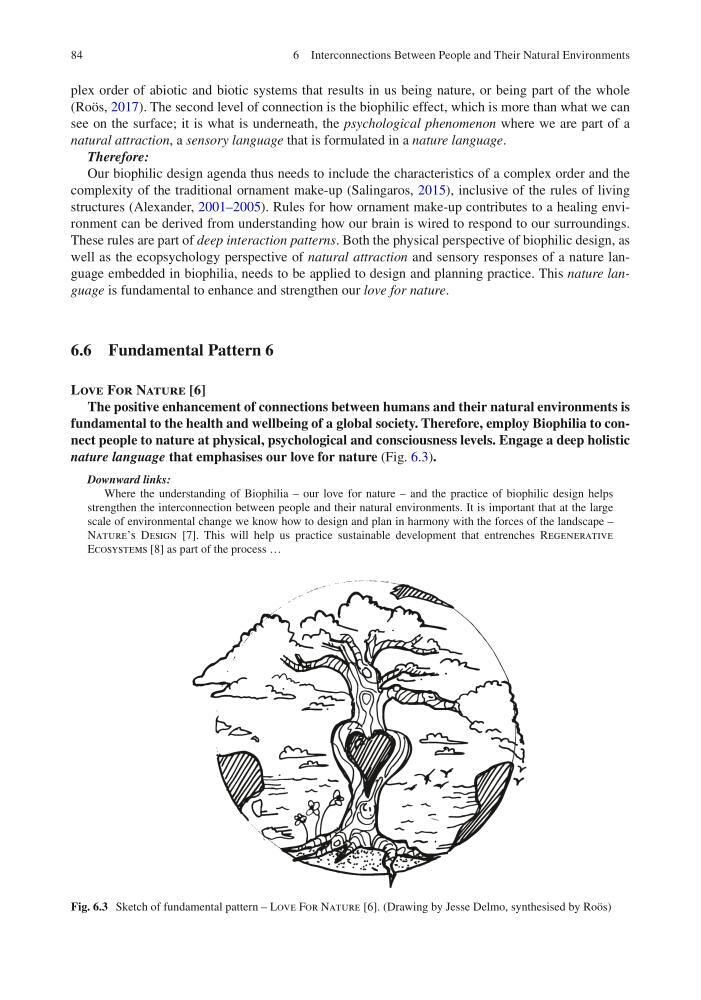
The positive enhancement of connections between humans and their natural environments is
fundamental to the health and wellbeing of a global society. Therefore, employ Biophilia to connect people to nature at physical, psychological and consciousness levels. Engage a deep holistic
nature language that emphasises our love for nature (Fig. 6.3).
Downward links:
Where the understanding of Biophilia – our love for nature – and the practice of biophilic design helps
strengthen the interconnection between people and their natural environments. It is important that at the large
scale of environmental change we know how to design and plan in harmony with the forces of the landscape –
Nature’s Design [7]. This will help us practice sustainable development that entrenches Regenerative
Ecosystems [8] as part of the process …
Fig. 6.3 Sketch of fundamental pattern – Love For Nature [6]. (Drawing by Jesse Delmo, synthesised by Roös)
6 Interconnections Between People and Their Natural Environments
plex order of abiotic and biotic systems that results in us being nature, or being part of the whole
(Roös, 2017). The second level of connection is the biophilic effect, which is more than what we can
see on the surface; it is what is underneath, the psychological phenomenon where we are part of a
natural attraction, a sensory language that is formulated in a nature language.
Therefore:
Our biophilic design agenda thus needs to include the characteristics of a complex order and the
complexity of the traditional ornament make- up (Salingaros, 2015), inclusive of the rules of living
structures (Alexander, 2001–2005). Rules for how ornament make-up contributes to a healing environment can be derived from understanding how our brain is wired to respond to our surroundings.
These rules are part of deep interaction patterns. Both the physical perspective of biophilic design, as
well as the ecopsychology perspective of natural attraction and sensory responses of a nature language embedded in biophilia, needs to be applied to design and planning practice. This nature language is fundamental to enhance and strengthen our love for nature.
6.6 Fundamental Pattern 6
Love For Nature [6]
The positive enhancement of connections between humans and their natural environments is
fundamental to the health and wellbeing of a global society. Therefore, employ Biophilia to connect people to nature at physical, psychological and consciousness levels. Engage a deep holistic
nature language that emphasises our love for nature (Fig. 6.3).
Downward links:
Where the understanding of Biophilia – our love for nature – and the practice of biophilic design helps
strengthen the interconnection between people and their natural environments. It is important that at the large
scale of environmental change we know how to design and plan in harmony with the forces of the landscape –
Nature’s Design [7]. This will help us practice sustainable development that entrenches Regenerative
Ecosystems [8] as part of the process …
Fig. 6.3 Sketch of fundamental pattern – Love For Nature [6]. (Drawing by Jesse Delmo, synthesised by Roös)
6 Interconnections Between People and Their Natural Environments