

83
embody the structure of an engaged and meaningful human activity in, through part of, and with
nature (Kahn Jr., Ruckert, & Hasbach, 2012, p. 57). An interesting observation when analysing the
nature language proposed by Kahn Jr. et al. (2012), and indeed acknowledged by them, is that interaction patterns are not fundamentally distinct from each other, but they rather exist within a networked
relationship. This relationship is similar to the proposition by Cohen (2013) that these patterns are an
inherent part of the webstring of life, as described earlier.
It is evident that the human-nature interaction is beyond the physical patterns that we know, and as
Greenway (2009) argued, we need a more robust language that can reflect our experience of nature.
He stated that:
I work towards and ecopsychology that will find within the language an accurate articulation of the humannature relationship. This will of course be based on experience, but will be couched in a language… It must take
up the deepest meanings of relationships in general and relationships in “mind” and “nature” in particular. It will
be based on a variety of “modes of knowing” – neither ignoring or privileging science (Greenway, 2009, p. 50).
In the context of the regenerative-adaptive pattern language, it is this language of connecting
“mind” with “nature” that is fundamental in seeking a deep sustainability, going beyond and acknowledging that we as humans are part of nature and not above it.
6.5 Conclusion Statement
The interconnections between humans and nature exists on two levels. One is where physical interactions enhance living structures and are part of the whole that interacts with our organic and inorganic
surroundings on Earth to form a synergistic, self-regulating, complex system that helps to maintain
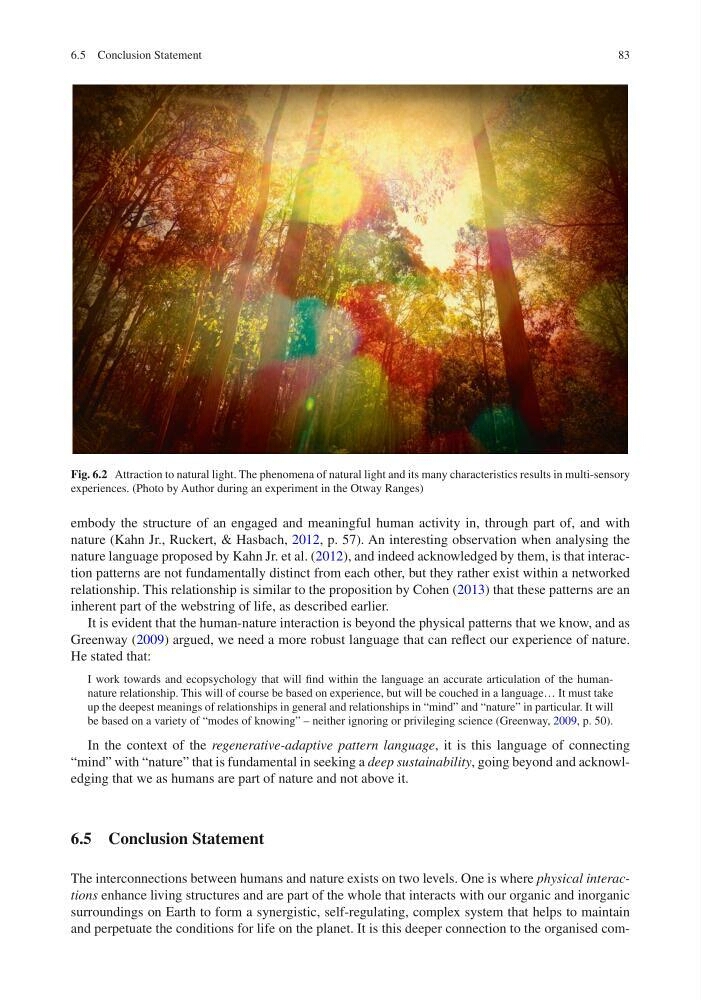
and perpetuate the conditions for life on the planet. It is this deeper connection to the organised comFig. 6.2 Attraction to natural light. The phenomena of natural light and its many characteristics results in multi-sensory
experiences. (Photo by Author during an experiment in the Otway Ranges)
6.5 Conclusion Statement
embody the structure of an engaged and meaningful human activity in, through part of, and with
nature (Kahn Jr., Ruckert, & Hasbach, 2012, p. 57). An interesting observation when analysing the
nature language proposed by Kahn Jr. et al. (2012), and indeed acknowledged by them, is that interaction patterns are not fundamentally distinct from each other, but they rather exist within a networked
relationship. This relationship is similar to the proposition by Cohen (2013) that these patterns are an
inherent part of the webstring of life, as described earlier.
It is evident that the human-nature interaction is beyond the physical patterns that we know, and as
Greenway (2009) argued, we need a more robust language that can reflect our experience of nature.
He stated that:
I work towards and ecopsychology that will find within the language an accurate articulation of the humannature relationship. This will of course be based on experience, but will be couched in a language… It must take
up the deepest meanings of relationships in general and relationships in “mind” and “nature” in particular. It will
be based on a variety of “modes of knowing” – neither ignoring or privileging science (Greenway, 2009, p. 50).
In the context of the regenerative-adaptive pattern language, it is this language of connecting
“mind” with “nature” that is fundamental in seeking a deep sustainability, going beyond and acknowledging that we as humans are part of nature and not above it.
6.5 Conclusion Statement
The interconnections between humans and nature exists on two levels. One is where physical interactions enhance living structures and are part of the whole that interacts with our organic and inorganic
surroundings on Earth to form a synergistic, self-regulating, complex system that helps to maintain
and perpetuate the conditions for life on the planet. It is this deeper connection to the organised comFig. 6.2 Attraction to natural light. The phenomena of natural light and its many characteristics results in multi-sensory
experiences. (Photo by Author during an experiment in the Otway Ranges)
6.5 Conclusion Statement