

64
under oceanic salinity conditions. What were they doing in estuarine sediments?
Just as surprising was the presence of pristine specimens of several planktonic foraminiferal species that we know are restricted to the warm waters of the Gulf Stream.
How do we get shelf benthic species to live behind the barrier islands and wellpreserved specimens of Gulf Stream planktonic in a core from a modern estuary?
The only way this can occur is by removing large portions of the barrier island – the
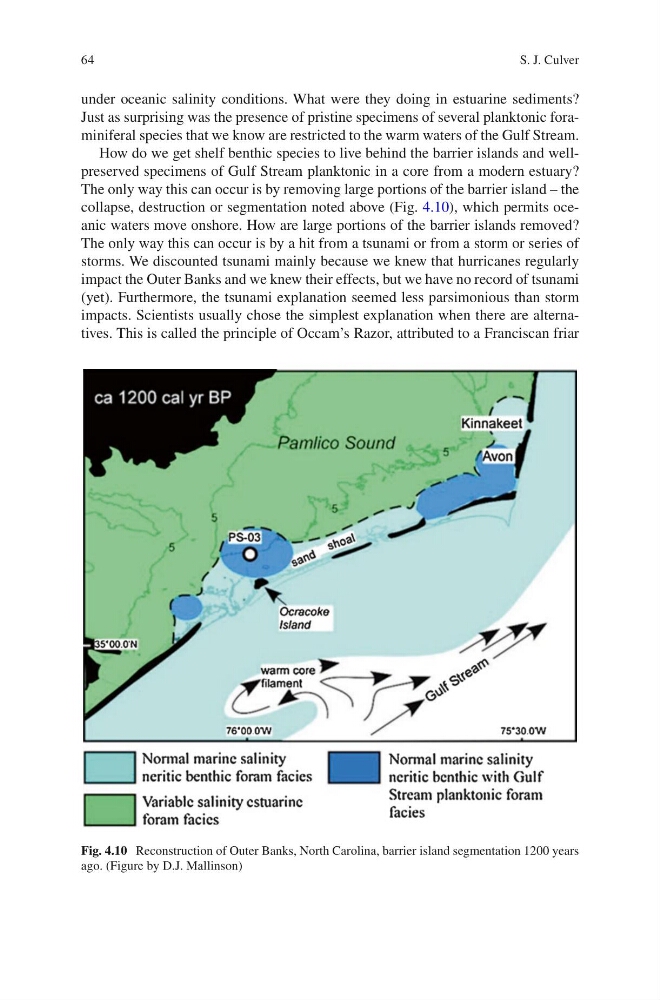
collapse, destruction or segmentation noted above (Fig. 4.10), which permits oceanic waters move onshore. How are large portions of the barrier islands removed?
The only way this can occur is by a hit from a tsunami or from a storm or series of
storms. We discounted tsunami mainly because we knew that hurricanes regularly
impact the Outer Banks and we knew their effects, but we have no record of tsunami
(yet). Furthermore, the tsunami explanation seemed less parsimonious than storm
impacts. Scientists usually chose the simplest explanation when there are alternatives. This is called the principle of Occam’s Razor, attributed to a Franciscan friar
Fig. 4.10 Reconstruction of Outer Banks, North Carolina, barrier island segmentation 1200 years
ago. (Figure by D.J. Mallinson)
S. J. Culver
under oceanic salinity conditions. What were they doing in estuarine sediments?
Just as surprising was the presence of pristine specimens of several planktonic foraminiferal species that we know are restricted to the warm waters of the Gulf Stream.
How do we get shelf benthic species to live behind the barrier islands and wellpreserved specimens of Gulf Stream planktonic in a core from a modern estuary?
The only way this can occur is by removing large portions of the barrier island – the
collapse, destruction or segmentation noted above (Fig. 4.10), which permits oceanic waters move onshore. How are large portions of the barrier islands removed?
The only way this can occur is by a hit from a tsunami or from a storm or series of
storms. We discounted tsunami mainly because we knew that hurricanes regularly
impact the Outer Banks and we knew their effects, but we have no record of tsunami
(yet). Furthermore, the tsunami explanation seemed less parsimonious than storm
impacts. Scientists usually chose the simplest explanation when there are alternatives. This is called the principle of Occam’s Razor, attributed to a Franciscan friar
Fig. 4.10 Reconstruction of Outer Banks, North Carolina, barrier island segmentation 1200 years
ago. (Figure by D.J. Mallinson)
S. J. Culver