

63
and “big picture” guy to put all of this together. I did this in a short paper, coauthored by a cast of thousands, which caused considerable interest. It was titled,
“Late Holocene barrier island collapse: Outer Banks, North Carolina, USA”. The
president for the Society of Sedimentary Geology (SEPM) used this paper as an
example of how this kind of research can aid in petroleum exploration. My student
senior authored a more detailed research paper a few years later.
Unexpected Results Lead to Thought-Provoking Conclusions
What was the evidence for this barrier island destruction? The mud in core PS03
(Fig. 4.8) contained low diversity (ten or fewer species) estuarine, variably brackish,
foram assemblages identical to those that live in Pamlico Sound today (Fig. 4.4).
That certainly seemed understandable. But the foram assemblages in the two sand
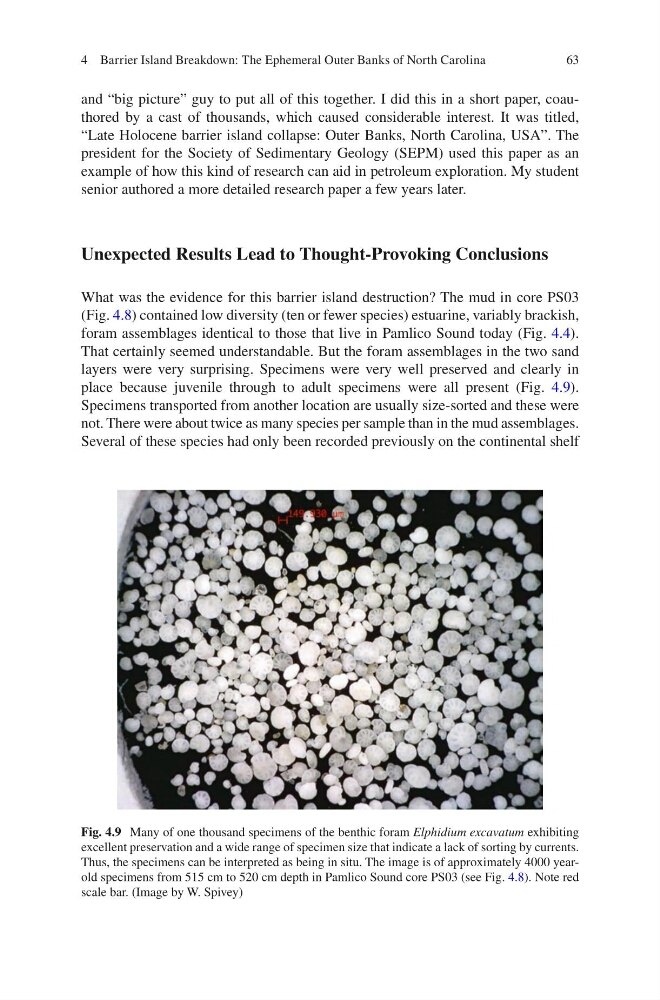
layers were very surprising. Specimens were very well preserved and clearly in
place because juvenile through to adult specimens were all present (Fig. 4.9).
Specimens transported from another location are usually size-sorted and these were
not. There were about twice as many species per sample than in the mud assemblages.
Several of these species had only been recorded previously on the continental shelf
Fig. 4.9 Many of one thousand specimens of the benthic foram Elphidium excavatum exhibiting
excellent preservation and a wide range of specimen size that indicate a lack of sorting by currents.
Thus, the specimens can be interpreted as being in situ. The image is of approximately 4000 yearold specimens from 515 cm to 520 cm depth in Pamlico Sound core PS03 (see Fig. 4.8). Note red
scale bar. (Image by W. Spivey)
4 Barrier Island Breakdown: The Ephemeral Outer Banks of North Carolina
and “big picture” guy to put all of this together. I did this in a short paper, coauthored by a cast of thousands, which caused considerable interest. It was titled,
“Late Holocene barrier island collapse: Outer Banks, North Carolina, USA”. The
president for the Society of Sedimentary Geology (SEPM) used this paper as an
example of how this kind of research can aid in petroleum exploration. My student
senior authored a more detailed research paper a few years later.
Unexpected Results Lead to Thought-Provoking Conclusions
What was the evidence for this barrier island destruction? The mud in core PS03
(Fig. 4.8) contained low diversity (ten or fewer species) estuarine, variably brackish,
foram assemblages identical to those that live in Pamlico Sound today (Fig. 4.4).
That certainly seemed understandable. But the foram assemblages in the two sand
layers were very surprising. Specimens were very well preserved and clearly in
place because juvenile through to adult specimens were all present (Fig. 4.9).
Specimens transported from another location are usually size-sorted and these were
not. There were about twice as many species per sample than in the mud assemblages.
Several of these species had only been recorded previously on the continental shelf
Fig. 4.9 Many of one thousand specimens of the benthic foram Elphidium excavatum exhibiting
excellent preservation and a wide range of specimen size that indicate a lack of sorting by currents.
Thus, the specimens can be interpreted as being in situ. The image is of approximately 4000 yearold specimens from 515 cm to 520 cm depth in Pamlico Sound core PS03 (see Fig. 4.8). Note red
scale bar. (Image by W. Spivey)
4 Barrier Island Breakdown: The Ephemeral Outer Banks of North Carolina