

61
thousand years of paleoenvironmental change in Pamlico Sound by studying the
forams in several of these cores. But which core should I choose to commence the
project? I pored over the logs and one core jumped out at me. Most of the longer
cores were composed of mud (mud is easier to penetrate than sand and so the longer
cores were muddy) but this particular core (PS03) had two distinctive sandy layers
interbedded in the mud (Fig. 4.8). I knew from first geological principles that coarser
sediments indicate a higher energy environment than finer sediments. Thus, the
transition from mud to sand and back to mud again represents a change from a low
energy environment to a higher energy environment back to a low energy environment. Ok, so this core exhibited environmental change and that was what I was
looking for. I then spent several days carefully cutting this 8 m core into 2 cm slices.
My job was to look at the forams in each of these 400 samples.
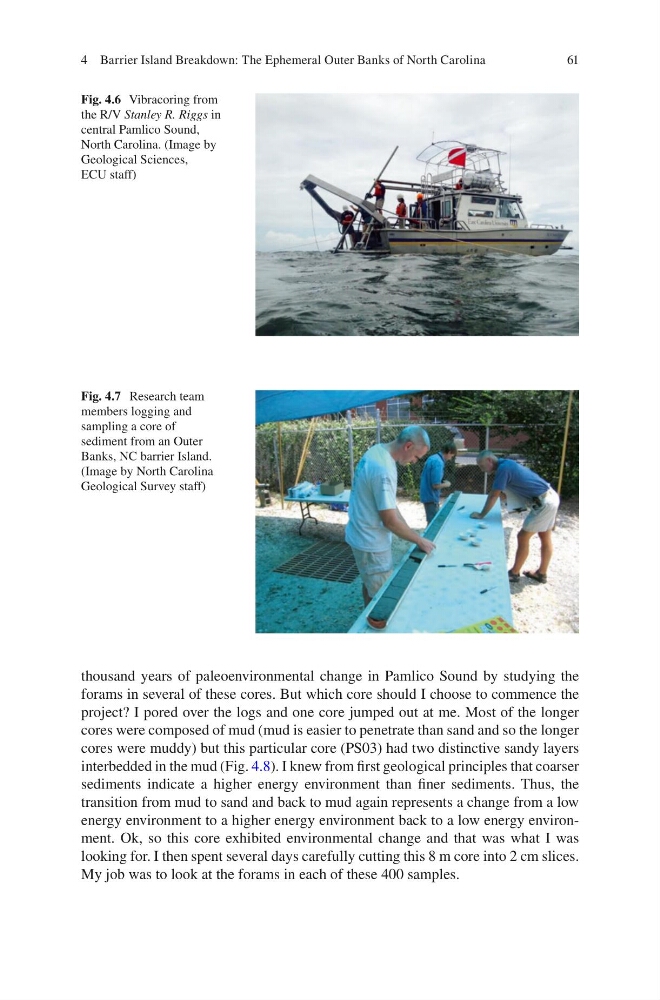
Fig. 4.6 Vibracoring from
the R/V Stanley R. Riggs in
central Pamlico Sound,
North Carolina. (Image by
Geological Sciences,
ECU staff)
Fig. 4.7 Research team
members logging and
sampling a core of
sediment from an Outer
Banks, NC barrier Island.
(Image by North Carolina
Geological Survey staff)
4 Barrier Island Breakdown: The Ephemeral Outer Banks of North Carolina
thousand years of paleoenvironmental change in Pamlico Sound by studying the
forams in several of these cores. But which core should I choose to commence the
project? I pored over the logs and one core jumped out at me. Most of the longer
cores were composed of mud (mud is easier to penetrate than sand and so the longer
cores were muddy) but this particular core (PS03) had two distinctive sandy layers
interbedded in the mud (Fig. 4.8). I knew from first geological principles that coarser
sediments indicate a higher energy environment than finer sediments. Thus, the
transition from mud to sand and back to mud again represents a change from a low
energy environment to a higher energy environment back to a low energy environment. Ok, so this core exhibited environmental change and that was what I was
looking for. I then spent several days carefully cutting this 8 m core into 2 cm slices.
My job was to look at the forams in each of these 400 samples.
Fig. 4.6 Vibracoring from
the R/V Stanley R. Riggs in
central Pamlico Sound,
North Carolina. (Image by
Geological Sciences,
ECU staff)
Fig. 4.7 Research team
members logging and
sampling a core of
sediment from an Outer
Banks, NC barrier Island.
(Image by North Carolina
Geological Survey staff)
4 Barrier Island Breakdown: The Ephemeral Outer Banks of North Carolina