

60
forams, like all groups of organisms, evolve through time while some species
become extinct (and both of these processes are irreversible), the micropaleontologist can also tell the relative age of foram-containing strata. With these two lines of
information (paleoenvironment and age), combined with others such as sedimentological, geochemical and geophysical data, the three-dimensional structure of sedimentary rock basins can be reconstructed and the locations where a petroleum
company might drill for oil and/or gas can be narrowed down to much smaller
target areas.
My specialty in micropaleontology is the reconstruction of past environments
using benthic foraminifera. Back in 2001 when I was redirecting my research
activities, I discussed the geology of coastal North Carolina with my colleagues
Stan Riggs, Dave Mallinson and Reide Corbett and we came up with several
research topics that would contribute to a much larger research program, involving the North Carolina Geological Survey and the U. S. Geological Survey, who
funded the program. The aims of the program were to understand the origin and
evolution of North Carolina’s coastal system, to understand the modern geological and oceanographic processes that occur today, and to determine what these
two threads of information might mean for the future of this large and very complex system. This research would build on the geologic information preserved in
a suite of 30 or more vibracores collected several years earlier in Pamlico Sound
by Riggs.
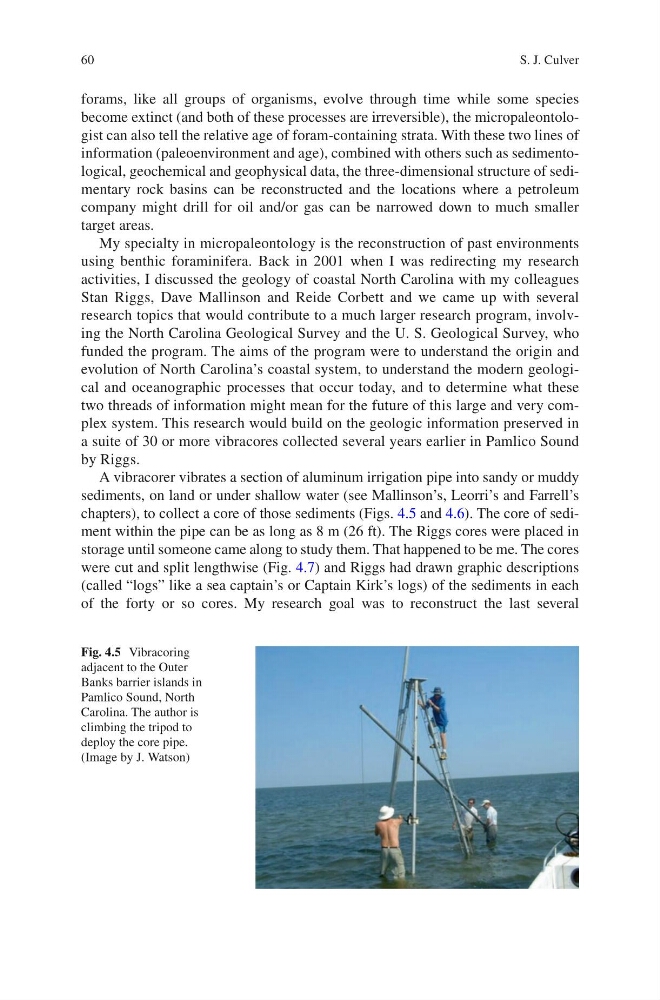
A vibracorer vibrates a section of aluminum irrigation pipe into sandy or muddy
sediments, on land or under shallow water (see Mallinson’s, Leorri’s and Farrell’s
chapters), to collect a core of those sediments (Figs. 4.5 and 4.6). The core of sediment within the pipe can be as long as 8 m (26 ft). The Riggs cores were placed in
storage until someone came along to study them. That happened to be me. The cores
were cut and split lengthwise (Fig. 4.7) and Riggs had drawn graphic descriptions
(called “logs” like a sea captain’s or Captain Kirk’s logs) of the sediments in each
of the forty or so cores. My research goal was to reconstruct the last several
Fig. 4.5 Vibracoring
adjacent to the Outer
Banks barrier islands in
Pamlico Sound, North
Carolina. The author is
climbing the tripod to
deploy the core pipe.
(Image by J. Watson)
S. J. Culver
forams, like all groups of organisms, evolve through time while some species
become extinct (and both of these processes are irreversible), the micropaleontologist can also tell the relative age of foram-containing strata. With these two lines of
information (paleoenvironment and age), combined with others such as sedimentological, geochemical and geophysical data, the three-dimensional structure of sedimentary rock basins can be reconstructed and the locations where a petroleum
company might drill for oil and/or gas can be narrowed down to much smaller
target areas.
My specialty in micropaleontology is the reconstruction of past environments
using benthic foraminifera. Back in 2001 when I was redirecting my research
activities, I discussed the geology of coastal North Carolina with my colleagues
Stan Riggs, Dave Mallinson and Reide Corbett and we came up with several
research topics that would contribute to a much larger research program, involving the North Carolina Geological Survey and the U. S. Geological Survey, who
funded the program. The aims of the program were to understand the origin and
evolution of North Carolina’s coastal system, to understand the modern geological and oceanographic processes that occur today, and to determine what these
two threads of information might mean for the future of this large and very complex system. This research would build on the geologic information preserved in
a suite of 30 or more vibracores collected several years earlier in Pamlico Sound
by Riggs.
A vibracorer vibrates a section of aluminum irrigation pipe into sandy or muddy
sediments, on land or under shallow water (see Mallinson’s, Leorri’s and Farrell’s
chapters), to collect a core of those sediments (Figs. 4.5 and 4.6). The core of sediment within the pipe can be as long as 8 m (26 ft). The Riggs cores were placed in
storage until someone came along to study them. That happened to be me. The cores
were cut and split lengthwise (Fig. 4.7) and Riggs had drawn graphic descriptions
(called “logs” like a sea captain’s or Captain Kirk’s logs) of the sediments in each
of the forty or so cores. My research goal was to reconstruct the last several
Fig. 4.5 Vibracoring
adjacent to the Outer
Banks barrier islands in
Pamlico Sound, North
Carolina. The author is
climbing the tripod to
deploy the core pipe.
(Image by J. Watson)
S. J. Culver