

29
occurring to the Outer Banks, until recently. Even these geologically and historically minor changes – shoreline erosion, inlet formation, etc. – currently cost millions of dollars each year in loss of property, maintenance, and business losses.
What happens as climate changes, and sea-level rise accelerates, as is occurring
now? Our data show that the islands tend to become more fragmented, eroding rapidly, and allowing much more ocean water to enter the estuaries. This has multiple
effects, which will greatly impact the various ecosystems and residents throughout
the region. As barrier islands become more fragmented, an increase in the tidal
range and tidal currents will occur, which will inundate low-lying areas and further
exacerbate the effects of sea-level rise. As the estuary expands and deepens, wave
energy will increase, which will increase rates of estuarine shoreline erosion and
threaten the existence of coastal properties. An increase in the number of inlets, in
addition to destroying the roads and properties, will alter sediment transport and
trap sand which will increase rates of ocean shoreline erosion. Changes to the salinity and the suspended sediment in the water will affect the living organisms in the
region, impacting the various fisheries (fin-fish as well as shell-fish). Rising waters
and increasing salinities will result in saltwater intrusion into farmlands, rendering
them unproductive for crops, and will contaminate water wells used for drinking
water and irrigation. All of these issues directly impact the livelihoods of well over
a million people in North Carolina and Virginia. Our modern coastal societies and
community structures are intertwined with the coastal environment. We are intimately connected to both the land and the water.
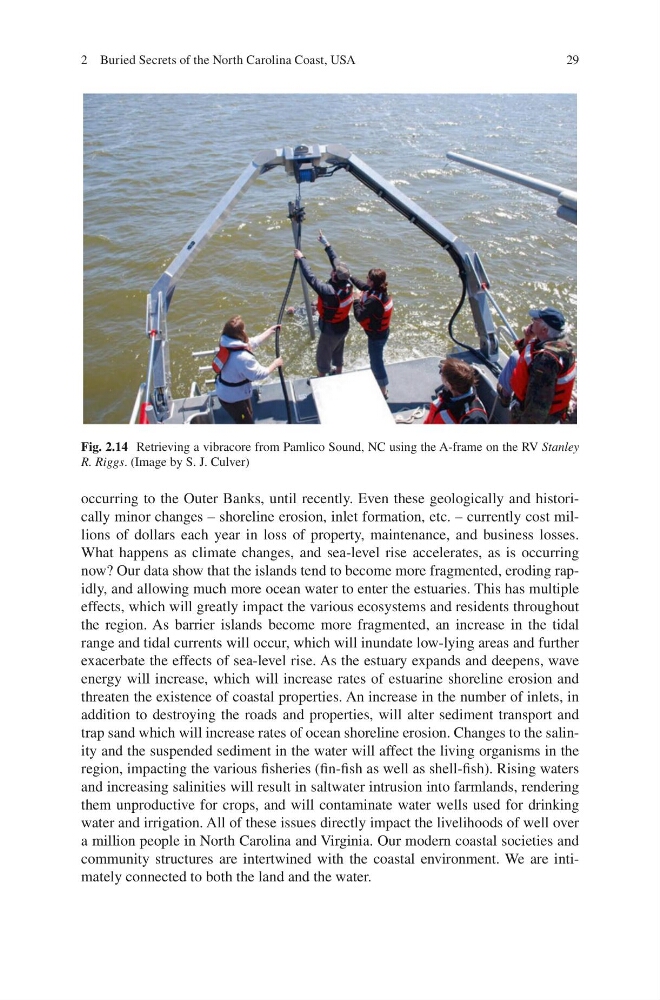
Fig. 2.14 Retrieving a vibracore from Pamlico Sound, NC using the A-frame on the RV Stanley
R. Riggs. (Image by S. J. Culver)
2 Buried Secrets of the North Carolina Coast, USA
occurring to the Outer Banks, until recently. Even these geologically and historically minor changes – shoreline erosion, inlet formation, etc. – currently cost millions of dollars each year in loss of property, maintenance, and business losses.
What happens as climate changes, and sea-level rise accelerates, as is occurring
now? Our data show that the islands tend to become more fragmented, eroding rapidly, and allowing much more ocean water to enter the estuaries. This has multiple
effects, which will greatly impact the various ecosystems and residents throughout
the region. As barrier islands become more fragmented, an increase in the tidal
range and tidal currents will occur, which will inundate low-lying areas and further
exacerbate the effects of sea-level rise. As the estuary expands and deepens, wave
energy will increase, which will increase rates of estuarine shoreline erosion and
threaten the existence of coastal properties. An increase in the number of inlets, in
addition to destroying the roads and properties, will alter sediment transport and
trap sand which will increase rates of ocean shoreline erosion. Changes to the salinity and the suspended sediment in the water will affect the living organisms in the
region, impacting the various fisheries (fin-fish as well as shell-fish). Rising waters
and increasing salinities will result in saltwater intrusion into farmlands, rendering
them unproductive for crops, and will contaminate water wells used for drinking
water and irrigation. All of these issues directly impact the livelihoods of well over
a million people in North Carolina and Virginia. Our modern coastal societies and
community structures are intertwined with the coastal environment. We are intimately connected to both the land and the water.
Fig. 2.14 Retrieving a vibracore from Pamlico Sound, NC using the A-frame on the RV Stanley
R. Riggs. (Image by S. J. Culver)
2 Buried Secrets of the North Carolina Coast, USA