

23
More Core!
We pull the core from the ground using a winch and load it up on the truck after
taking careful measurements and cutting it into shorter sections. The cores, and
there are many dozens of them, are transported back to the core cutting lab at East
Carolina University (ECU). Here we split them lengthwise, using a circular saw and
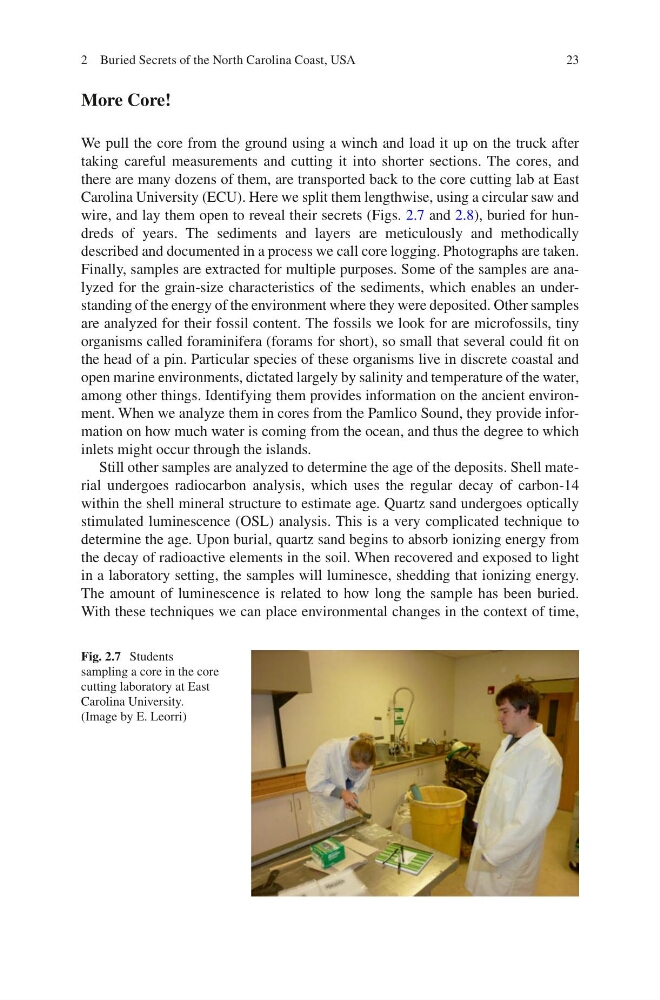
wire, and lay them open to reveal their secrets (Figs. 2.7 and 2.8), buried for hundreds of years. The sediments and layers are meticulously and methodically
described and documented in a process we call core logging. Photographs are taken.
Finally, samples are extracted for multiple purposes. Some of the samples are analyzed for the grain-size characteristics of the sediments, which enables an understanding of the energy of the environment where they were deposited. Other samples
are analyzed for their fossil content. The fossils we look for are microfossils, tiny
organisms called foraminifera (forams for short), so small that several could fit on
the head of a pin. Particular species of these organisms live in discrete coastal and
open marine environments, dictated largely by salinity and temperature of the water,
among other things. Identifying them provides information on the ancient environment. When we analyze them in cores from the Pamlico Sound, they provide information on how much water is coming from the ocean, and thus the degree to which
inlets might occur through the islands.
Still other samples are analyzed to determine the age of the deposits. Shell material undergoes radiocarbon analysis, which uses the regular decay of carbon-14
within the shell mineral structure to estimate age. Quartz sand undergoes optically
stimulated luminescence (OSL) analysis. This is a very complicated technique to
determine the age. Upon burial, quartz sand begins to absorb ionizing energy from
the decay of radioactive elements in the soil. When recovered and exposed to light
in a laboratory setting, the samples will luminesce, shedding that ionizing energy.
The amount of luminescence is related to how long the sample has been buried.
With these techniques we can place environmental changes in the context of time,
Fig. 2.7 Students
sampling a core in the core
cutting laboratory at East
Carolina University.
(Image by E. Leorri)
2 Buried Secrets of the North Carolina Coast, USA
More Core!
We pull the core from the ground using a winch and load it up on the truck after
taking careful measurements and cutting it into shorter sections. The cores, and
there are many dozens of them, are transported back to the core cutting lab at East
Carolina University (ECU). Here we split them lengthwise, using a circular saw and
wire, and lay them open to reveal their secrets (Figs. 2.7 and 2.8), buried for hundreds of years. The sediments and layers are meticulously and methodically
described and documented in a process we call core logging. Photographs are taken.
Finally, samples are extracted for multiple purposes. Some of the samples are analyzed for the grain-size characteristics of the sediments, which enables an understanding of the energy of the environment where they were deposited. Other samples
are analyzed for their fossil content. The fossils we look for are microfossils, tiny
organisms called foraminifera (forams for short), so small that several could fit on
the head of a pin. Particular species of these organisms live in discrete coastal and
open marine environments, dictated largely by salinity and temperature of the water,
among other things. Identifying them provides information on the ancient environment. When we analyze them in cores from the Pamlico Sound, they provide information on how much water is coming from the ocean, and thus the degree to which
inlets might occur through the islands.
Still other samples are analyzed to determine the age of the deposits. Shell material undergoes radiocarbon analysis, which uses the regular decay of carbon-14
within the shell mineral structure to estimate age. Quartz sand undergoes optically
stimulated luminescence (OSL) analysis. This is a very complicated technique to
determine the age. Upon burial, quartz sand begins to absorb ionizing energy from
the decay of radioactive elements in the soil. When recovered and exposed to light
in a laboratory setting, the samples will luminesce, shedding that ionizing energy.
The amount of luminescence is related to how long the sample has been buried.
With these techniques we can place environmental changes in the context of time,
Fig. 2.7 Students
sampling a core in the core
cutting laboratory at East
Carolina University.
(Image by E. Leorri)
2 Buried Secrets of the North Carolina Coast, USA