

262
the tiny fossils, foraminifera, that I could use to help reconstruct past environments
and, therefore, coastal change. Where the drill-string (several rotating steel pipes
screwed together and tipped with a drill bit and core retrieval tube) entered the substrate I could see bubbles in the water between the drill-string and the borehole
casing. I didn’t think too much about it until we pulled the drill-string out of the hole
(Fig. 16.5) and water shot some 3 ft. (1 m) beyond the end of the drill-string in
pulses that continued until we took the drill-string out of the core hole. At that point
bubbles came rapidly and continuously to the surface of the water within the casing.
Dave, Frank and I realized that we had struck gas! But what sort of gas was it and
what was the source? We were a little worried that we might have drilled into the
main sewer pipe that ran underground parallel to the main road between the
Mumbles and Swansea.
I reported our strike to Fred, and he organized a chemist to take a sample
(Fig. 16.6) and analyze the composition. The gas was methane. We surmised that
the source was 300 million year-old Carboniferous coal-bearing strata that underly
the boulder clay in this region. The local press took an interest and Dave, Frank and
I enjoyed our 15 minutes of fame. I left Swansea two years later, PhD in hand, and
taught for a couple of years at the University of Sierra Leone in West Africa. I then
got a post-doctoral position at the Smithsonian Institution in Washington, D.C. So,
four years after we struck gas, on my way from Sierra Leone to the USA, I stopped
off at Swansea to visit old friends. My curiosity was too strong to resist. I crossed
the Mumbles Road and found the several inch diameter hole in the peat. We had
filled in the hole with sand when we had finished drilling but, to my surprise, bubbles were still coming to the surface of the 6 inches or so of water that filled the top
of the core hole. I haven’t been back since, but maybe the bubbles still continue.
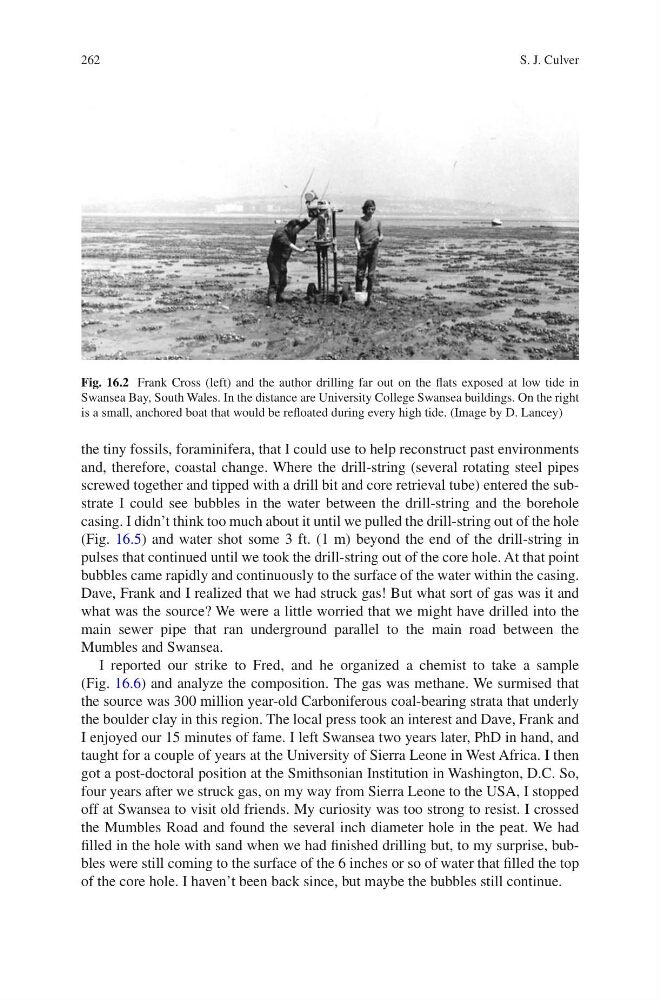
Fig. 16.2 Frank Cross (left) and the author drilling far out on the flats exposed at low tide in
Swansea Bay, South Wales. In the distance are University College Swansea buildings. On the right
is a small, anchored boat that would be refloated during every high tide. (Image by D. Lancey)
S. J. Culver
the tiny fossils, foraminifera, that I could use to help reconstruct past environments
and, therefore, coastal change. Where the drill-string (several rotating steel pipes
screwed together and tipped with a drill bit and core retrieval tube) entered the substrate I could see bubbles in the water between the drill-string and the borehole
casing. I didn’t think too much about it until we pulled the drill-string out of the hole
(Fig. 16.5) and water shot some 3 ft. (1 m) beyond the end of the drill-string in
pulses that continued until we took the drill-string out of the core hole. At that point
bubbles came rapidly and continuously to the surface of the water within the casing.
Dave, Frank and I realized that we had struck gas! But what sort of gas was it and
what was the source? We were a little worried that we might have drilled into the
main sewer pipe that ran underground parallel to the main road between the
Mumbles and Swansea.
I reported our strike to Fred, and he organized a chemist to take a sample
(Fig. 16.6) and analyze the composition. The gas was methane. We surmised that
the source was 300 million year-old Carboniferous coal-bearing strata that underly
the boulder clay in this region. The local press took an interest and Dave, Frank and
I enjoyed our 15 minutes of fame. I left Swansea two years later, PhD in hand, and
taught for a couple of years at the University of Sierra Leone in West Africa. I then
got a post-doctoral position at the Smithsonian Institution in Washington, D.C. So,
four years after we struck gas, on my way from Sierra Leone to the USA, I stopped
off at Swansea to visit old friends. My curiosity was too strong to resist. I crossed
the Mumbles Road and found the several inch diameter hole in the peat. We had
filled in the hole with sand when we had finished drilling but, to my surprise, bubbles were still coming to the surface of the 6 inches or so of water that filled the top
of the core hole. I haven’t been back since, but maybe the bubbles still continue.
Fig. 16.2 Frank Cross (left) and the author drilling far out on the flats exposed at low tide in
Swansea Bay, South Wales. In the distance are University College Swansea buildings. On the right
is a small, anchored boat that would be refloated during every high tide. (Image by D. Lancey)
S. J. Culver