

261
tide, dragging our gear with us, until we got to a place where we could safely site
the portable drill rig (Fig. 16.2). When the tide turned, we retreated quickly before
it. Thus, a little planning was necessary. We decided not to drive the Land Rover
below the high tide mark because the intertidal zone was a complex network of
varying substrates (Fig. 16.3). In some places there were modern sand bars and
between them were soft, wet, muddy troughs where your rubber boots (“wellies” in
English) could easily be sucked off your feet (Fig. 16.4). In other places there were
pebbles and cobbles of all sizes where the underlying “boulder clay”, a glacial
deposit with an uneven surface laid down by the last ice sheet to cover this area
approximately 18,000 to 20,000 years ago, came to the surface (Fig. 16.3). And then
there were the deposits that I was targeting, pale blue, over-consolidated clay, almost
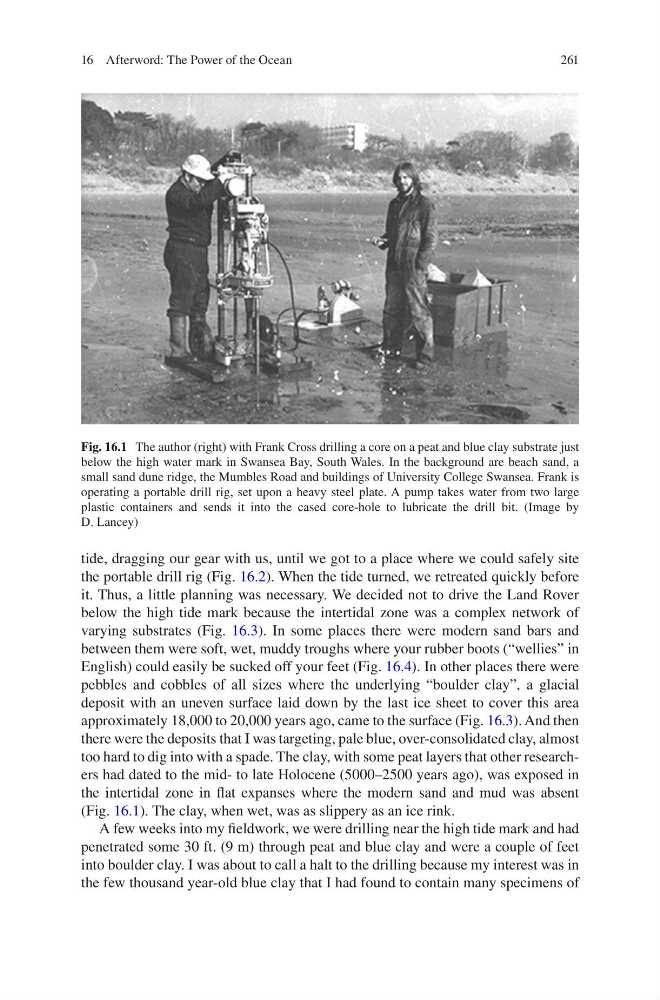
too hard to dig into with a spade. The clay, with some peat layers that other researchers had dated to the mid- to late Holocene (5000–2500 years ago), was exposed in
the intertidal zone in flat expanses where the modern sand and mud was absent
(Fig. 16.1). The clay, when wet, was as slippery as an ice rink.
A few weeks into my fieldwork, we were drilling near the high tide mark and had
penetrated some 30 ft. (9 m) through peat and blue clay and were a couple of feet
into boulder clay. I was about to call a halt to the drilling because my interest was in
the few thousand year-old blue clay that I had found to contain many specimens of
Fig. 16.1 The author (right) with Frank Cross drilling a core on a peat and blue clay substrate just
below the high water mark in Swansea Bay, South Wales. In the background are beach sand, a
small sand dune ridge, the Mumbles Road and buildings of University College Swansea. Frank is
operating a portable drill rig, set upon a heavy steel plate. A pump takes water from two large
plastic containers and sends it into the cased core-hole to lubricate the drill bit. (Image by
D. Lancey)
16 Afterword: The Power of the Ocean
tide, dragging our gear with us, until we got to a place where we could safely site
the portable drill rig (Fig. 16.2). When the tide turned, we retreated quickly before
it. Thus, a little planning was necessary. We decided not to drive the Land Rover
below the high tide mark because the intertidal zone was a complex network of
varying substrates (Fig. 16.3). In some places there were modern sand bars and
between them were soft, wet, muddy troughs where your rubber boots (“wellies” in
English) could easily be sucked off your feet (Fig. 16.4). In other places there were
pebbles and cobbles of all sizes where the underlying “boulder clay”, a glacial
deposit with an uneven surface laid down by the last ice sheet to cover this area
approximately 18,000 to 20,000 years ago, came to the surface (Fig. 16.3). And then
there were the deposits that I was targeting, pale blue, over-consolidated clay, almost
too hard to dig into with a spade. The clay, with some peat layers that other researchers had dated to the mid- to late Holocene (5000–2500 years ago), was exposed in
the intertidal zone in flat expanses where the modern sand and mud was absent
(Fig. 16.1). The clay, when wet, was as slippery as an ice rink.
A few weeks into my fieldwork, we were drilling near the high tide mark and had
penetrated some 30 ft. (9 m) through peat and blue clay and were a couple of feet
into boulder clay. I was about to call a halt to the drilling because my interest was in
the few thousand year-old blue clay that I had found to contain many specimens of
Fig. 16.1 The author (right) with Frank Cross drilling a core on a peat and blue clay substrate just
below the high water mark in Swansea Bay, South Wales. In the background are beach sand, a
small sand dune ridge, the Mumbles Road and buildings of University College Swansea. Frank is
operating a portable drill rig, set upon a heavy steel plate. A pump takes water from two large
plastic containers and sends it into the cased core-hole to lubricate the drill bit. (Image by
D. Lancey)
16 Afterword: The Power of the Ocean