

246
in very clear waters, while others can tolerate a substantial amount of turbidity.
Their symbionts also vary, from groups that provide their hosts with most of what is
produced during photosynthesis, to algae that keep more for their own growth and
reproduction, and from groups that thrive under high light to those that are highly
susceptible to photo-oxidative stress.
At the same time, corals provide important lessons in understanding organisms,
their ecological roles, and how the combination of stresses can disrupt an ecosystem. Prior to the 1980s, and even well into the 1990s, sedimentation associated with
coastal development and changes in land use in upland watersheds were widely
considered by scientists and coastal managers to be the primary threat to reefs. By
the 1990s, nutrient pollution began to be taken seriously by many scientists.
However, by then disease outbreaks had become increasingly common, but were
overshadowed by the devastation caused by the mass bleachings in 1997–1998.
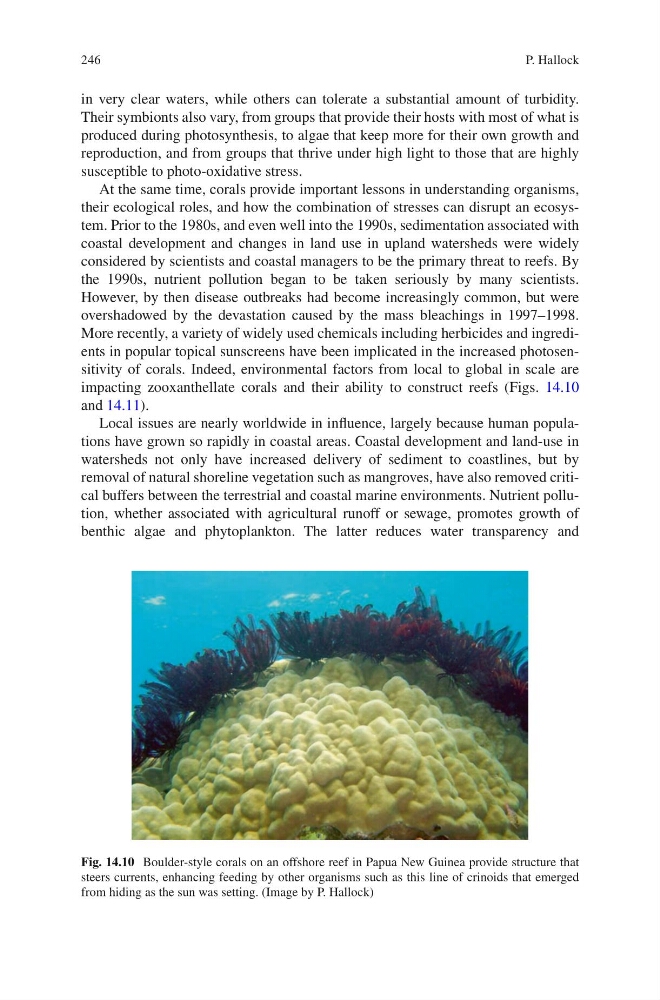
More recently, a variety of widely used chemicals including herbicides and ingredients in popular topical sunscreens have been implicated in the increased photosensitivity of corals. Indeed, environmental factors from local to global in scale are
impacting zooxanthellate corals and their ability to construct reefs (Figs. 14.10
and 14.11).
Local issues are nearly worldwide in influence, largely because human populations have grown so rapidly in coastal areas. Coastal development and land-use in
watersheds not only have increased delivery of sediment to coastlines, but by
removal of natural shoreline vegetation such as mangroves, have also removed critical buffers between the terrestrial and coastal marine environments. Nutrient pollution, whether associated with agricultural runoff or sewage, promotes growth of
benthic algae and phytoplankton. The latter reduces water transparency and
Fig. 14.10 Boulder-style corals on an offshore reef in Papua New Guinea provide structure that
steers currents, enhancing feeding by other organisms such as this line of crinoids that emerged
from hiding as the sun was setting. (Image by P. Hallock)
P. Hallock
in very clear waters, while others can tolerate a substantial amount of turbidity.
Their symbionts also vary, from groups that provide their hosts with most of what is
produced during photosynthesis, to algae that keep more for their own growth and
reproduction, and from groups that thrive under high light to those that are highly
susceptible to photo-oxidative stress.
At the same time, corals provide important lessons in understanding organisms,
their ecological roles, and how the combination of stresses can disrupt an ecosystem. Prior to the 1980s, and even well into the 1990s, sedimentation associated with
coastal development and changes in land use in upland watersheds were widely
considered by scientists and coastal managers to be the primary threat to reefs. By
the 1990s, nutrient pollution began to be taken seriously by many scientists.
However, by then disease outbreaks had become increasingly common, but were
overshadowed by the devastation caused by the mass bleachings in 1997–1998.
More recently, a variety of widely used chemicals including herbicides and ingredients in popular topical sunscreens have been implicated in the increased photosensitivity of corals. Indeed, environmental factors from local to global in scale are
impacting zooxanthellate corals and their ability to construct reefs (Figs. 14.10
and 14.11).
Local issues are nearly worldwide in influence, largely because human populations have grown so rapidly in coastal areas. Coastal development and land-use in
watersheds not only have increased delivery of sediment to coastlines, but by
removal of natural shoreline vegetation such as mangroves, have also removed critical buffers between the terrestrial and coastal marine environments. Nutrient pollution, whether associated with agricultural runoff or sewage, promotes growth of
benthic algae and phytoplankton. The latter reduces water transparency and
Fig. 14.10 Boulder-style corals on an offshore reef in Papua New Guinea provide structure that
steers currents, enhancing feeding by other organisms such as this line of crinoids that emerged
from hiding as the sun was setting. (Image by P. Hallock)
P. Hallock