

238
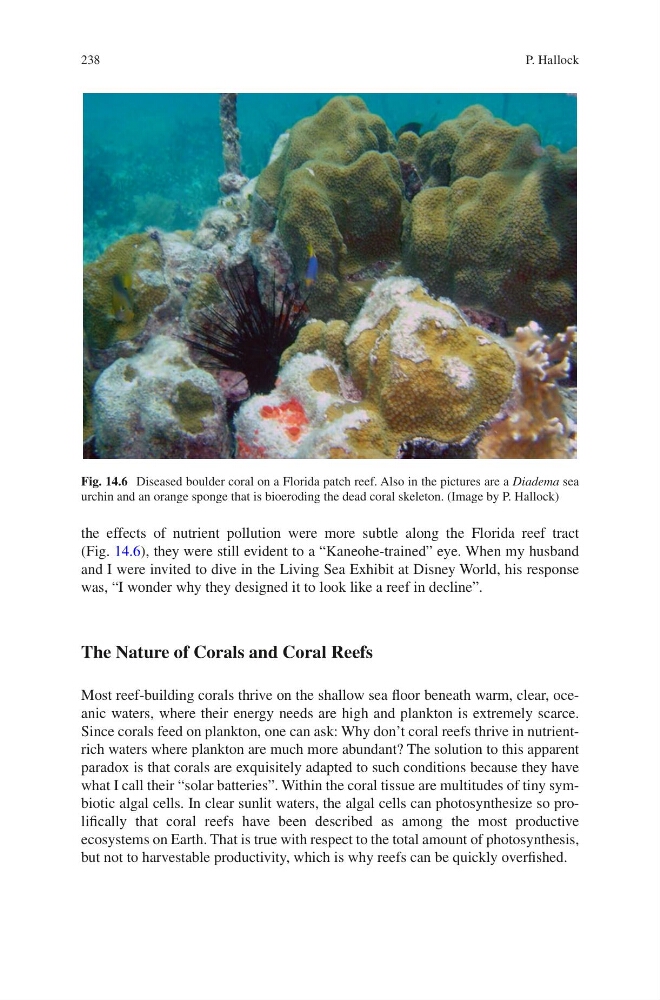
the effects of nutrient pollution were more subtle along the Florida reef tract
(Fig. 14.6), they were still evident to a “Kaneohe-trained” eye. When my husband
and I were invited to dive in the Living Sea Exhibit at Disney World, his response
was, “I wonder why they designed it to look like a reef in decline”.
The Nature of Corals and Coral Reefs
Most reef-building corals thrive on the shallow sea floor beneath warm, clear, oceanic waters, where their energy needs are high and plankton is extremely scarce.
Since corals feed on plankton, one can ask: Why don’t coral reefs thrive in nutrientrich waters where plankton are much more abundant? The solution to this apparent
paradox is that corals are exquisitely adapted to such conditions because they have
what I call their “solar batteries”. Within the coral tissue are multitudes of tiny symbiotic algal cells. In clear sunlit waters, the algal cells can photosynthesize so prolifically that coral reefs have been described as among the most productive
ecosystems on Earth. That is true with respect to the total amount of photosynthesis,
but not to harvestable productivity, which is why reefs can be quickly overfished.
Fig. 14.6 Diseased boulder coral on a Florida patch reef. Also in the pictures are a Diadema sea
urchin and an orange sponge that is bioeroding the dead coral skeleton. (Image by P. Hallock)
P. Hallock
the effects of nutrient pollution were more subtle along the Florida reef tract
(Fig. 14.6), they were still evident to a “Kaneohe-trained” eye. When my husband
and I were invited to dive in the Living Sea Exhibit at Disney World, his response
was, “I wonder why they designed it to look like a reef in decline”.
The Nature of Corals and Coral Reefs
Most reef-building corals thrive on the shallow sea floor beneath warm, clear, oceanic waters, where their energy needs are high and plankton is extremely scarce.
Since corals feed on plankton, one can ask: Why don’t coral reefs thrive in nutrientrich waters where plankton are much more abundant? The solution to this apparent
paradox is that corals are exquisitely adapted to such conditions because they have
what I call their “solar batteries”. Within the coral tissue are multitudes of tiny symbiotic algal cells. In clear sunlit waters, the algal cells can photosynthesize so prolifically that coral reefs have been described as among the most productive
ecosystems on Earth. That is true with respect to the total amount of photosynthesis,
but not to harvestable productivity, which is why reefs can be quickly overfished.
Fig. 14.6 Diseased boulder coral on a Florida patch reef. Also in the pictures are a Diadema sea
urchin and an orange sponge that is bioeroding the dead coral skeleton. (Image by P. Hallock)
P. Hallock