

218
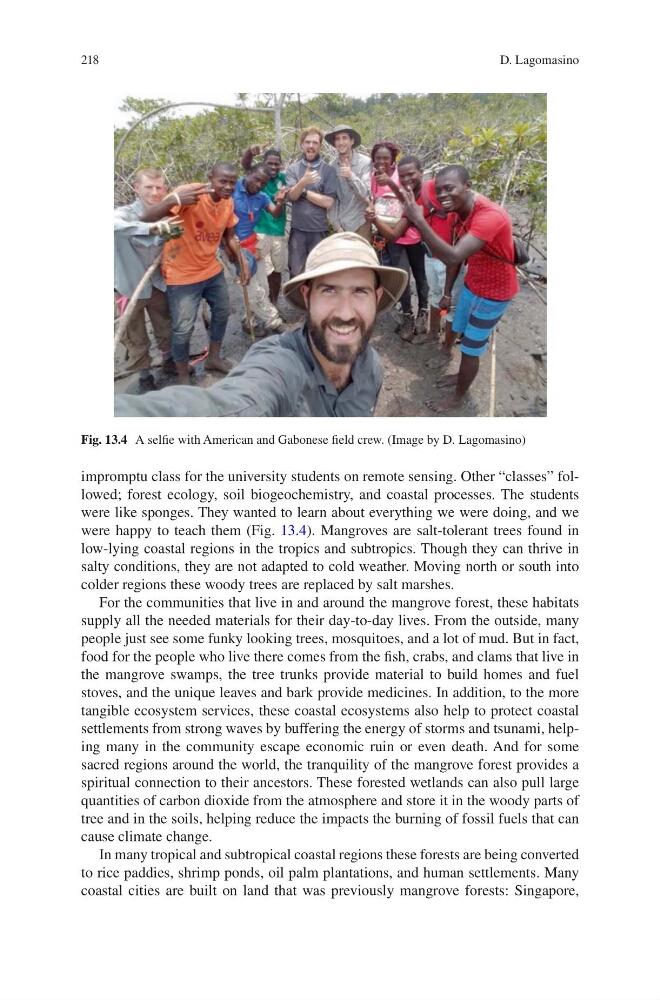
impromptu class for the university students on remote sensing. Other “classes” followed; forest ecology, soil biogeochemistry, and coastal processes. The students
were like sponges. They wanted to learn about everything we were doing, and we
were happy to teach them (Fig. 13.4). Mangroves are salt-tolerant trees found in
low-lying coastal regions in the tropics and subtropics. Though they can thrive in
salty conditions, they are not adapted to cold weather. Moving north or south into
colder regions these woody trees are replaced by salt marshes.
For the communities that live in and around the mangrove forest, these habitats
supply all the needed materials for their day-to-day lives. From the outside, many
people just see some funky looking trees, mosquitoes, and a lot of mud. But in fact,
food for the people who live there comes from the fish, crabs, and clams that live in
the mangrove swamps, the tree trunks provide material to build homes and fuel
stoves, and the unique leaves and bark provide medicines. In addition, to the more
tangible ecosystem services, these coastal ecosystems also help to protect coastal
settlements from strong waves by buffering the energy of storms and tsunami, helping many in the community escape economic ruin or even death. And for some
sacred regions around the world, the tranquility of the mangrove forest provides a
spiritual connection to their ancestors. These forested wetlands can also pull large
quantities of carbon dioxide from the atmosphere and store it in the woody parts of
tree and in the soils, helping reduce the impacts the burning of fossil fuels that can
cause climate change.
In many tropical and subtropical coastal regions these forests are being converted
to rice paddies, shrimp ponds, oil palm plantations, and human settlements. Many
coastal cities are built on land that was previously mangrove forests: Singapore,
Fig. 13.4 A selfie with American and Gabonese field crew. (Image by D. Lagomasino)
D. Lagomasino
impromptu class for the university students on remote sensing. Other “classes” followed; forest ecology, soil biogeochemistry, and coastal processes. The students
were like sponges. They wanted to learn about everything we were doing, and we
were happy to teach them (Fig. 13.4). Mangroves are salt-tolerant trees found in
low-lying coastal regions in the tropics and subtropics. Though they can thrive in
salty conditions, they are not adapted to cold weather. Moving north or south into
colder regions these woody trees are replaced by salt marshes.
For the communities that live in and around the mangrove forest, these habitats
supply all the needed materials for their day-to-day lives. From the outside, many
people just see some funky looking trees, mosquitoes, and a lot of mud. But in fact,
food for the people who live there comes from the fish, crabs, and clams that live in
the mangrove swamps, the tree trunks provide material to build homes and fuel
stoves, and the unique leaves and bark provide medicines. In addition, to the more
tangible ecosystem services, these coastal ecosystems also help to protect coastal
settlements from strong waves by buffering the energy of storms and tsunami, helping many in the community escape economic ruin or even death. And for some
sacred regions around the world, the tranquility of the mangrove forest provides a
spiritual connection to their ancestors. These forested wetlands can also pull large
quantities of carbon dioxide from the atmosphere and store it in the woody parts of
tree and in the soils, helping reduce the impacts the burning of fossil fuels that can
cause climate change.
In many tropical and subtropical coastal regions these forests are being converted
to rice paddies, shrimp ponds, oil palm plantations, and human settlements. Many
coastal cities are built on land that was previously mangrove forests: Singapore,
Fig. 13.4 A selfie with American and Gabonese field crew. (Image by D. Lagomasino)
D. Lagomasino