

217
room and would be my accommodations for the next week. Our clothes, soaked
with rainwater, were strung up across the room, nearly impossible to dry in the high
humidity. As the sun set, we prepped our stoves and starting cooking as we gazed
from the front porch at an incredible view of the mangrove forests that we would be
surveying. We discussed the plans for the next day, over canned fish and pasta.
Although we were exhausted, it was difficult to sleep. The humid, still air left us
in a constant sweat. But that I was able to overcome. It was the epic battle between
rival gangs of rats taking place in the rafters of the house that would keep me up.
These battles took place every evening. It became a bit of a running joke by the end
of the trip. I hedged my bets on the gang led by Splinter.
So, you might be thinking, “Why the heck are these folks out there sleeping in
the jungle with rats? For some big trees?”. Well part of that answer is, yes, because
of the big trees. There are a bunch of interesting questions as to why the biggest
mangroves are there. But more importantly, we are there to understand the structure
and function of these coastal ecosystem. We are interested to understand how the
environmental conditions in which these forests grow contribute to how the forests
look. Similarly, we want to know that if the environmental conditions change (rainfall, temperature, or storm frequency), how will the forest respond to those changes.
This is important because as the forest and the surrounding habitats and communities change, the services provided by the ecosystem will also change for the better
or for the worse.
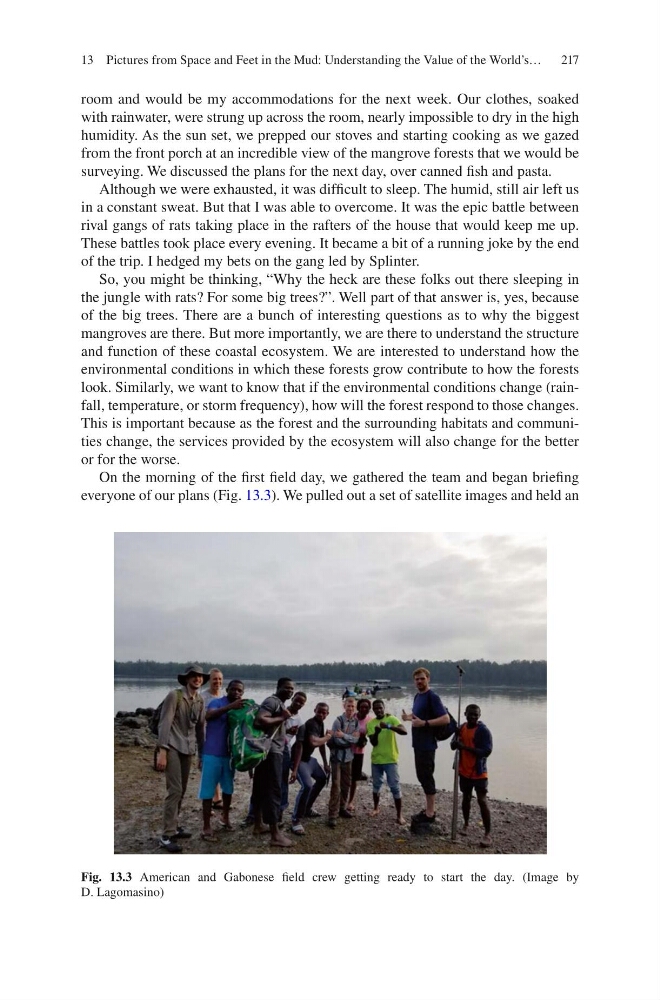
On the morning of the first field day, we gathered the team and began briefing
everyone of our plans (Fig. 13.3). We pulled out a set of satellite images and held an
Fig. 13.3 American and Gabonese field crew getting ready to start the day. (Image by
D. Lagomasino)
13 Pictures from Space and Feet in the Mud: Understanding the Value of the World’s…
room and would be my accommodations for the next week. Our clothes, soaked
with rainwater, were strung up across the room, nearly impossible to dry in the high
humidity. As the sun set, we prepped our stoves and starting cooking as we gazed
from the front porch at an incredible view of the mangrove forests that we would be
surveying. We discussed the plans for the next day, over canned fish and pasta.
Although we were exhausted, it was difficult to sleep. The humid, still air left us
in a constant sweat. But that I was able to overcome. It was the epic battle between
rival gangs of rats taking place in the rafters of the house that would keep me up.
These battles took place every evening. It became a bit of a running joke by the end
of the trip. I hedged my bets on the gang led by Splinter.
So, you might be thinking, “Why the heck are these folks out there sleeping in
the jungle with rats? For some big trees?”. Well part of that answer is, yes, because
of the big trees. There are a bunch of interesting questions as to why the biggest
mangroves are there. But more importantly, we are there to understand the structure
and function of these coastal ecosystem. We are interested to understand how the
environmental conditions in which these forests grow contribute to how the forests
look. Similarly, we want to know that if the environmental conditions change (rainfall, temperature, or storm frequency), how will the forest respond to those changes.
This is important because as the forest and the surrounding habitats and communities change, the services provided by the ecosystem will also change for the better
or for the worse.
On the morning of the first field day, we gathered the team and began briefing
everyone of our plans (Fig. 13.3). We pulled out a set of satellite images and held an
Fig. 13.3 American and Gabonese field crew getting ready to start the day. (Image by
D. Lagomasino)
13 Pictures from Space and Feet in the Mud: Understanding the Value of the World’s…