

198
and mangrove transition zone, then I needed to start systematically collecting data
on the ecological preferences of all these new (to me) species of mollusks.
Up until this point in my career, like most geologists and paleontologists, I spent
time scrambling around outcrops, climbing bluffs, fighting with vegetation that was
obscuring what I wanted to see, working laboriously to extract my precious fossils,
then filling up bags with sediment and fossils and hauling them off the site for further work in the laboratory. Field work in Florida Bay and the mangrove waterways
is completely different. First, the mudbanks, islands, and mangrove shorelines are
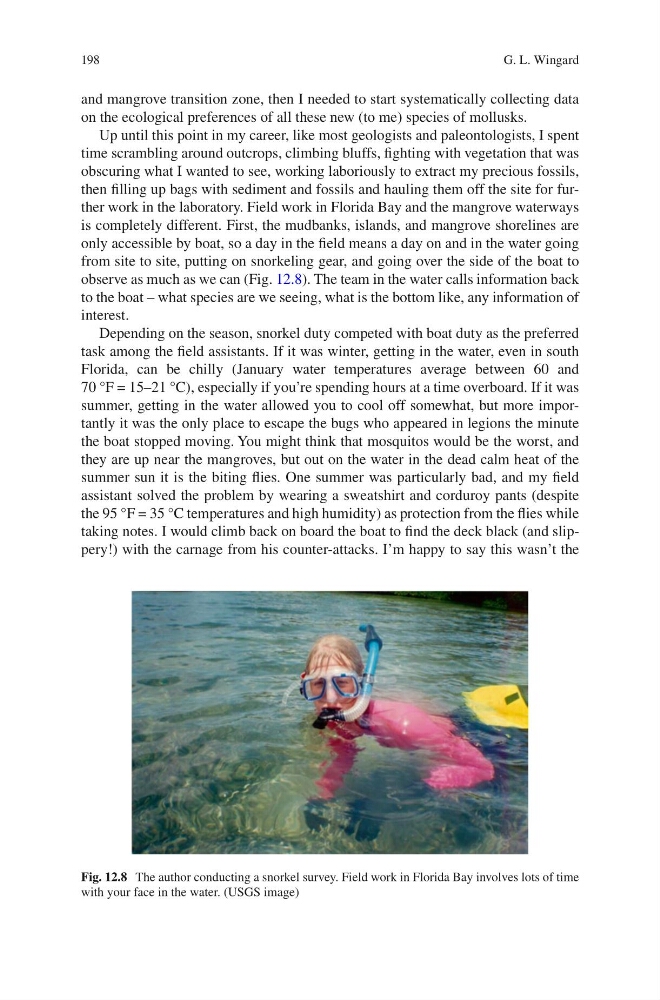
only accessible by boat, so a day in the field means a day on and in the water going
from site to site, putting on snorkeling gear, and going over the side of the boat to
observe as much as we can (Fig. 12.8). The team in the water calls information back
to the boat – what species are we seeing, what is the bottom like, any information of
interest.
Depending on the season, snorkel duty competed with boat duty as the preferred
task among the field assistants. If it was winter, getting in the water, even in south
Florida, can be chilly (January water temperatures average between 60 and
70 °F = 15–21 °C), especially if you’re spending hours at a time overboard. If it was
summer, getting in the water allowed you to cool off somewhat, but more importantly it was the only place to escape the bugs who appeared in legions the minute
the boat stopped moving. You might think that mosquitos would be the worst, and
they are up near the mangroves, but out on the water in the dead calm heat of the
summer sun it is the biting flies. One summer was particularly bad, and my field
assistant solved the problem by wearing a sweatshirt and corduroy pants (despite
the 95 °F = 35 °C temperatures and high humidity) as protection from the flies while
taking notes. I would climb back on board the boat to find the deck black (and slippery!) with the carnage from his counter-attacks. I’m happy to say this wasn’t the
Fig. 12.8 The author conducting a snorkel survey. Field work in Florida Bay involves lots of time
with your face in the water. (USGS image)
G. L. Wingard
and mangrove transition zone, then I needed to start systematically collecting data
on the ecological preferences of all these new (to me) species of mollusks.
Up until this point in my career, like most geologists and paleontologists, I spent
time scrambling around outcrops, climbing bluffs, fighting with vegetation that was
obscuring what I wanted to see, working laboriously to extract my precious fossils,
then filling up bags with sediment and fossils and hauling them off the site for further work in the laboratory. Field work in Florida Bay and the mangrove waterways
is completely different. First, the mudbanks, islands, and mangrove shorelines are
only accessible by boat, so a day in the field means a day on and in the water going
from site to site, putting on snorkeling gear, and going over the side of the boat to
observe as much as we can (Fig. 12.8). The team in the water calls information back
to the boat – what species are we seeing, what is the bottom like, any information of
interest.
Depending on the season, snorkel duty competed with boat duty as the preferred
task among the field assistants. If it was winter, getting in the water, even in south
Florida, can be chilly (January water temperatures average between 60 and
70 °F = 15–21 °C), especially if you’re spending hours at a time overboard. If it was
summer, getting in the water allowed you to cool off somewhat, but more importantly it was the only place to escape the bugs who appeared in legions the minute
the boat stopped moving. You might think that mosquitos would be the worst, and
they are up near the mangroves, but out on the water in the dead calm heat of the
summer sun it is the biting flies. One summer was particularly bad, and my field
assistant solved the problem by wearing a sweatshirt and corduroy pants (despite
the 95 °F = 35 °C temperatures and high humidity) as protection from the flies while
taking notes. I would climb back on board the boat to find the deck black (and slippery!) with the carnage from his counter-attacks. I’m happy to say this wasn’t the
Fig. 12.8 The author conducting a snorkel survey. Field work in Florida Bay involves lots of time
with your face in the water. (USGS image)
G. L. Wingard