

197
To manage salt, black mangroves excrete it through pores in their leaves. White
mangroves are the least tolerant of water of the three species and are found at the
higher elevations and upper reaches of the tides. Together these three species make
up the over 500 square miles of mangrove habitat in Everglades National Park,
along the southwest Florida Coast and the shoreline and islands of Florida Bay.
The Joys of Fieldwork
I will never forget my first day in the field in Florida Bay. Swimming in the murky
waters of the Chesapeake Bay and its tributaries as a child, I was unprepared for the
underwater world that awaited me when I donned mask and snorkel and put my face
in the waters of Florida Bay. Flowering grasses under water! Dozens of snails and
mussels clinging to the grass blades, carnivorous snails plowing through the grasses
in search of food, and one of my favorites, the Scaly Wing Oyster that somewhat
resembles a Venus fly trap and has flexible spines when alive (Fig. 12.4d). Perhaps
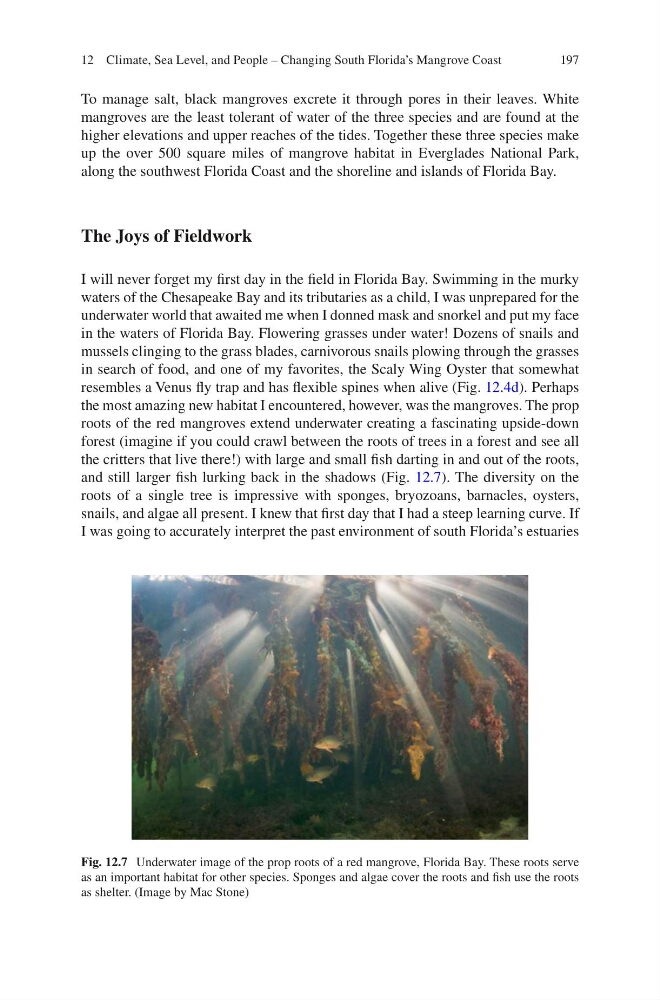
the most amazing new habitat I encountered, however, was the mangroves. The prop
roots of the red mangroves extend underwater creating a fascinating upside-down
forest (imagine if you could crawl between the roots of trees in a forest and see all
the critters that live there!) with large and small fish darting in and out of the roots,
and still larger fish lurking back in the shadows (Fig. 12.7). The diversity on the
roots of a single tree is impressive with sponges, bryozoans, barnacles, oysters,
snails, and algae all present. I knew that first day that I had a steep learning curve. If
I was going to accurately interpret the past environment of south Florida’s estuaries
Fig. 12.7 Underwater image of the prop roots of a red mangrove, Florida Bay. These roots serve
as an important habitat for other species. Sponges and algae cover the roots and fish use the roots
as shelter. (Image by Mac Stone)
12 Climate, Sea Level, and People – Changing South Florida’s Mangrove Coast
To manage salt, black mangroves excrete it through pores in their leaves. White
mangroves are the least tolerant of water of the three species and are found at the
higher elevations and upper reaches of the tides. Together these three species make
up the over 500 square miles of mangrove habitat in Everglades National Park,
along the southwest Florida Coast and the shoreline and islands of Florida Bay.
The Joys of Fieldwork
I will never forget my first day in the field in Florida Bay. Swimming in the murky
waters of the Chesapeake Bay and its tributaries as a child, I was unprepared for the
underwater world that awaited me when I donned mask and snorkel and put my face
in the waters of Florida Bay. Flowering grasses under water! Dozens of snails and
mussels clinging to the grass blades, carnivorous snails plowing through the grasses
in search of food, and one of my favorites, the Scaly Wing Oyster that somewhat
resembles a Venus fly trap and has flexible spines when alive (Fig. 12.4d). Perhaps
the most amazing new habitat I encountered, however, was the mangroves. The prop
roots of the red mangroves extend underwater creating a fascinating upside-down
forest (imagine if you could crawl between the roots of trees in a forest and see all
the critters that live there!) with large and small fish darting in and out of the roots,
and still larger fish lurking back in the shadows (Fig. 12.7). The diversity on the
roots of a single tree is impressive with sponges, bryozoans, barnacles, oysters,
snails, and algae all present. I knew that first day that I had a steep learning curve. If
I was going to accurately interpret the past environment of south Florida’s estuaries
Fig. 12.7 Underwater image of the prop roots of a red mangrove, Florida Bay. These roots serve
as an important habitat for other species. Sponges and algae cover the roots and fish use the roots
as shelter. (Image by Mac Stone)
12 Climate, Sea Level, and People – Changing South Florida’s Mangrove Coast