

187
Conclusions
“ECU by the sea” was the initial impetus that drove ECU’s coastal and marine science programs, and which had the basic goal of determining the origin and evolutionary history of the North Carolina coastal system. From that important beginning,
my colleagues, students and I, together, have carried out a cumulative life-time of
research projects extending from the outer continental shelf westward through
North Carolina, from the rocky shores of New England southwards to the reefs and
deltas in the Gulf of Mexico, and various locations around our planet. Geologists
are not only involved with history and dynamics of the past, but are intimately associated with understanding the present, and projecting the science of change into the
future. This means that we work in the realms of geologic time (millions of years),
as well as human time (millennia to hours and minutes).
Based on a foundation of solid science, it is clear that the climate North Carolina
enjoys is still changing (as it always has done in the past), sea level is rising at
increasing rates, and storm dynamics increasingly impact the human-modified
coastal system. The mindset of unlimited growth and development on NC’s coastal
system will not continue to be economically sustainable. There is, of course, no
indication that natural processes will cease or that the status quo can be engineered
for the coastal system into the future. The challenge is for each of us to look carefully at the natural world that exists on our little but unique (at least for our solar
system) planet. Then we should ask serious questions concerning the relationship of
our civilization to the planet Earth and its dynamics and resources. It is increasingly
realized and accepted that the future of our civilization (seven plus billion people
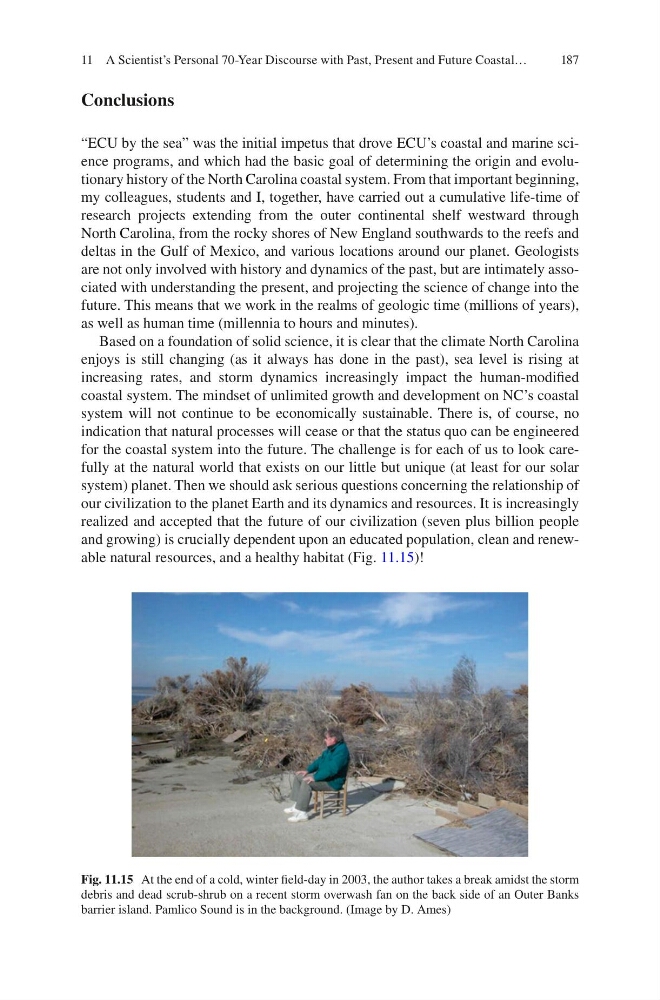
and growing) is crucially dependent upon an educated population, clean and renewable natural resources, and a healthy habitat (Fig. 11.15)!
Fig. 11.15 At the end of a cold, winter field-day in 2003, the author takes a break amidst the storm
debris and dead scrub-shrub on a recent storm overwash fan on the back side of an Outer Banks
barrier island. Pamlico Sound is in the background. (Image by D. Ames)
11 A Scientist’s Personal 70-Year Discourse with Past, Present and Future Coastal…
Conclusions
“ECU by the sea” was the initial impetus that drove ECU’s coastal and marine science programs, and which had the basic goal of determining the origin and evolutionary history of the North Carolina coastal system. From that important beginning,
my colleagues, students and I, together, have carried out a cumulative life-time of
research projects extending from the outer continental shelf westward through
North Carolina, from the rocky shores of New England southwards to the reefs and
deltas in the Gulf of Mexico, and various locations around our planet. Geologists
are not only involved with history and dynamics of the past, but are intimately associated with understanding the present, and projecting the science of change into the
future. This means that we work in the realms of geologic time (millions of years),
as well as human time (millennia to hours and minutes).
Based on a foundation of solid science, it is clear that the climate North Carolina
enjoys is still changing (as it always has done in the past), sea level is rising at
increasing rates, and storm dynamics increasingly impact the human-modified
coastal system. The mindset of unlimited growth and development on NC’s coastal
system will not continue to be economically sustainable. There is, of course, no
indication that natural processes will cease or that the status quo can be engineered
for the coastal system into the future. The challenge is for each of us to look carefully at the natural world that exists on our little but unique (at least for our solar
system) planet. Then we should ask serious questions concerning the relationship of
our civilization to the planet Earth and its dynamics and resources. It is increasingly
realized and accepted that the future of our civilization (seven plus billion people
and growing) is crucially dependent upon an educated population, clean and renewable natural resources, and a healthy habitat (Fig. 11.15)!
Fig. 11.15 At the end of a cold, winter field-day in 2003, the author takes a break amidst the storm
debris and dead scrub-shrub on a recent storm overwash fan on the back side of an Outer Banks
barrier island. Pamlico Sound is in the background. (Image by D. Ames)
11 A Scientist’s Personal 70-Year Discourse with Past, Present and Future Coastal…