

185
old Little California school. Over the decades the coastal and marine program at
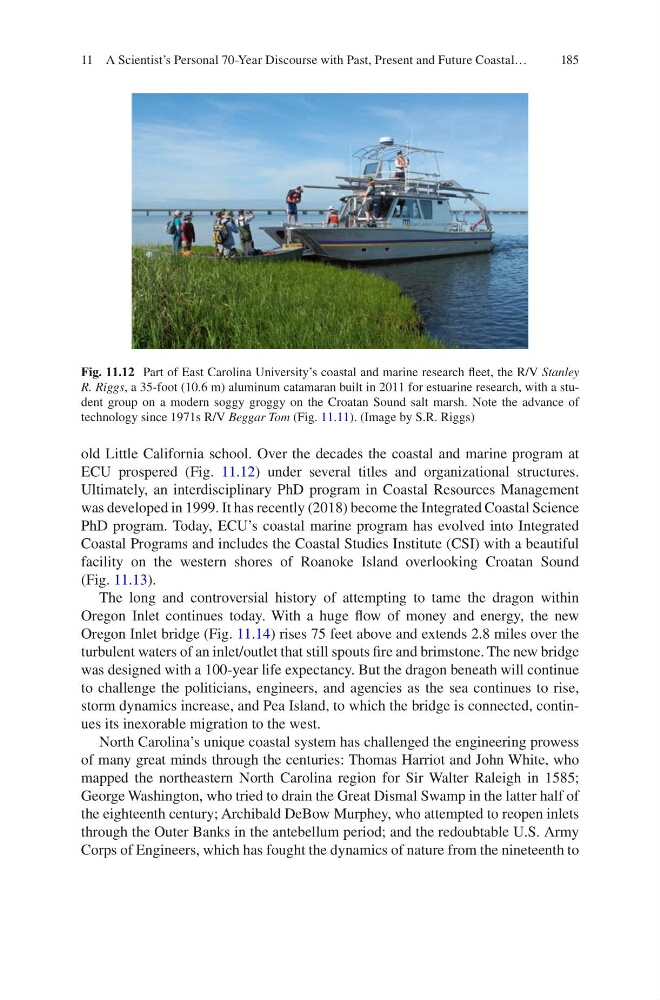
ECU prospered (Fig. 11.12) under several titles and organizational structures.
Ultimately, an interdisciplinary PhD program in Coastal Resources Management
was developed in 1999. It has recently (2018) become the Integrated Coastal Science
PhD program. Today, ECU’s coastal marine program has evolved into Integrated
Coastal Programs and includes the Coastal Studies Institute (CSI) with a beautiful
facility on the western shores of Roanoke Island overlooking Croatan Sound
(Fig. 11.13).
The long and controversial history of attempting to tame the dragon within
Oregon Inlet continues today. With a huge flow of money and energy, the new
Oregon Inlet bridge (Fig. 11.14) rises 75 feet above and extends 2.8 miles over the
turbulent waters of an inlet/outlet that still spouts fire and brimstone. The new bridge
was designed with a 100-year life expectancy. But the dragon beneath will continue
to challenge the politicians, engineers, and agencies as the sea continues to rise,
storm dynamics increase, and Pea Island, to which the bridge is connected, continues its inexorable migration to the west.
North Carolina’s unique coastal system has challenged the engineering prowess
of many great minds through the centuries: Thomas Harriot and John White, who
mapped the northeastern North Carolina region for Sir Walter Raleigh in 1585;
George Washington, who tried to drain the Great Dismal Swamp in the latter half of
the eighteenth century; Archibald DeBow Murphey, who attempted to reopen inlets
through the Outer Banks in the antebellum period; and the redoubtable U.S. Army
Corps of Engineers, which has fought the dynamics of nature from the nineteenth to
Fig. 11.12 Part of East Carolina University’s coastal and marine research fleet, the R/V Stanley
R. Riggs, a 35-foot (10.6 m) aluminum catamaran built in 2011 for estuarine research, with a student group on a modern soggy groggy on the Croatan Sound salt marsh. Note the advance of
technology since 1971s R/V Beggar Tom (Fig. 11.11). (Image by S.R. Riggs)
11 A Scientist’s Personal 70-Year Discourse with Past, Present and Future Coastal…
old Little California school. Over the decades the coastal and marine program at
ECU prospered (Fig. 11.12) under several titles and organizational structures.
Ultimately, an interdisciplinary PhD program in Coastal Resources Management
was developed in 1999. It has recently (2018) become the Integrated Coastal Science
PhD program. Today, ECU’s coastal marine program has evolved into Integrated
Coastal Programs and includes the Coastal Studies Institute (CSI) with a beautiful
facility on the western shores of Roanoke Island overlooking Croatan Sound
(Fig. 11.13).
The long and controversial history of attempting to tame the dragon within
Oregon Inlet continues today. With a huge flow of money and energy, the new
Oregon Inlet bridge (Fig. 11.14) rises 75 feet above and extends 2.8 miles over the
turbulent waters of an inlet/outlet that still spouts fire and brimstone. The new bridge
was designed with a 100-year life expectancy. But the dragon beneath will continue
to challenge the politicians, engineers, and agencies as the sea continues to rise,
storm dynamics increase, and Pea Island, to which the bridge is connected, continues its inexorable migration to the west.
North Carolina’s unique coastal system has challenged the engineering prowess
of many great minds through the centuries: Thomas Harriot and John White, who
mapped the northeastern North Carolina region for Sir Walter Raleigh in 1585;
George Washington, who tried to drain the Great Dismal Swamp in the latter half of
the eighteenth century; Archibald DeBow Murphey, who attempted to reopen inlets
through the Outer Banks in the antebellum period; and the redoubtable U.S. Army
Corps of Engineers, which has fought the dynamics of nature from the nineteenth to
Fig. 11.12 Part of East Carolina University’s coastal and marine research fleet, the R/V Stanley
R. Riggs, a 35-foot (10.6 m) aluminum catamaran built in 2011 for estuarine research, with a student group on a modern soggy groggy on the Croatan Sound salt marsh. Note the advance of
technology since 1971s R/V Beggar Tom (Fig. 11.11). (Image by S.R. Riggs)
11 A Scientist’s Personal 70-Year Discourse with Past, Present and Future Coastal…