

184
were through. Editors immediately informed us that this was too much “doom and
gloom” and we should write a third section with a strong “Vision for the Future” of
our coastal system, from a geologist’s perspective and within a scientific framework. In brief, to avoid catastrophic losses of life, economy, infrastructure, and
property, North Carolina, like other coastal regions of the world, will need to
develop responsible land-use plans for its barrier islands, estuaries, wetlands, and
adjacent uplands. Such a proposal of learning to live with the natural dynamics was
set forth as a concept titled, “North Carolina Land of Water” (NC LOW). NC LOW
was a new, flexible and adaptable paradigm for our coastal system, in which humans
adapt to long-term barrier island evolution and migration with a gentle pattern of
retreat. With a science-based economic paradigm and a population of educated
managers, politicians, and citizenry, North Carolina can adapt to changes and maintain a viable and sustainable economy within a dynamic and changing coastal system. This initiative is built on an integrated natural, cultural, and economic resource
base that will build connectivity throughout the coastal system, utilizing a multimodal transport system by water and land.
The concept and geographic region of the North Carolina Land of Water became
a reality in 2013 when, with several colleagues, I began an NC LOW 501 c 3 nonprofit organization. This effort was initially supported by and ultimately funded by
the Kenan Institute of Engineering, Technology, and Science at North Carolina
State University. Today, NC LOW (www.nclandofwater.org) is funded by several
agencies and foundations and carries out research and educational programs
throughout the Outer and Inner Banks of North Carolina.
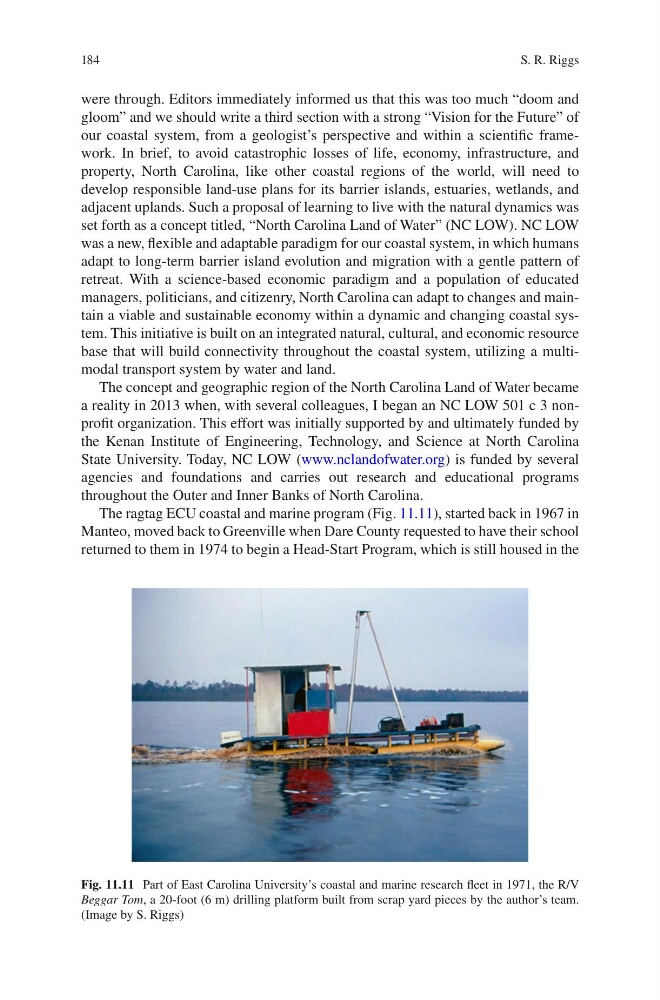
The ragtag ECU coastal and marine program (Fig. 11.11), started back in 1967 in
Manteo, moved back to Greenville when Dare County requested to have their school
returned to them in 1974 to begin a Head-Start Program, which is still housed in the
Fig. 11.11 Part of East Carolina University’s coastal and marine research fleet in 1971, the R/V
Beggar Tom, a 20-foot (6 m) drilling platform built from scrap yard pieces by the author’s team.
(Image by S. Riggs)
S. R. Riggs
were through. Editors immediately informed us that this was too much “doom and
gloom” and we should write a third section with a strong “Vision for the Future” of
our coastal system, from a geologist’s perspective and within a scientific framework. In brief, to avoid catastrophic losses of life, economy, infrastructure, and
property, North Carolina, like other coastal regions of the world, will need to
develop responsible land-use plans for its barrier islands, estuaries, wetlands, and
adjacent uplands. Such a proposal of learning to live with the natural dynamics was
set forth as a concept titled, “North Carolina Land of Water” (NC LOW). NC LOW
was a new, flexible and adaptable paradigm for our coastal system, in which humans
adapt to long-term barrier island evolution and migration with a gentle pattern of
retreat. With a science-based economic paradigm and a population of educated
managers, politicians, and citizenry, North Carolina can adapt to changes and maintain a viable and sustainable economy within a dynamic and changing coastal system. This initiative is built on an integrated natural, cultural, and economic resource
base that will build connectivity throughout the coastal system, utilizing a multimodal transport system by water and land.
The concept and geographic region of the North Carolina Land of Water became
a reality in 2013 when, with several colleagues, I began an NC LOW 501 c 3 nonprofit organization. This effort was initially supported by and ultimately funded by
the Kenan Institute of Engineering, Technology, and Science at North Carolina
State University. Today, NC LOW (www.nclandofwater.org) is funded by several
agencies and foundations and carries out research and educational programs
throughout the Outer and Inner Banks of North Carolina.
The ragtag ECU coastal and marine program (Fig. 11.11), started back in 1967 in
Manteo, moved back to Greenville when Dare County requested to have their school
returned to them in 1974 to begin a Head-Start Program, which is still housed in the
Fig. 11.11 Part of East Carolina University’s coastal and marine research fleet in 1971, the R/V
Beggar Tom, a 20-foot (6 m) drilling platform built from scrap yard pieces by the author’s team.
(Image by S. Riggs)
S. R. Riggs