

176
Oregon Inlet (Fig. 11.3) became the arena for the Dragon Soggy Groggy. Oregon
Inlet is like a dragon that “breathes fire and smoke”, but instead of fire and smoke,
it breathes extreme energy and fierce dynamics. The operating forces range from
pure beauty and gentleness to wild and dramatic events that cause this particular
system to evolve before your very eyes. The Oregon Inlet soggy groggys were field
projects over extended periods of time during which we would monitor the processes and responses first through a normal day’s tide cycles, followed by a multiday storm cycle. Stations were established within the inlet and adjacent habitats as
control points for monitoring the various processes of change including water levels, winds, waves, currents, etc., as well as the responses such as the erosion, transport, and deposition of different types of sediment; fluctuations in water depth and
its chemistry; and changing activity of biotic communities.
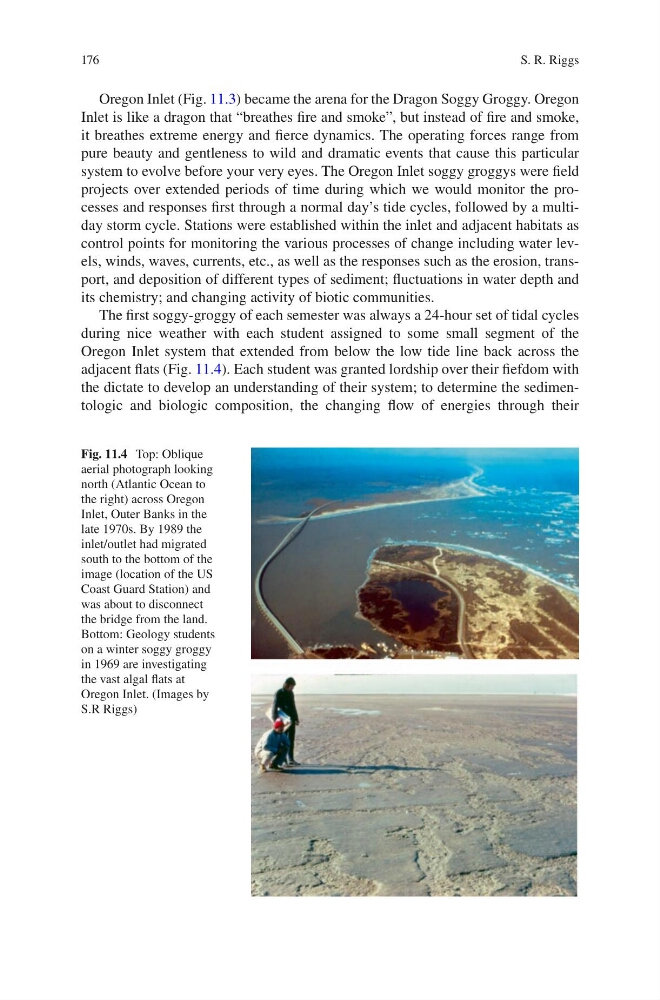
The first soggy-groggy of each semester was always a 24-hour set of tidal cycles
during nice weather with each student assigned to some small segment of the
Oregon Inlet system that extended from below the low tide line back across the
adjacent flats (Fig. 11.4). Each student was granted lordship over their fiefdom with
the dictate to develop an understanding of their system; to determine the sedimentologic and biologic composition, the changing flow of energies through their
Fig. 11.4 Top: Oblique
aerial photograph looking
north (Atlantic Ocean to
the right) across Oregon
Inlet, Outer Banks in the
late 1970s. By 1989 the
inlet/outlet had migrated
south to the bottom of the
image (location of the US
Coast Guard Station) and
was about to disconnect
the bridge from the land.
Bottom: Geology students
on a winter soggy groggy
in 1969 are investigating
the vast algal flats at
Oregon Inlet. (Images by
S.R Riggs)
S. R. Riggs
Oregon Inlet (Fig. 11.3) became the arena for the Dragon Soggy Groggy. Oregon
Inlet is like a dragon that “breathes fire and smoke”, but instead of fire and smoke,
it breathes extreme energy and fierce dynamics. The operating forces range from
pure beauty and gentleness to wild and dramatic events that cause this particular
system to evolve before your very eyes. The Oregon Inlet soggy groggys were field
projects over extended periods of time during which we would monitor the processes and responses first through a normal day’s tide cycles, followed by a multiday storm cycle. Stations were established within the inlet and adjacent habitats as
control points for monitoring the various processes of change including water levels, winds, waves, currents, etc., as well as the responses such as the erosion, transport, and deposition of different types of sediment; fluctuations in water depth and
its chemistry; and changing activity of biotic communities.
The first soggy-groggy of each semester was always a 24-hour set of tidal cycles
during nice weather with each student assigned to some small segment of the
Oregon Inlet system that extended from below the low tide line back across the
adjacent flats (Fig. 11.4). Each student was granted lordship over their fiefdom with
the dictate to develop an understanding of their system; to determine the sedimentologic and biologic composition, the changing flow of energies through their
Fig. 11.4 Top: Oblique
aerial photograph looking
north (Atlantic Ocean to
the right) across Oregon
Inlet, Outer Banks in the
late 1970s. By 1989 the
inlet/outlet had migrated
south to the bottom of the
image (location of the US
Coast Guard Station) and
was about to disconnect
the bridge from the land.
Bottom: Geology students
on a winter soggy groggy
in 1969 are investigating
the vast algal flats at
Oregon Inlet. (Images by
S.R Riggs)
S. R. Riggs