

158
We cleaned up, put everything back in our packs, and started to make our way off
the marsh. The other student and I had most of the equipment and our advisor the
samples. A better part of the day had passed, and the tide was much higher than during our journey out to the site. This meant that we couldn’t backtrack along the way
we came in because the tidal channels would be full of water and too deep to cross
on foot. So, we started our several hour return trip by navigating toward the back of
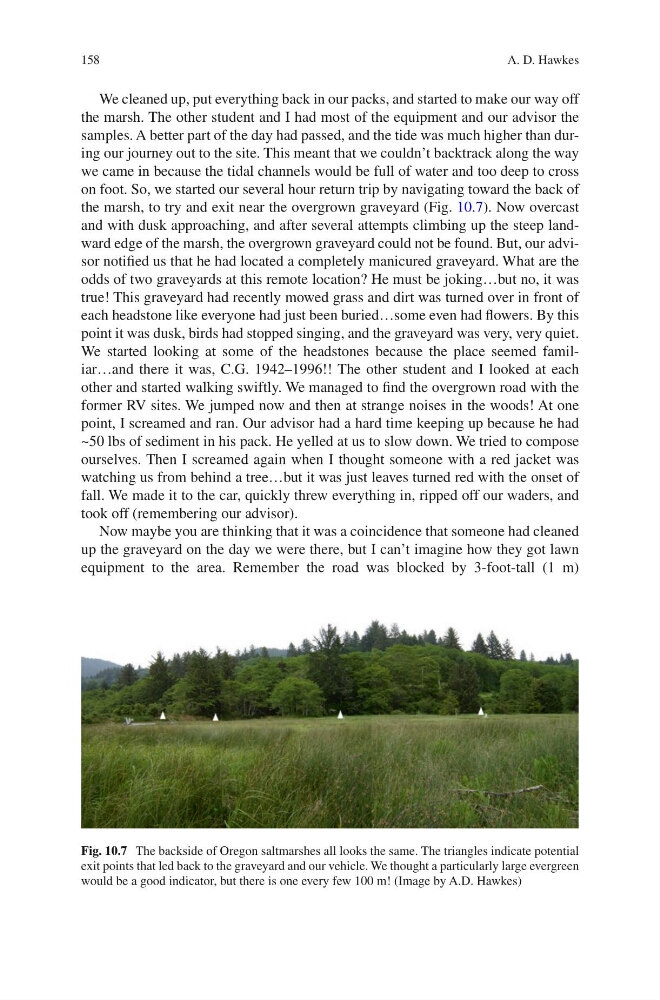
the marsh, to try and exit near the overgrown graveyard (Fig. 10.7). Now overcast
and with dusk approaching, and after several attempts climbing up the steep landward edge of the marsh, the overgrown graveyard could not be found. But, our advisor notified us that he had located a completely manicured graveyard. What are the
odds of two graveyards at this remote location? He must be joking…but no, it was
true! This graveyard had recently mowed grass and dirt was turned over in front of
each headstone like everyone had just been buried…some even had flowers. By this
point it was dusk, birds had stopped singing, and the graveyard was very, very quiet.
We started looking at some of the headstones because the place seemed familiar…and there it was, C.G. 1942–1996!! The other student and I looked at each
other and started walking swiftly. We managed to find the overgrown road with the
former RV sites. We jumped now and then at strange noises in the woods! At one
point, I screamed and ran. Our advisor had a hard time keeping up because he had
~50 lbs of sediment in his pack. He yelled at us to slow down. We tried to compose
ourselves. Then I screamed again when I thought someone with a red jacket was
watching us from behind a tree…but it was just leaves turned red with the onset of
fall. We made it to the car, quickly threw everything in, ripped off our waders, and
took off (remembering our advisor).
Now maybe you are thinking that it was a coincidence that someone had cleaned
up the graveyard on the day we were there, but I can’t imagine how they got lawn
equipment to the area. Remember the road was blocked by 3-foot-tall (1 m)
Fig. 10.7 The backside of Oregon saltmarshes all looks the same. The triangles indicate potential
exit points that led back to the graveyard and our vehicle. We thought a particularly large evergreen
would be a good indicator, but there is one every few 100 m! (Image by A.D. Hawkes)
A. D. Hawkes
We cleaned up, put everything back in our packs, and started to make our way off
the marsh. The other student and I had most of the equipment and our advisor the
samples. A better part of the day had passed, and the tide was much higher than during our journey out to the site. This meant that we couldn’t backtrack along the way
we came in because the tidal channels would be full of water and too deep to cross
on foot. So, we started our several hour return trip by navigating toward the back of
the marsh, to try and exit near the overgrown graveyard (Fig. 10.7). Now overcast
and with dusk approaching, and after several attempts climbing up the steep landward edge of the marsh, the overgrown graveyard could not be found. But, our advisor notified us that he had located a completely manicured graveyard. What are the
odds of two graveyards at this remote location? He must be joking…but no, it was
true! This graveyard had recently mowed grass and dirt was turned over in front of
each headstone like everyone had just been buried…some even had flowers. By this
point it was dusk, birds had stopped singing, and the graveyard was very, very quiet.
We started looking at some of the headstones because the place seemed familiar…and there it was, C.G. 1942–1996!! The other student and I looked at each
other and started walking swiftly. We managed to find the overgrown road with the
former RV sites. We jumped now and then at strange noises in the woods! At one
point, I screamed and ran. Our advisor had a hard time keeping up because he had
~50 lbs of sediment in his pack. He yelled at us to slow down. We tried to compose
ourselves. Then I screamed again when I thought someone with a red jacket was
watching us from behind a tree…but it was just leaves turned red with the onset of
fall. We made it to the car, quickly threw everything in, ripped off our waders, and
took off (remembering our advisor).
Now maybe you are thinking that it was a coincidence that someone had cleaned
up the graveyard on the day we were there, but I can’t imagine how they got lawn
equipment to the area. Remember the road was blocked by 3-foot-tall (1 m)
Fig. 10.7 The backside of Oregon saltmarshes all looks the same. The triangles indicate potential
exit points that led back to the graveyard and our vehicle. We thought a particularly large evergreen
would be a good indicator, but there is one every few 100 m! (Image by A.D. Hawkes)
A. D. Hawkes