

153
North of the San Andreas is a different kind of tectonic setting where oceanic
plates made of denser rock material (in this case the Juan de Fuca and Gorda plates;
Fig. 10.1) converge into a less dense continental plate (in this case the North
American plate) causing the oceanic plates to subduct (dive slowly down beneath
the continental plate). Geologic records show that giant megathrust earthquakes
(M w > 8) have happened repeatedly along the west coast from northern California
through Oregon, Washington, and British Columbia over the past ~10,000 years
(Fig. 10.1).
Along the west coast of the U.S., the Gorda and Juan de Fuca oceanic plates are
subducting beneath the continental North American plate at a relatively fast rate
(tectonically-speaking) of 4–5 cm/year. Unfortunately, the plates don’t subduct
smoothly, so the strain between the plates builds for hundreds of years and is then
released episodically as a giant megathrust earthquake. This type of tectonic setting
outlines much of the Pacific Ocean and is referred to as the Pacific Ring of Fire due
to the co-occurrence of subduction-related volcanos. Several historic and recent
giant earthquakes in Alaska (1964 M w 9.2), Japan (2011, M w 9.0), Chile (1960,
M w 9.5; 2010, M w 8.8) are located along the Ring of Fire. This same tectonic setting
is also found in the Indian Ocean, and was responsible for the deadly 2004 Indian
Ocean earthquake (M w 9.1–9.3) and associated tsunami.
What is unique about the west coast of the U.S. is that there have been no historic
or instrumentally recorded great earthquakes…they just haven’t happened in the
short, written history of western North America. There is evidence that First Nations
peoples in the region were impacted by the most recent giant earthquake in the year
1700; evidence includes buried textiles in coastal forests and myths of a struggle
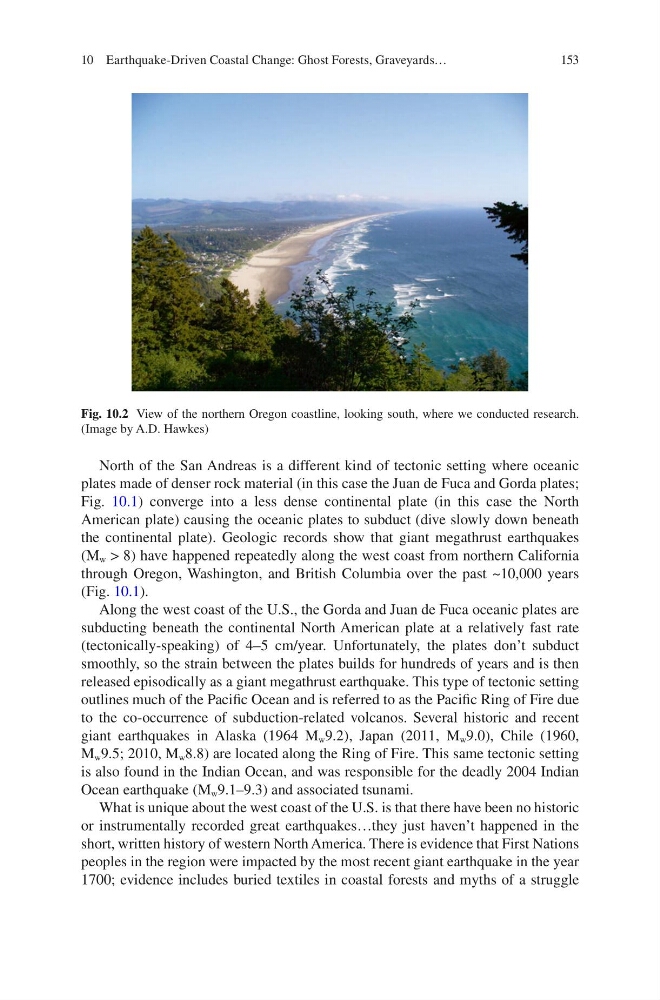
Fig. 10.2 View of the northern Oregon coastline, looking south, where we conducted research.
(Image by A.D. Hawkes)
10 Earthquake-Driven Coastal Change: Ghost Forests, Graveyards…
North of the San Andreas is a different kind of tectonic setting where oceanic
plates made of denser rock material (in this case the Juan de Fuca and Gorda plates;
Fig. 10.1) converge into a less dense continental plate (in this case the North
American plate) causing the oceanic plates to subduct (dive slowly down beneath
the continental plate). Geologic records show that giant megathrust earthquakes
(M w > 8) have happened repeatedly along the west coast from northern California
through Oregon, Washington, and British Columbia over the past ~10,000 years
(Fig. 10.1).
Along the west coast of the U.S., the Gorda and Juan de Fuca oceanic plates are
subducting beneath the continental North American plate at a relatively fast rate
(tectonically-speaking) of 4–5 cm/year. Unfortunately, the plates don’t subduct
smoothly, so the strain between the plates builds for hundreds of years and is then
released episodically as a giant megathrust earthquake. This type of tectonic setting
outlines much of the Pacific Ocean and is referred to as the Pacific Ring of Fire due
to the co-occurrence of subduction-related volcanos. Several historic and recent
giant earthquakes in Alaska (1964 M w 9.2), Japan (2011, M w 9.0), Chile (1960,
M w 9.5; 2010, M w 8.8) are located along the Ring of Fire. This same tectonic setting
is also found in the Indian Ocean, and was responsible for the deadly 2004 Indian
Ocean earthquake (M w 9.1–9.3) and associated tsunami.
What is unique about the west coast of the U.S. is that there have been no historic
or instrumentally recorded great earthquakes…they just haven’t happened in the
short, written history of western North America. There is evidence that First Nations
peoples in the region were impacted by the most recent giant earthquake in the year
1700; evidence includes buried textiles in coastal forests and myths of a struggle
Fig. 10.2 View of the northern Oregon coastline, looking south, where we conducted research.
(Image by A.D. Hawkes)
10 Earthquake-Driven Coastal Change: Ghost Forests, Graveyards…