

141
between the geomorphology of the Coastal Plain and the stratigraphy that underlies
it, or in other words, the dynamic evolution of the Quaternary landscape. Although
these concepts are always on my mind, most people that I meet, the farmers, watermen, neighbors, landowners and friends at the pub, rarely understand this obsession! Although, somewhat surprising to me, some do!
My first exposure to the geologic coring of unconsolidated modern coastal
deposits occurred when I was a PhD student at Louisiana State University in the
1980s. During this period, I signed up for a summer field course with coastal and
planetary geologist, Dr. Dag Nummedal (who discovered the channels on Mars) and
six other students. That field course consisted of cruising (by boat) around the
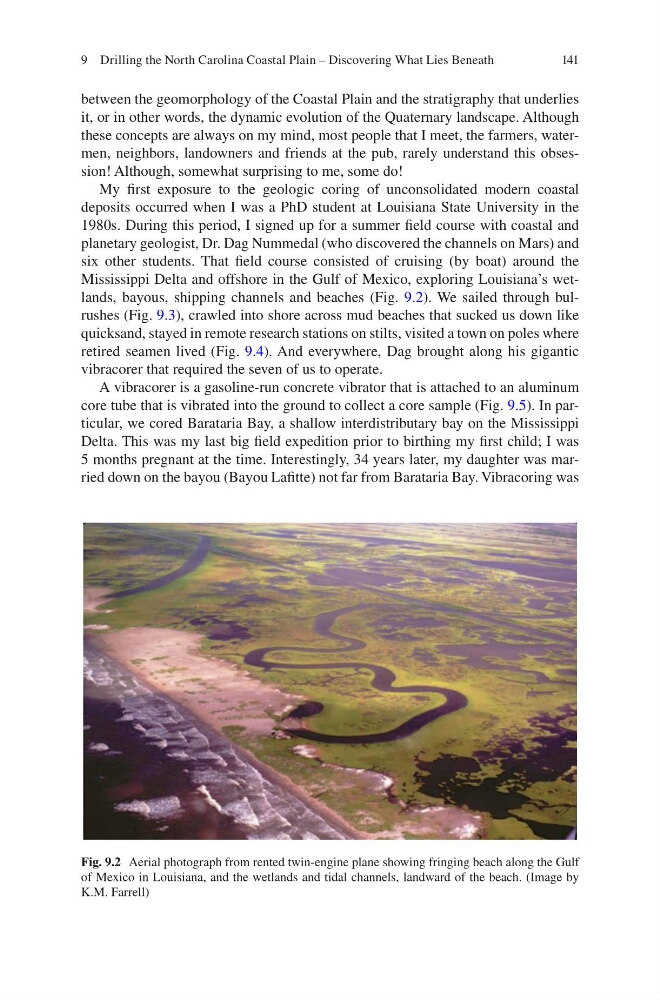
Mississippi Delta and offshore in the Gulf of Mexico, exploring Louisiana’s wetlands, bayous, shipping channels and beaches (Fig. 9.2). We sailed through bulrushes (Fig. 9.3), crawled into shore across mud beaches that sucked us down like
quicksand, stayed in remote research stations on stilts, visited a town on poles where
retired seamen lived (Fig. 9.4). And everywhere, Dag brought along his gigantic
vibracorer that required the seven of us to operate.
A vibracorer is a gasoline-run concrete vibrator that is attached to an aluminum
core tube that is vibrated into the ground to collect a core sample (Fig. 9.5). In particular, we cored Barataria Bay, a shallow interdistributary bay on the Mississippi
Delta. This was my last big field expedition prior to birthing my first child; I was
5 months pregnant at the time. Interestingly, 34 years later, my daughter was married down on the bayou (Bayou Lafitte) not far from Barataria Bay. Vibracoring was
Fig. 9.2 Aerial photograph from rented twin-engine plane showing fringing beach along the Gulf
of Mexico in Louisiana, and the wetlands and tidal channels, landward of the beach. (Image by
K.M. Farrell)
9 Drilling the North Carolina Coastal Plain – Discovering What Lies Beneath
between the geomorphology of the Coastal Plain and the stratigraphy that underlies
it, or in other words, the dynamic evolution of the Quaternary landscape. Although
these concepts are always on my mind, most people that I meet, the farmers, watermen, neighbors, landowners and friends at the pub, rarely understand this obsession! Although, somewhat surprising to me, some do!
My first exposure to the geologic coring of unconsolidated modern coastal
deposits occurred when I was a PhD student at Louisiana State University in the
1980s. During this period, I signed up for a summer field course with coastal and
planetary geologist, Dr. Dag Nummedal (who discovered the channels on Mars) and
six other students. That field course consisted of cruising (by boat) around the
Mississippi Delta and offshore in the Gulf of Mexico, exploring Louisiana’s wetlands, bayous, shipping channels and beaches (Fig. 9.2). We sailed through bulrushes (Fig. 9.3), crawled into shore across mud beaches that sucked us down like
quicksand, stayed in remote research stations on stilts, visited a town on poles where
retired seamen lived (Fig. 9.4). And everywhere, Dag brought along his gigantic
vibracorer that required the seven of us to operate.
A vibracorer is a gasoline-run concrete vibrator that is attached to an aluminum
core tube that is vibrated into the ground to collect a core sample (Fig. 9.5). In particular, we cored Barataria Bay, a shallow interdistributary bay on the Mississippi
Delta. This was my last big field expedition prior to birthing my first child; I was
5 months pregnant at the time. Interestingly, 34 years later, my daughter was married down on the bayou (Bayou Lafitte) not far from Barataria Bay. Vibracoring was
Fig. 9.2 Aerial photograph from rented twin-engine plane showing fringing beach along the Gulf
of Mexico in Louisiana, and the wetlands and tidal channels, landward of the beach. (Image by
K.M. Farrell)
9 Drilling the North Carolina Coastal Plain – Discovering What Lies Beneath