

117
When we wanted to understand estuarine evolution, including anthropogenic
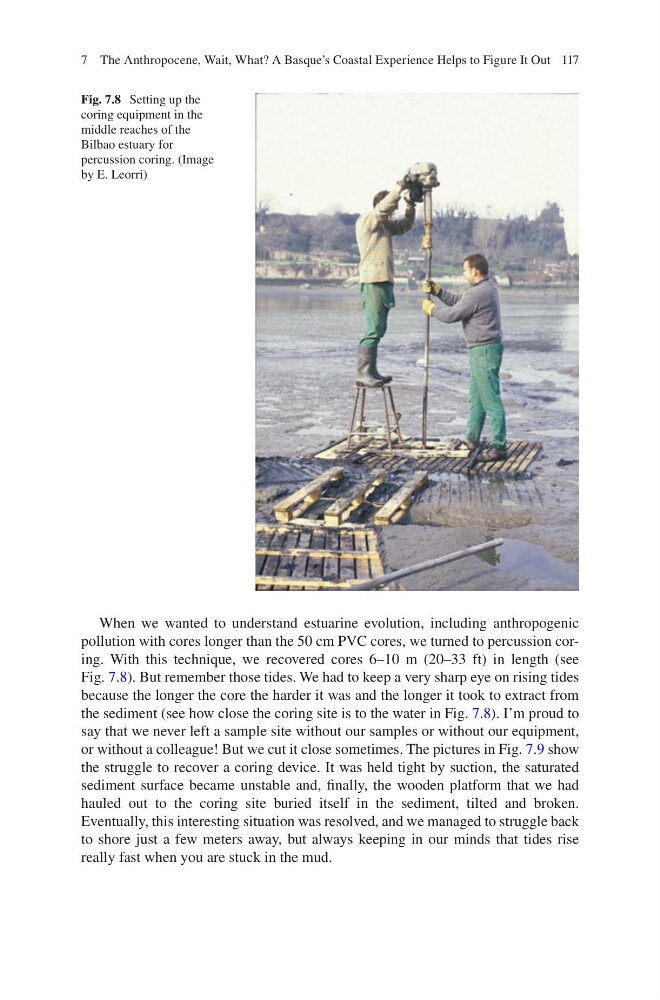
pollution with cores longer than the 50 cm PVC cores, we turned to percussion coring. With this technique, we recovered cores 6–10 m (20–33 ft) in length (see
Fig. 7.8). But remember those tides. We had to keep a very sharp eye on rising tides
because the longer the core the harder it was and the longer it took to extract from
the sediment (see how close the coring site is to the water in Fig. 7.8). I’m proud to
say that we never left a sample site without our samples or without our equipment,
or without a colleague! But we cut it close sometimes. The pictures in Fig. 7.9 show
the struggle to recover a coring device. It was held tight by suction, the saturated
sediment surface became unstable and, finally, the wooden platform that we had
hauled out to the coring site buried itself in the sediment, tilted and broken.
Eventually, this interesting situation was resolved, and we managed to struggle back
to shore just a few meters away, but always keeping in our minds that tides rise
really fast when you are stuck in the mud.
Fig. 7.8 Setting up the
coring equipment in the
middle reaches of the
Bilbao estuary for
percussion coring. (Image
by E. Leorri)
7 The Anthropocene, Wait, What? A Basque’s Coastal Experience Helps to Figure It Out
When we wanted to understand estuarine evolution, including anthropogenic
pollution with cores longer than the 50 cm PVC cores, we turned to percussion coring. With this technique, we recovered cores 6–10 m (20–33 ft) in length (see
Fig. 7.8). But remember those tides. We had to keep a very sharp eye on rising tides
because the longer the core the harder it was and the longer it took to extract from
the sediment (see how close the coring site is to the water in Fig. 7.8). I’m proud to
say that we never left a sample site without our samples or without our equipment,
or without a colleague! But we cut it close sometimes. The pictures in Fig. 7.9 show
the struggle to recover a coring device. It was held tight by suction, the saturated
sediment surface became unstable and, finally, the wooden platform that we had
hauled out to the coring site buried itself in the sediment, tilted and broken.
Eventually, this interesting situation was resolved, and we managed to struggle back
to shore just a few meters away, but always keeping in our minds that tides rise
really fast when you are stuck in the mud.
Fig. 7.8 Setting up the
coring equipment in the
middle reaches of the
Bilbao estuary for
percussion coring. (Image
by E. Leorri)
7 The Anthropocene, Wait, What? A Basque’s Coastal Experience Helps to Figure It Out