

116
relative safety of the concrete quay (which is quite slippery – accidents happened
there!). Did I mention that you need to plan your work around the tides so you don’t
suddenly find the water rising around you? This is even more fun if you are coring.
The surface sediment samples provided an understanding of the modern environment (we sampled several times, seasonally and over the years). But what about the
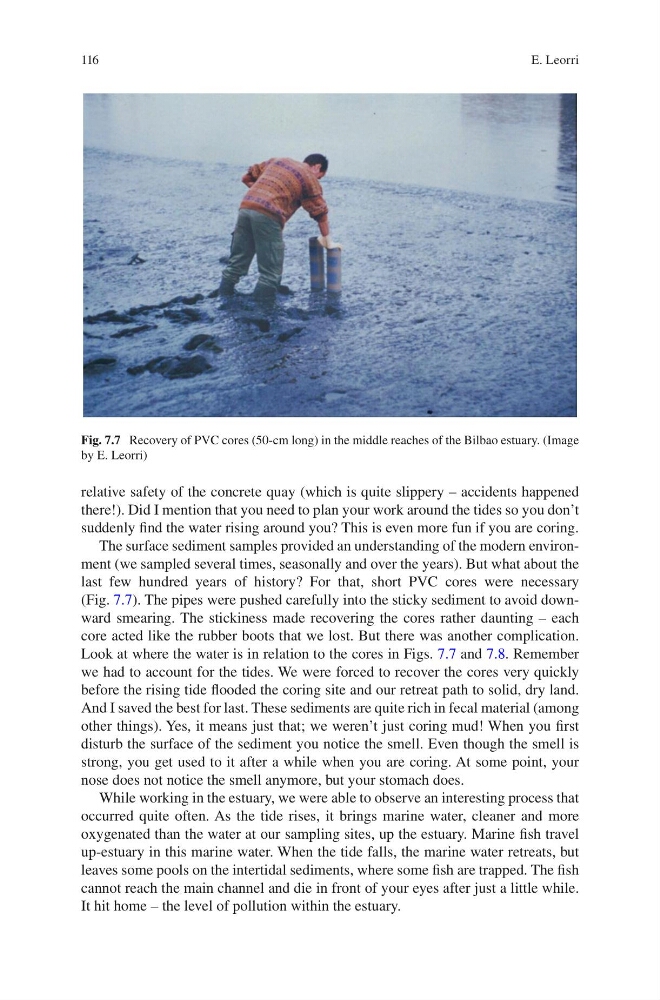
last few hundred years of history? For that, short PVC cores were necessary
(Fig. 7.7). The pipes were pushed carefully into the sticky sediment to avoid downward smearing. The stickiness made recovering the cores rather daunting – each
core acted like the rubber boots that we lost. But there was another complication.
Look at where the water is in relation to the cores in Figs. 7.7 and 7.8. Remember
we had to account for the tides. We were forced to recover the cores very quickly
before the rising tide flooded the coring site and our retreat path to solid, dry land.
And I saved the best for last. These sediments are quite rich in fecal material (among
other things). Yes, it means just that; we weren’t just coring mud! When you first
disturb the surface of the sediment you notice the smell. Even though the smell is
strong, you get used to it after a while when you are coring. At some point, your
nose does not notice the smell anymore, but your stomach does.
While working in the estuary, we were able to observe an interesting process that
occurred quite often. As the tide rises, it brings marine water, cleaner and more
oxygenated than the water at our sampling sites, up the estuary. Marine fish travel
up-estuary in this marine water. When the tide falls, the marine water retreats, but
leaves some pools on the intertidal sediments, where some fish are trapped. The fish
cannot reach the main channel and die in front of your eyes after just a little while.
It hit home – the level of pollution within the estuary.
Fig. 7.7 Recovery of PVC cores (50-cm long) in the middle reaches of the Bilbao estuary. (Image
by E. Leorri)
E. Leorri
relative safety of the concrete quay (which is quite slippery – accidents happened
there!). Did I mention that you need to plan your work around the tides so you don’t
suddenly find the water rising around you? This is even more fun if you are coring.
The surface sediment samples provided an understanding of the modern environment (we sampled several times, seasonally and over the years). But what about the
last few hundred years of history? For that, short PVC cores were necessary
(Fig. 7.7). The pipes were pushed carefully into the sticky sediment to avoid downward smearing. The stickiness made recovering the cores rather daunting – each
core acted like the rubber boots that we lost. But there was another complication.
Look at where the water is in relation to the cores in Figs. 7.7 and 7.8. Remember
we had to account for the tides. We were forced to recover the cores very quickly
before the rising tide flooded the coring site and our retreat path to solid, dry land.
And I saved the best for last. These sediments are quite rich in fecal material (among
other things). Yes, it means just that; we weren’t just coring mud! When you first
disturb the surface of the sediment you notice the smell. Even though the smell is
strong, you get used to it after a while when you are coring. At some point, your
nose does not notice the smell anymore, but your stomach does.
While working in the estuary, we were able to observe an interesting process that
occurred quite often. As the tide rises, it brings marine water, cleaner and more
oxygenated than the water at our sampling sites, up the estuary. Marine fish travel
up-estuary in this marine water. When the tide falls, the marine water retreats, but
leaves some pools on the intertidal sediments, where some fish are trapped. The fish
cannot reach the main channel and die in front of your eyes after just a little while.
It hit home – the level of pollution within the estuary.
Fig. 7.7 Recovery of PVC cores (50-cm long) in the middle reaches of the Bilbao estuary. (Image
by E. Leorri)
E. Leorri