

99
studies. He and a large team had studied the mighty Amazon, through many oceanographic field investigations. An important difference of PNG is that it is home to
man-eating saltwater crocodiles! And unfortunately, the malaria medication I was
taking was giving me vivid nightmares of being attacked.
One story from PNG always brings a smile to my face. After two days of steaming north aboard the R/V Harry Messel we encountered very rough seas in the Gulf
of Papua. We abandoned our plan to go farther north to the Purari River mouth and
instead retreated westward to the expansive Fly River. After navigating upstream for
a day, we anchored and got prepared for coring. The next morning, we embarked on
an inflatable boat into the maze of mangroves in the delta. I was nervous but excited
to collect my first core. In fact, I had never used the vibracoring system before, but
I was pretty certain I’d figure it out. After a little exploration, we found a gently
sloped muddy bank for our first sampling attempt. As we waddled up the bank
through knee-deep mud with heavy gear, thoughts of being a crocodile’s lunch
weighed heavily upon my mind. Struggling to find firm footing, we put down some
plywood squares to work on. Soon after I stepped atop the “platform”, I found
myself surfing down the mudbank towards the murky water below. Terrified of the
sure-to-be-lurking reptiles, I was launched face-first into the mud-laden waters.
Realizing I wasn’t consumed, I laughed and humbly trudged through the mud back
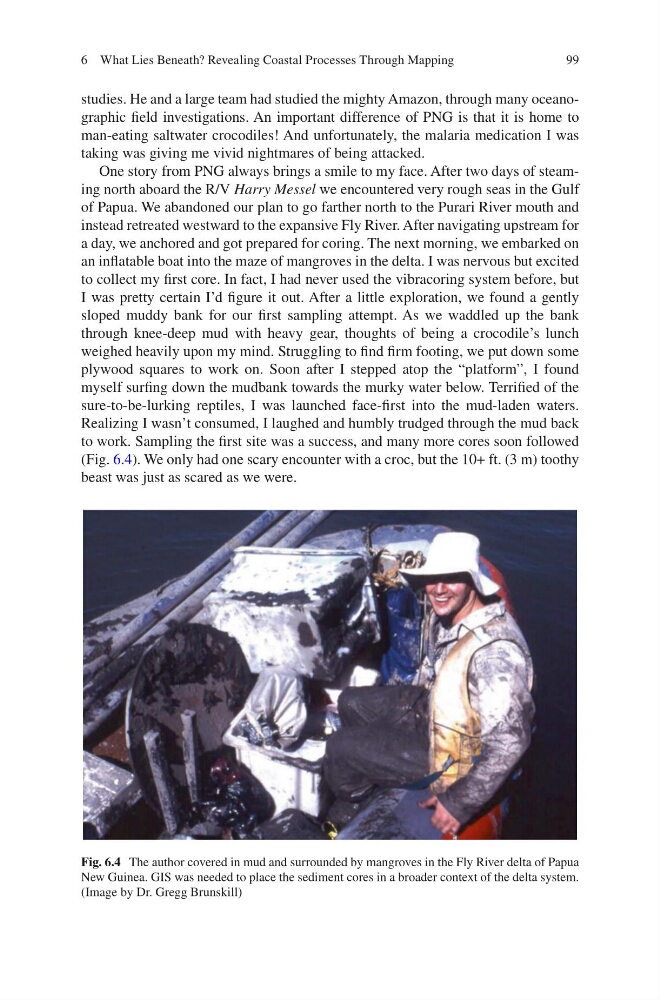
to work. Sampling the first site was a success, and many more cores soon followed
(Fig. 6.4). We only had one scary encounter with a croc, but the 10+ ft. (3 m) toothy
beast was just as scared as we were.
Fig. 6.4 The author covered in mud and surrounded by mangroves in the Fly River delta of Papua
New Guinea. GIS was needed to place the sediment cores in a broader context of the delta system.
(Image by Dr. Gregg Brunskill)
6 What Lies Beneath? Revealing Coastal Processes Through Mapping
studies. He and a large team had studied the mighty Amazon, through many oceanographic field investigations. An important difference of PNG is that it is home to
man-eating saltwater crocodiles! And unfortunately, the malaria medication I was
taking was giving me vivid nightmares of being attacked.
One story from PNG always brings a smile to my face. After two days of steaming north aboard the R/V Harry Messel we encountered very rough seas in the Gulf
of Papua. We abandoned our plan to go farther north to the Purari River mouth and
instead retreated westward to the expansive Fly River. After navigating upstream for
a day, we anchored and got prepared for coring. The next morning, we embarked on
an inflatable boat into the maze of mangroves in the delta. I was nervous but excited
to collect my first core. In fact, I had never used the vibracoring system before, but
I was pretty certain I’d figure it out. After a little exploration, we found a gently
sloped muddy bank for our first sampling attempt. As we waddled up the bank
through knee-deep mud with heavy gear, thoughts of being a crocodile’s lunch
weighed heavily upon my mind. Struggling to find firm footing, we put down some
plywood squares to work on. Soon after I stepped atop the “platform”, I found
myself surfing down the mudbank towards the murky water below. Terrified of the
sure-to-be-lurking reptiles, I was launched face-first into the mud-laden waters.
Realizing I wasn’t consumed, I laughed and humbly trudged through the mud back
to work. Sampling the first site was a success, and many more cores soon followed
(Fig. 6.4). We only had one scary encounter with a croc, but the 10+ ft. (3 m) toothy
beast was just as scared as we were.
Fig. 6.4 The author covered in mud and surrounded by mangroves in the Fly River delta of Papua
New Guinea. GIS was needed to place the sediment cores in a broader context of the delta system.
(Image by Dr. Gregg Brunskill)
6 What Lies Beneath? Revealing Coastal Processes Through Mapping