

89
locations interpreted by previous researchers as evidence of pre-Holocene high sea
level proved to me that they had been misinterpreted and were thus invalid. Some of
the highest elevation sites, previously interpreted as evidence of high sea level,
turned out to be archeological shell middens where early people had processed seafood under rock shelters or on what would have once been islands.
In Borneo, I had surveyed the coastal zone and islands from Tanjung Datu, at the
extreme western end of Sarawak, to Tawau, at the southeast corner of Sabah
(Fig. 5.3). In the more tectonically active region, northeast of Sarawak’s Lupar
River, the paleo-sea-level record is complex and variable. From northern Sarawak to
southern Sabah, there is strong evidence for uplift extending into the Holocene. One
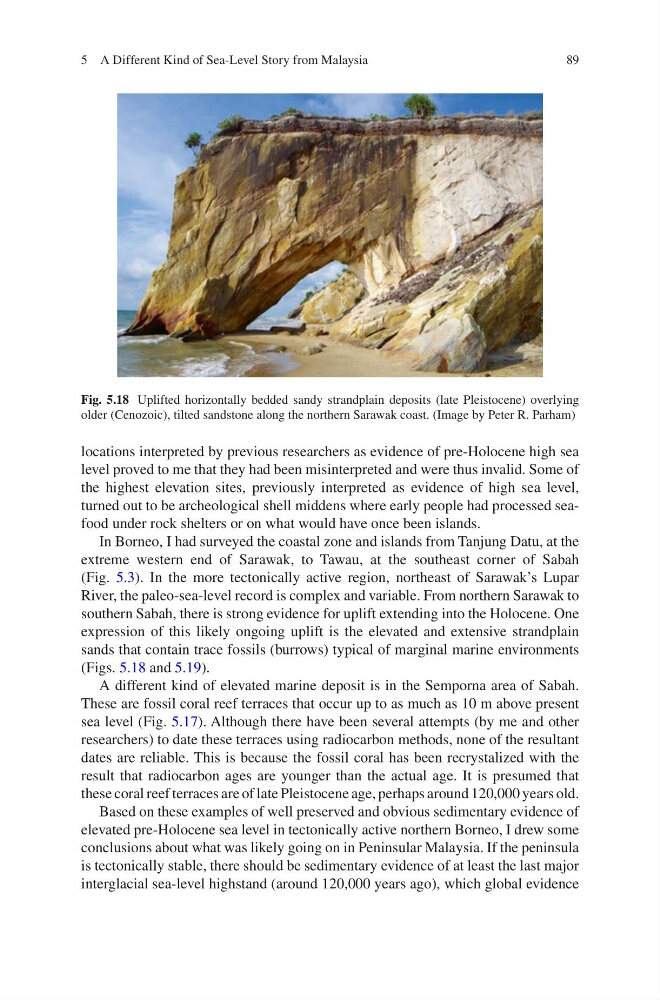
expression of this likely ongoing uplift is the elevated and extensive strandplain
sands that contain trace fossils (burrows) typical of marginal marine environments
(Figs. 5.18 and 5.19).
A different kind of elevated marine deposit is in the Semporna area of Sabah.
These are fossil coral reef terraces that occur up to as much as 10 m above present
sea level (Fig. 5.17). Although there have been several attempts (by me and other
researchers) to date these terraces using radiocarbon methods, none of the resultant
dates are reliable. This is because the fossil coral has been recrystalized with the
result that radiocarbon ages are younger than the actual age. It is presumed that
these coral reef terraces are of late Pleistocene age, perhaps around 120,000 years old.
Based on these examples of well preserved and obvious sedimentary evidence of
elevated pre-Holocene sea level in tectonically active northern Borneo, I drew some
conclusions about what was likely going on in Peninsular Malaysia. If the peninsula
is tectonically stable, there should be sedimentary evidence of at least the last major
interglacial sea-level highstand (around 120,000 years ago), which global evidence
Fig. 5.18 Uplifted horizontally bedded sandy strandplain deposits (late Pleistocene) overlying
older (Cenozoic), tilted sandstone along the northern Sarawak coast. (Image by Peter R. Parham)
5 A Different Kind of Sea-Level Story from Malaysia
locations interpreted by previous researchers as evidence of pre-Holocene high sea
level proved to me that they had been misinterpreted and were thus invalid. Some of
the highest elevation sites, previously interpreted as evidence of high sea level,
turned out to be archeological shell middens where early people had processed seafood under rock shelters or on what would have once been islands.
In Borneo, I had surveyed the coastal zone and islands from Tanjung Datu, at the
extreme western end of Sarawak, to Tawau, at the southeast corner of Sabah
(Fig. 5.3). In the more tectonically active region, northeast of Sarawak’s Lupar
River, the paleo-sea-level record is complex and variable. From northern Sarawak to
southern Sabah, there is strong evidence for uplift extending into the Holocene. One
expression of this likely ongoing uplift is the elevated and extensive strandplain
sands that contain trace fossils (burrows) typical of marginal marine environments
(Figs. 5.18 and 5.19).
A different kind of elevated marine deposit is in the Semporna area of Sabah.
These are fossil coral reef terraces that occur up to as much as 10 m above present
sea level (Fig. 5.17). Although there have been several attempts (by me and other
researchers) to date these terraces using radiocarbon methods, none of the resultant
dates are reliable. This is because the fossil coral has been recrystalized with the
result that radiocarbon ages are younger than the actual age. It is presumed that
these coral reef terraces are of late Pleistocene age, perhaps around 120,000 years old.
Based on these examples of well preserved and obvious sedimentary evidence of
elevated pre-Holocene sea level in tectonically active northern Borneo, I drew some
conclusions about what was likely going on in Peninsular Malaysia. If the peninsula
is tectonically stable, there should be sedimentary evidence of at least the last major
interglacial sea-level highstand (around 120,000 years ago), which global evidence
Fig. 5.18 Uplifted horizontally bedded sandy strandplain deposits (late Pleistocene) overlying
older (Cenozoic), tilted sandstone along the northern Sarawak coast. (Image by Peter R. Parham)
5 A Different Kind of Sea-Level Story from Malaysia