

88
a speedboat with guys in camouflage, black watch caps and submachine guns.
Thankfully, they were a special unit of the marine police. After investigating my
boatman, finding out what I was doing, and checking my permits, they invited me
on board so that they could all take selfies with me. We parted the best of friends.
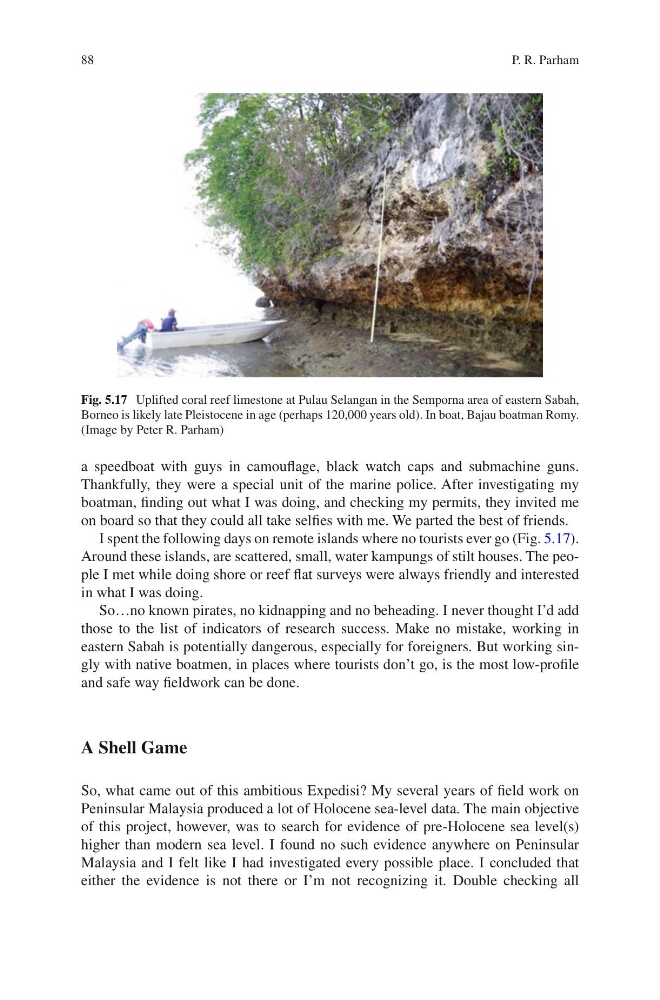
I spent the following days on remote islands where no tourists ever go (Fig. 5.17).
Around these islands, are scattered, small, water kampungs of stilt houses. The people I met while doing shore or reef flat surveys were always friendly and interested
in what I was doing.
So…no known pirates, no kidnapping and no beheading. I never thought I’d add
those to the list of indicators of research success. Make no mistake, working in
eastern Sabah is potentially dangerous, especially for foreigners. But working singly with native boatmen, in places where tourists don’t go, is the most low-profile
and safe way fieldwork can be done.
A Shell Game
So, what came out of this ambitious Expedisi? My several years of field work on
Peninsular Malaysia produced a lot of Holocene sea-level data. The main objective
of this project, however, was to search for evidence of pre-Holocene sea level(s)
higher than modern sea level. I found no such evidence anywhere on Peninsular
Malaysia and I felt like I had investigated every possible place. I concluded that
either the evidence is not there or I’m not recognizing it. Double checking all
Fig. 5.17 Uplifted coral reef limestone at Pulau Selangan in the Semporna area of eastern Sabah,
Borneo is likely late Pleistocene in age (perhaps 120,000 years old). In boat, Bajau boatman Romy.
(Image by Peter R. Parham)
P. R. Parham
a speedboat with guys in camouflage, black watch caps and submachine guns.
Thankfully, they were a special unit of the marine police. After investigating my
boatman, finding out what I was doing, and checking my permits, they invited me
on board so that they could all take selfies with me. We parted the best of friends.
I spent the following days on remote islands where no tourists ever go (Fig. 5.17).
Around these islands, are scattered, small, water kampungs of stilt houses. The people I met while doing shore or reef flat surveys were always friendly and interested
in what I was doing.
So…no known pirates, no kidnapping and no beheading. I never thought I’d add
those to the list of indicators of research success. Make no mistake, working in
eastern Sabah is potentially dangerous, especially for foreigners. But working singly with native boatmen, in places where tourists don’t go, is the most low-profile
and safe way fieldwork can be done.
A Shell Game
So, what came out of this ambitious Expedisi? My several years of field work on
Peninsular Malaysia produced a lot of Holocene sea-level data. The main objective
of this project, however, was to search for evidence of pre-Holocene sea level(s)
higher than modern sea level. I found no such evidence anywhere on Peninsular
Malaysia and I felt like I had investigated every possible place. I concluded that
either the evidence is not there or I’m not recognizing it. Double checking all
Fig. 5.17 Uplifted coral reef limestone at Pulau Selangan in the Semporna area of eastern Sabah,
Borneo is likely late Pleistocene in age (perhaps 120,000 years old). In boat, Bajau boatman Romy.
(Image by Peter R. Parham)
P. R. Parham