

behind the machine, causing mixing and disruption of firm
soil material as it falls. Diggers can work systematically, and
surprisingly quickly, across a landscape.
Flipping is practised in a range of New Zealand soils
particularly to transform marginal land into profitable dairy
production in Westland, and to improve summer pasture
production in parts of the central North Island. In the Gley
Soils and Perch-gley Podzols of the Westland region flipping
has been used to disrupt profile drainage impediments,
and/or to bury infertile surface horizons.
In the central North Island, on dairy farms near Murupara,
flipping has been used to raise fine-grained, clay- and
organic-bearing buried soil horizons on mid- to
late-Holocene tephra deposits closer to the surface and to
relocate the near-surface, coarse-grained, pumice-rich,
tephra layers deeper into the profile. The resulting ‘inverted’
soil profile may comprise chunks of materials from
throughout the original soil all mixed together (Fig. 3.1). At
some sites desirable clayey buried soil horizons (especially
that formed on the Whakatane tephra, c. 5500 years old) are
kept separate and placed at the soil surface, with the less
desirable coarse soil materials buried below. Either way, the
resultant soil has a higher-water holding capacity and greater
potential root depth than the original droughty, pumice-rich
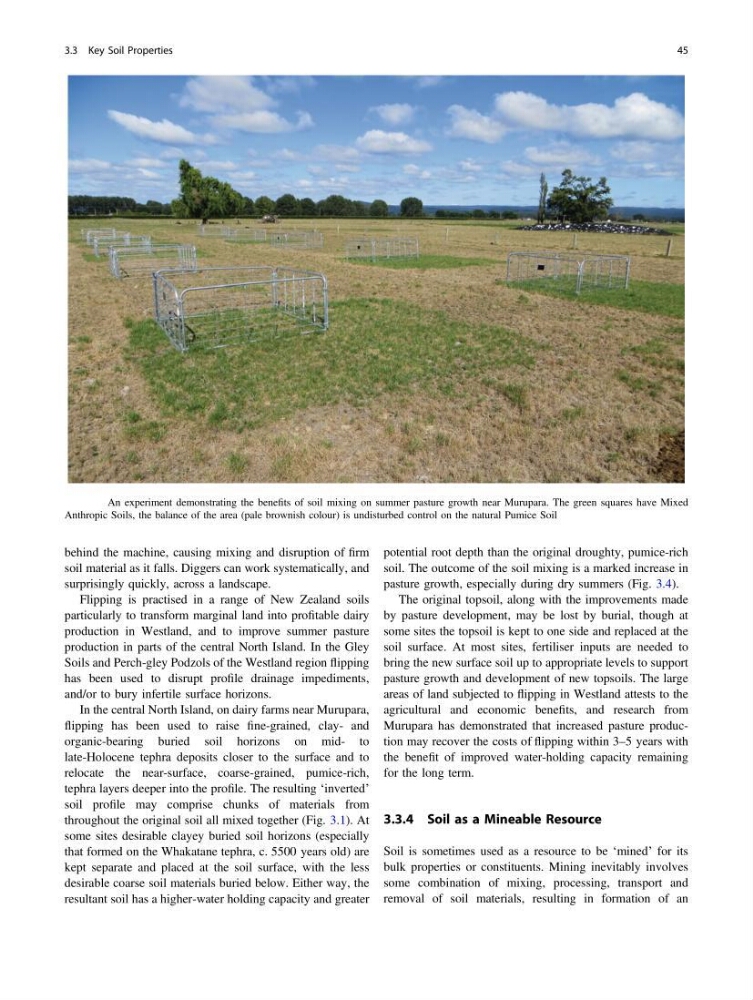
soil. The outcome of the soil mixing is a marked increase in
pasture growth, especially during dry summers (Fig. 3.4).
The original topsoil, along with the improvements made
by pasture development, may be lost by burial, though at
some sites the topsoil is kept to one side and replaced at the
soil surface. At most sites, fertiliser inputs are needed to
bring the new surface soil up to appropriate levels to support
pasture growth and development of new topsoils. The large
areas of land subjected to flipping in Westland attests to the
agricultural and economic benefits, and research from
Murupara has demonstrated that increased pasture production may recover the costs of flipping within 3–5 years with
the benefit of improved water-holding capacity remaining
for the long term.
3.3.4 Soil as a Mineable Resource
Soil is sometimes used as a resource to be ‘mined’ for its
bulk properties or constituents. Mining inevitably involves
some combination of mixing, processing, transport and
removal of soil materials, resulting in formation of an
Fig. 3.4 An experiment demonstrating the benefits of soil mixing on summer pasture growth near Murupara. The green squares have Mixed
Anthropic Soils, the balance of the area (pale brownish colour) is undisturbed control on the natural Pumice Soil
3.3 Key Soil Properties
45
soil material as it falls. Diggers can work systematically, and
surprisingly quickly, across a landscape.
Flipping is practised in a range of New Zealand soils
particularly to transform marginal land into profitable dairy
production in Westland, and to improve summer pasture
production in parts of the central North Island. In the Gley
Soils and Perch-gley Podzols of the Westland region flipping
has been used to disrupt profile drainage impediments,
and/or to bury infertile surface horizons.
In the central North Island, on dairy farms near Murupara,
flipping has been used to raise fine-grained, clay- and
organic-bearing buried soil horizons on mid- to
late-Holocene tephra deposits closer to the surface and to
relocate the near-surface, coarse-grained, pumice-rich,
tephra layers deeper into the profile. The resulting ‘inverted’
soil profile may comprise chunks of materials from
throughout the original soil all mixed together (Fig. 3.1). At
some sites desirable clayey buried soil horizons (especially
that formed on the Whakatane tephra, c. 5500 years old) are
kept separate and placed at the soil surface, with the less
desirable coarse soil materials buried below. Either way, the
resultant soil has a higher-water holding capacity and greater
potential root depth than the original droughty, pumice-rich
soil. The outcome of the soil mixing is a marked increase in
pasture growth, especially during dry summers (Fig. 3.4).
The original topsoil, along with the improvements made
by pasture development, may be lost by burial, though at
some sites the topsoil is kept to one side and replaced at the
soil surface. At most sites, fertiliser inputs are needed to
bring the new surface soil up to appropriate levels to support
pasture growth and development of new topsoils. The large
areas of land subjected to flipping in Westland attests to the
agricultural and economic benefits, and research from
Murupara has demonstrated that increased pasture production may recover the costs of flipping within 3–5 years with
the benefit of improved water-holding capacity remaining
for the long term.
3.3.4 Soil as a Mineable Resource
Soil is sometimes used as a resource to be ‘mined’ for its
bulk properties or constituents. Mining inevitably involves
some combination of mixing, processing, transport and
removal of soil materials, resulting in formation of an
Fig. 3.4 An experiment demonstrating the benefits of soil mixing on summer pasture growth near Murupara. The green squares have Mixed
Anthropic Soils, the balance of the area (pale brownish colour) is undisturbed control on the natural Pumice Soil
3.3 Key Soil Properties
45