

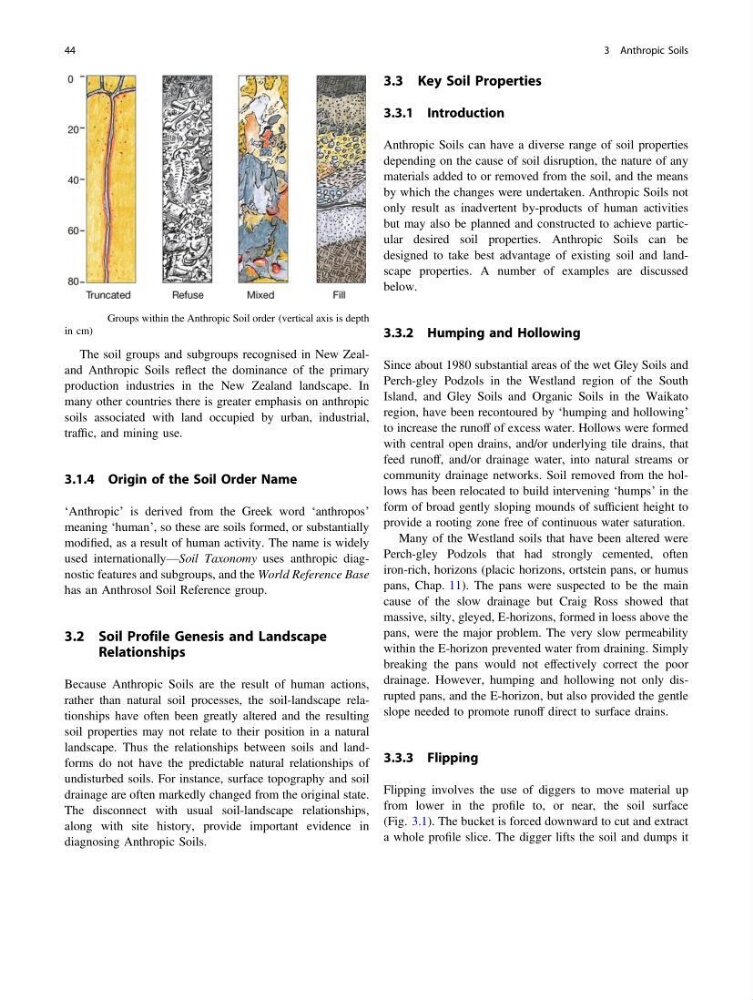
The soil groups and subgroups recognised in New Zealand Anthropic Soils reflect the dominance of the primary
production industries in the New Zealand landscape. In
many other countries there is greater emphasis on anthropic
soils associated with land occupied by urban, industrial,
traffic, and mining use.
3.1.4 Origin of the Soil Order Name
‘Anthropic’ is derived from the Greek word ‘anthropos’
meaning ‘human’, so these are soils formed, or substantially
modified, as a result of human activity. The name is widely
used internationally—Soil Taxonomy uses anthropic diagnostic features and subgroups, and the World Reference Base
has an Anthrosol Soil Reference group.
3.2 Soil Profile Genesis and Landscape
Relationships
Because Anthropic Soils are the result of human actions,
rather than natural soil processes, the soil-landscape relationships have often been greatly altered and the resulting
soil properties may not relate to their position in a natural
landscape. Thus the relationships between soils and landforms do not have the predictable natural relationships of
undisturbed soils. For instance, surface topography and soil
drainage are often markedly changed from the original state.
The disconnect with usual soil-landscape relationships,
along with site history, provide important evidence in
diagnosing Anthropic Soils.
3.3 Key Soil Properties
3.3.1 Introduction
Anthropic Soils can have a diverse range of soil properties
depending on the cause of soil disruption, the nature of any
materials added to or removed from the soil, and the means
by which the changes were undertaken. Anthropic Soils not
only result as inadvertent by-products of human activities
but may also be planned and constructed to achieve particular desired soil properties. Anthropic Soils can be
designed to take best advantage of existing soil and landscape properties. A number of examples are discussed
below.
3.3.2 Humping and Hollowing
Since about 1980 substantial areas of the wet Gley Soils and
Perch-gley Podzols in the Westland region of the South
Island, and Gley Soils and Organic Soils in the Waikato
region, have been recontoured by ‘humping and hollowing’
to increase the runoff of excess water. Hollows were formed
with central open drains, and/or underlying tile drains, that
feed runoff, and/or drainage water, into natural streams or
community drainage networks. Soil removed from the hollows has been relocated to build intervening ‘humps’ in the
form of broad gently sloping mounds of sufficient height to
provide a rooting zone free of continuous water saturation.
Many of the Westland soils that have been altered were
Perch-gley Podzols that had strongly cemented, often
iron-rich, horizons (placic horizons, ortstein pans, or humus
pans, Chap. 11). The pans were suspected to be the main
cause of the slow drainage but Craig Ross showed that
massive, silty, gleyed, E-horizons, formed in loess above the
pans, were the major problem. The very slow permeability
within the E-horizon prevented water from draining. Simply
breaking the pans would not effectively correct the poor
drainage. However, humping and hollowing not only disrupted pans, and the E-horizon, but also provided the gentle
slope needed to promote runoff direct to surface drains.
3.3.3 Flipping
Flipping involves the use of diggers to move material up
from lower in the profile to, or near, the soil surface
(Fig. 3.1). The bucket is forced downward to cut and extract
a whole profile slice. The digger lifts the soil and dumps it
Fig. 3.3 Groups within the Anthropic Soil order (vertical axis is depth
in cm)
44
3 Anthropic Soils
production industries in the New Zealand landscape. In
many other countries there is greater emphasis on anthropic
soils associated with land occupied by urban, industrial,
traffic, and mining use.
3.1.4 Origin of the Soil Order Name
‘Anthropic’ is derived from the Greek word ‘anthropos’
meaning ‘human’, so these are soils formed, or substantially
modified, as a result of human activity. The name is widely
used internationally—Soil Taxonomy uses anthropic diagnostic features and subgroups, and the World Reference Base
has an Anthrosol Soil Reference group.
3.2 Soil Profile Genesis and Landscape
Relationships
Because Anthropic Soils are the result of human actions,
rather than natural soil processes, the soil-landscape relationships have often been greatly altered and the resulting
soil properties may not relate to their position in a natural
landscape. Thus the relationships between soils and landforms do not have the predictable natural relationships of
undisturbed soils. For instance, surface topography and soil
drainage are often markedly changed from the original state.
The disconnect with usual soil-landscape relationships,
along with site history, provide important evidence in
diagnosing Anthropic Soils.
3.3 Key Soil Properties
3.3.1 Introduction
Anthropic Soils can have a diverse range of soil properties
depending on the cause of soil disruption, the nature of any
materials added to or removed from the soil, and the means
by which the changes were undertaken. Anthropic Soils not
only result as inadvertent by-products of human activities
but may also be planned and constructed to achieve particular desired soil properties. Anthropic Soils can be
designed to take best advantage of existing soil and landscape properties. A number of examples are discussed
below.
3.3.2 Humping and Hollowing
Since about 1980 substantial areas of the wet Gley Soils and
Perch-gley Podzols in the Westland region of the South
Island, and Gley Soils and Organic Soils in the Waikato
region, have been recontoured by ‘humping and hollowing’
to increase the runoff of excess water. Hollows were formed
with central open drains, and/or underlying tile drains, that
feed runoff, and/or drainage water, into natural streams or
community drainage networks. Soil removed from the hollows has been relocated to build intervening ‘humps’ in the
form of broad gently sloping mounds of sufficient height to
provide a rooting zone free of continuous water saturation.
Many of the Westland soils that have been altered were
Perch-gley Podzols that had strongly cemented, often
iron-rich, horizons (placic horizons, ortstein pans, or humus
pans, Chap. 11). The pans were suspected to be the main
cause of the slow drainage but Craig Ross showed that
massive, silty, gleyed, E-horizons, formed in loess above the
pans, were the major problem. The very slow permeability
within the E-horizon prevented water from draining. Simply
breaking the pans would not effectively correct the poor
drainage. However, humping and hollowing not only disrupted pans, and the E-horizon, but also provided the gentle
slope needed to promote runoff direct to surface drains.
3.3.3 Flipping
Flipping involves the use of diggers to move material up
from lower in the profile to, or near, the soil surface
(Fig. 3.1). The bucket is forced downward to cut and extract
a whole profile slice. The digger lifts the soil and dumps it
Fig. 3.3 Groups within the Anthropic Soil order (vertical axis is depth
in cm)
44
3 Anthropic Soils