

Gley Allophanic Soils are not common in the landscape
because usually halloysite (a crystalline aluminosilicate clay
relatively enriched in silicon) is the stable clay mineral
formed under slow drainage or wet reducing conditions. In
comparison allophane requires good drainage to form,
therefore, in poorly drained soils allophanic soil material
does not form (see Fig. 2.6).
Three subgroups recognise transitions from Allophanic
Soils to other related soil orders or soil groups: Mottled
(intergrade to Gley Soils), Peaty (to Organic Soils), and
Vitric (to Pumice Soils). Two subgroups, which depart from
the soil group, are recognised, namely Ironstone and Acidic.
The ironstone subgroup occurs where a distinct iron pan has
formed within the subsoil. Such soils occur most commonly
in Taranaki. The acidic subgroup comprises soils with
pH < 5.5 in the B-horizon. The subgroup closest to the
central concept of the group is identified as Typic.
2.1.4 Origin of the Soil Order Name
‘Allophanic’ refers to the dominance of the mineral allophane or other materials (ferrihydrite, or aluminium- or
iron-humus complexes) that impart similar properties. The
name ‘allophane’ was originally coined by mineralogists
from the Greek allos, meaning ‘other’, and phanos, meaning
‘to appear’, because of its unusual reaction to the blowpipe
flame used in early mineralogical testing.
2.2 Soil Profile Genesis
2.2.1 Soil Profile Formation
The mode of formation of most Allophanic Soils is different
from that of many other soil orders because it often comprises two processes (one geological, and one pedological)
operating at the same time:
(1) the gradual accumulation of tephra deposits, and
(2) the concurrent weathering and modification of the
accumulating tephra deposits by topdown soil-forming
processes to form soil horizons containing organic
matter, allophane, and associated minerals.
The overall process is referred to as ‘upbuilding pedogenesis’, meaning the soils are forming at the same time as
new tephra materials continue to be added to the land surface, building it upwards. The resultant soils may show
distinctive layering and buried horizons (often referred to as
paleosols), forming distinct multi-layered profiles where
successive tephra deposits are relatively thick (Fig. 2.4), or
homogenous-looking apedal earthy-fabrics where the
tephras are thin (Fig. 2.1).
In contrast, classical soil formation occurs sequentially in
two steps:
(1) a new parent material is exposed and then,
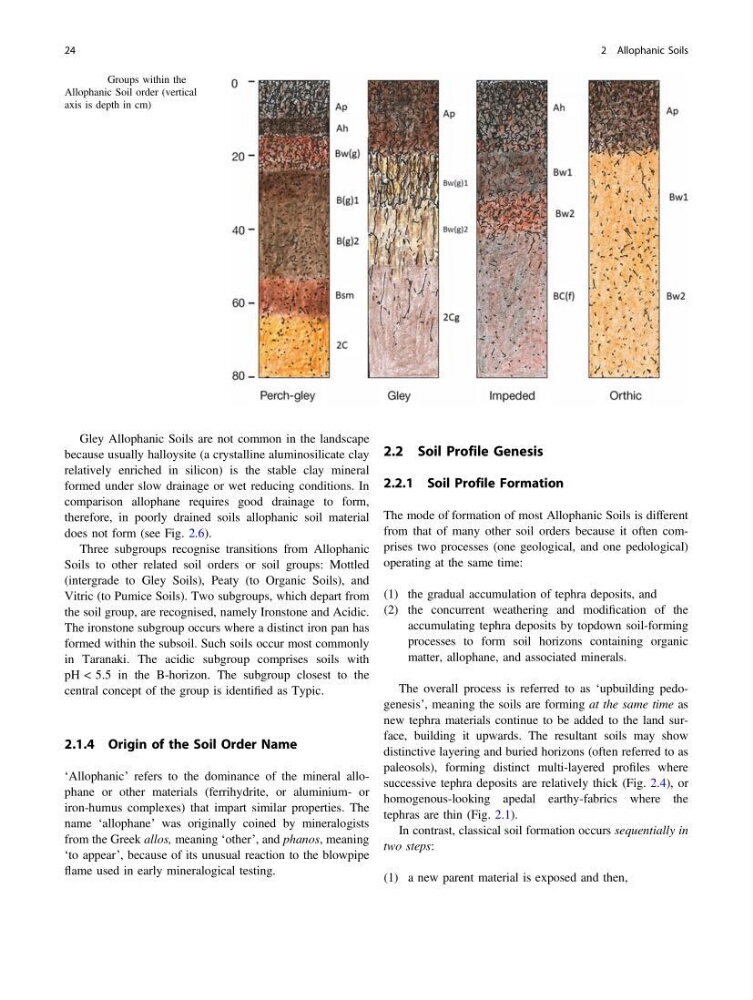
Fig. 2.3 Groups within the
Allophanic Soil order (vertical
axis is depth in cm)
24
2 Allophanic Soils
because usually halloysite (a crystalline aluminosilicate clay
relatively enriched in silicon) is the stable clay mineral
formed under slow drainage or wet reducing conditions. In
comparison allophane requires good drainage to form,
therefore, in poorly drained soils allophanic soil material
does not form (see Fig. 2.6).
Three subgroups recognise transitions from Allophanic
Soils to other related soil orders or soil groups: Mottled
(intergrade to Gley Soils), Peaty (to Organic Soils), and
Vitric (to Pumice Soils). Two subgroups, which depart from
the soil group, are recognised, namely Ironstone and Acidic.
The ironstone subgroup occurs where a distinct iron pan has
formed within the subsoil. Such soils occur most commonly
in Taranaki. The acidic subgroup comprises soils with
pH < 5.5 in the B-horizon. The subgroup closest to the
central concept of the group is identified as Typic.
2.1.4 Origin of the Soil Order Name
‘Allophanic’ refers to the dominance of the mineral allophane or other materials (ferrihydrite, or aluminium- or
iron-humus complexes) that impart similar properties. The
name ‘allophane’ was originally coined by mineralogists
from the Greek allos, meaning ‘other’, and phanos, meaning
‘to appear’, because of its unusual reaction to the blowpipe
flame used in early mineralogical testing.
2.2 Soil Profile Genesis
2.2.1 Soil Profile Formation
The mode of formation of most Allophanic Soils is different
from that of many other soil orders because it often comprises two processes (one geological, and one pedological)
operating at the same time:
(1) the gradual accumulation of tephra deposits, and
(2) the concurrent weathering and modification of the
accumulating tephra deposits by topdown soil-forming
processes to form soil horizons containing organic
matter, allophane, and associated minerals.
The overall process is referred to as ‘upbuilding pedogenesis’, meaning the soils are forming at the same time as
new tephra materials continue to be added to the land surface, building it upwards. The resultant soils may show
distinctive layering and buried horizons (often referred to as
paleosols), forming distinct multi-layered profiles where
successive tephra deposits are relatively thick (Fig. 2.4), or
homogenous-looking apedal earthy-fabrics where the
tephras are thin (Fig. 2.1).
In contrast, classical soil formation occurs sequentially in
two steps:
(1) a new parent material is exposed and then,
Fig. 2.3 Groups within the
Allophanic Soil order (vertical
axis is depth in cm)
24
2 Allophanic Soils