

Some allophane-bearing soils occur in the South Island
associated with Allophanic Brown Soils, and many Podzol
Soils, contain allophane formed by translocation of
proto-imogolite sols in the podzolization process involving
acid leaching (see Chap. 11). Most South Island soils have
no (or only tiny amounts) of tephra (from North Island
volcanoes), and the allophanic soil materials are formed
instead through the weathering of mainly quartzofeldspathic
minerals (such as in loess or greywacke) and strong leaching
of the soluble products under high rainfall, the loss of silicon
(desilication) and associated concentration of aluminium
being the key process favouring the formation of allophane.
Neverthless, the distal, Taupo-volcano-derived Kawakawa/
Oruanui Tephra, aged c. 25,400 years old, is an important
and widespread but diminutive deposit in South Island. The
Kawakawa/Oruanui Tephra is present as a thin visible layer
in peat deposits in northern South Island but elsewhere it
occurs mainly as a cryptotephra (‘hidden tephra’, a sparse
glass-shard concentration not visible to the naked eye)
including as far south as Otago and Southland.
2.1.3 Variation Within the Allophanic Soil Order
The following soil groups are defined in the New Zealand
Soil Classification (Fig. 2.3):
Perch-gley Allophanic Soils—periodic wetness (usually
marked by redox mottling or low chroma colours in the
upper subsoil only) caused by water perching on a slowly
permeable horizon (such as an ironstone-pan),
Gley Allophanic Soils—periodic wetness (usually marked
by redox mottling or low chroma colours) caused by a
groundwater table,
Impeded Allophanic Soils—have a slowly impermeable
layer that may impede downwards movement of plant roots
and water (within 90 cm of soil surface),
Orthic Allophanic Soils—Other Allophanic Soils.
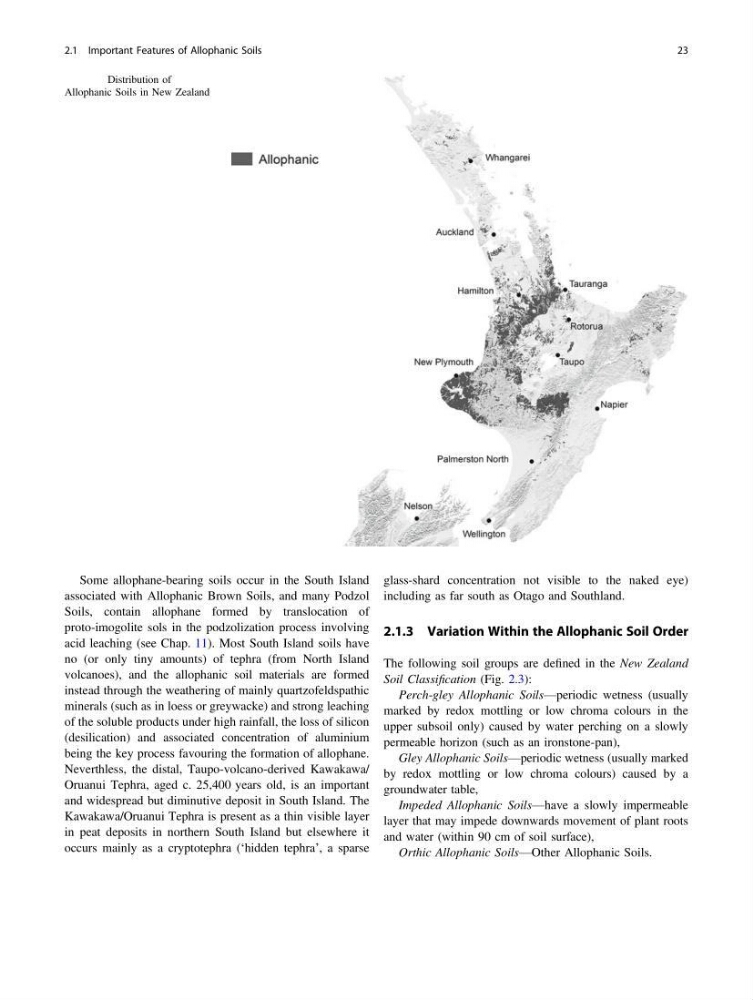
Fig. 2.2 Distribution of
Allophanic Soils in New Zealand
2.1 Important Features of Allophanic Soils
23
associated with Allophanic Brown Soils, and many Podzol
Soils, contain allophane formed by translocation of
proto-imogolite sols in the podzolization process involving
acid leaching (see Chap. 11). Most South Island soils have
no (or only tiny amounts) of tephra (from North Island
volcanoes), and the allophanic soil materials are formed
instead through the weathering of mainly quartzofeldspathic
minerals (such as in loess or greywacke) and strong leaching
of the soluble products under high rainfall, the loss of silicon
(desilication) and associated concentration of aluminium
being the key process favouring the formation of allophane.
Neverthless, the distal, Taupo-volcano-derived Kawakawa/
Oruanui Tephra, aged c. 25,400 years old, is an important
and widespread but diminutive deposit in South Island. The
Kawakawa/Oruanui Tephra is present as a thin visible layer
in peat deposits in northern South Island but elsewhere it
occurs mainly as a cryptotephra (‘hidden tephra’, a sparse
glass-shard concentration not visible to the naked eye)
including as far south as Otago and Southland.
2.1.3 Variation Within the Allophanic Soil Order
The following soil groups are defined in the New Zealand
Soil Classification (Fig. 2.3):
Perch-gley Allophanic Soils—periodic wetness (usually
marked by redox mottling or low chroma colours in the
upper subsoil only) caused by water perching on a slowly
permeable horizon (such as an ironstone-pan),
Gley Allophanic Soils—periodic wetness (usually marked
by redox mottling or low chroma colours) caused by a
groundwater table,
Impeded Allophanic Soils—have a slowly impermeable
layer that may impede downwards movement of plant roots
and water (within 90 cm of soil surface),
Orthic Allophanic Soils—Other Allophanic Soils.
Fig. 2.2 Distribution of
Allophanic Soils in New Zealand
2.1 Important Features of Allophanic Soils
23