

also provide the incremental accumulation of loess (upbuilding pedogenic conditions) to generate two-storeyed
soils, that comprise a Podzol Soil on alluvium, with effectively a Gley Soil in loess overlying it.
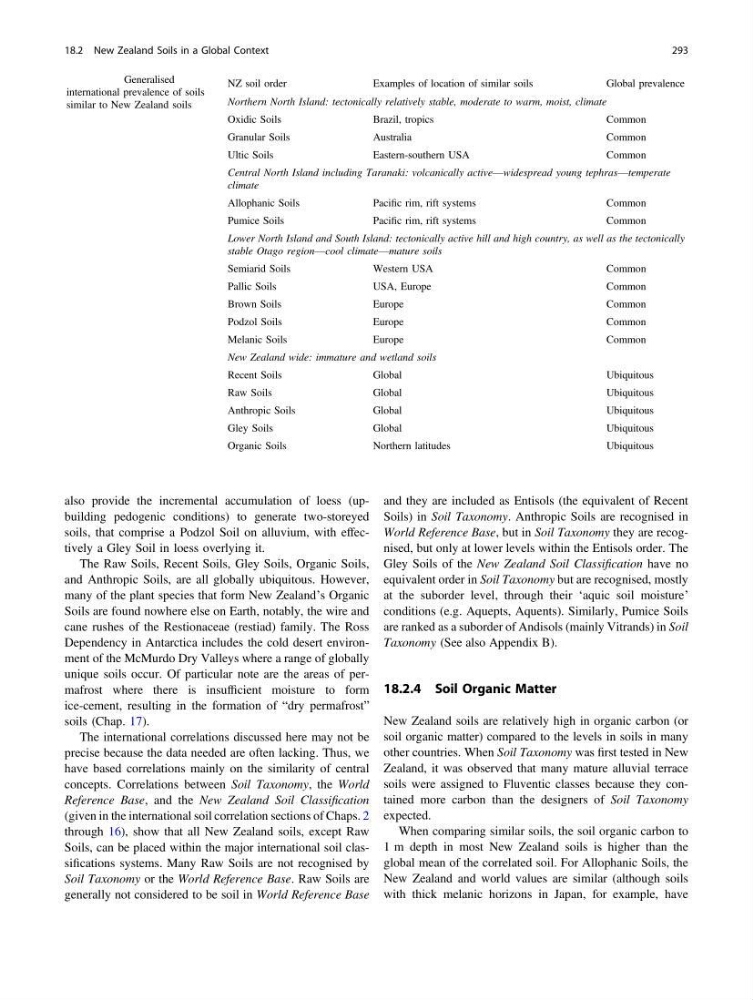
The Raw Soils, Recent Soils, Gley Soils, Organic Soils,
and Anthropic Soils, are all globally ubiquitous. However,
many of the plant species that form New Zealand’s Organic
Soils are found nowhere else on Earth, notably, the wire and
cane rushes of the Restionaceae (restiad) family. The Ross
Dependency in Antarctica includes the cold desert environment of the McMurdo Dry Valleys where a range of globally
unique soils occur. Of particular note are the areas of permafrost where there is insufficient moisture to form
ice-cement, resulting in the formation of “dry permafrost”
soils (Chap. 17).
The international correlations discussed here may not be
precise because the data needed are often lacking. Thus, we
have based correlations mainly on the similarity of central
concepts. Correlations between Soil Taxonomy, the World
Reference Base, and the New Zealand Soil Classification
(given in the international soil correlation sections of Chaps. 2
through 16), show that all New Zealand soils, except Raw
Soils, can be placed within the major international soil classifications systems. Many Raw Soils are not recognised by
Soil Taxonomy or the World Reference Base. Raw Soils are
generally not considered to be soil in World Reference Base
and they are included as Entisols (the equivalent of Recent
Soils) in Soil Taxonomy. Anthropic Soils are recognised in
World Reference Base, but in Soil Taxonomy they are recognised, but only at lower levels within the Entisols order. The
Gley Soils of the New Zealand Soil Classification have no
equivalent order in Soil Taxonomy but are recognised, mostly
at the suborder level, through their ‘aquic soil moisture’
conditions (e.g. Aquepts, Aquents). Similarly, Pumice Soils
are ranked as a suborder of Andisols (mainly Vitrands) in Soil
Taxonomy (See also Appendix B).
18.2.4 Soil Organic Matter
New Zealand soils are relatively high in organic carbon (or
soil organic matter) compared to the levels in soils in many
other countries. When Soil Taxonomy was first tested in New
Zealand, it was observed that many mature alluvial terrace
soils were assigned to Fluventic classes because they contained more carbon than the designers of Soil Taxonomy
expected.
When comparing similar soils, the soil organic carbon to
1 m depth in most New Zealand soils is higher than the
global mean of the correlated soil. For Allophanic Soils, the
New Zealand and world values are similar (although soils
with thick melanic horizons in Japan, for example, have
Table 18.2 Generalised
international prevalence of soils
similar to New Zealand soils
NZ soil order
Examples of location of similar soils
Global prevalence
Northern North Island: tectonically relatively stable, moderate to warm, moist, climate
Oxidic Soils
Brazil, tropics
Common
Granular Soils
Australia
Common
Ultic Soils
Eastern-southern USA
Common
Central North Island including Taranaki: volcanically active—widespread young tephras—temperate
climate
Allophanic Soils
Pacific rim, rift systems
Common
Pumice Soils
Pacific rim, rift systems
Common
Lower North Island and South Island: tectonically active hill and high country, as well as the tectonically
stable Otago region—cool climate—mature soils
Semiarid Soils
Western USA
Common
Pallic Soils
USA, Europe
Common
Brown Soils
Europe
Common
Podzol Soils
Europe
Common
Melanic Soils
Europe
Common
New Zealand wide: immature and wetland soils
Recent Soils
Global
Ubiquitous
Raw Soils
Global
Ubiquitous
Anthropic Soils
Global
Ubiquitous
Gley Soils
Global
Ubiquitous
Organic Soils
Northern latitudes
Ubiquitous
18.2 New Zealand Soils in a Global Context
293
soils, that comprise a Podzol Soil on alluvium, with effectively a Gley Soil in loess overlying it.
The Raw Soils, Recent Soils, Gley Soils, Organic Soils,
and Anthropic Soils, are all globally ubiquitous. However,
many of the plant species that form New Zealand’s Organic
Soils are found nowhere else on Earth, notably, the wire and
cane rushes of the Restionaceae (restiad) family. The Ross
Dependency in Antarctica includes the cold desert environment of the McMurdo Dry Valleys where a range of globally
unique soils occur. Of particular note are the areas of permafrost where there is insufficient moisture to form
ice-cement, resulting in the formation of “dry permafrost”
soils (Chap. 17).
The international correlations discussed here may not be
precise because the data needed are often lacking. Thus, we
have based correlations mainly on the similarity of central
concepts. Correlations between Soil Taxonomy, the World
Reference Base, and the New Zealand Soil Classification
(given in the international soil correlation sections of Chaps. 2
through 16), show that all New Zealand soils, except Raw
Soils, can be placed within the major international soil classifications systems. Many Raw Soils are not recognised by
Soil Taxonomy or the World Reference Base. Raw Soils are
generally not considered to be soil in World Reference Base
and they are included as Entisols (the equivalent of Recent
Soils) in Soil Taxonomy. Anthropic Soils are recognised in
World Reference Base, but in Soil Taxonomy they are recognised, but only at lower levels within the Entisols order. The
Gley Soils of the New Zealand Soil Classification have no
equivalent order in Soil Taxonomy but are recognised, mostly
at the suborder level, through their ‘aquic soil moisture’
conditions (e.g. Aquepts, Aquents). Similarly, Pumice Soils
are ranked as a suborder of Andisols (mainly Vitrands) in Soil
Taxonomy (See also Appendix B).
18.2.4 Soil Organic Matter
New Zealand soils are relatively high in organic carbon (or
soil organic matter) compared to the levels in soils in many
other countries. When Soil Taxonomy was first tested in New
Zealand, it was observed that many mature alluvial terrace
soils were assigned to Fluventic classes because they contained more carbon than the designers of Soil Taxonomy
expected.
When comparing similar soils, the soil organic carbon to
1 m depth in most New Zealand soils is higher than the
global mean of the correlated soil. For Allophanic Soils, the
New Zealand and world values are similar (although soils
with thick melanic horizons in Japan, for example, have
Table 18.2 Generalised
international prevalence of soils
similar to New Zealand soils
NZ soil order
Examples of location of similar soils
Global prevalence
Northern North Island: tectonically relatively stable, moderate to warm, moist, climate
Oxidic Soils
Brazil, tropics
Common
Granular Soils
Australia
Common
Ultic Soils
Eastern-southern USA
Common
Central North Island including Taranaki: volcanically active—widespread young tephras—temperate
climate
Allophanic Soils
Pacific rim, rift systems
Common
Pumice Soils
Pacific rim, rift systems
Common
Lower North Island and South Island: tectonically active hill and high country, as well as the tectonically
stable Otago region—cool climate—mature soils
Semiarid Soils
Western USA
Common
Pallic Soils
USA, Europe
Common
Brown Soils
Europe
Common
Podzol Soils
Europe
Common
Melanic Soils
Europe
Common
New Zealand wide: immature and wetland soils
Recent Soils
Global
Ubiquitous
Raw Soils
Global
Ubiquitous
Anthropic Soils
Global
Ubiquitous
Gley Soils
Global
Ubiquitous
Organic Soils
Northern latitudes
Ubiquitous
18.2 New Zealand Soils in a Global Context
293