

until human arrival; the nature of the (relatively restricted)
New Zealand native grassland; a lack of soil vertebrates or
native burrowing animals; and the relatively mild winters.
The Pallic Soils occur within areas on loess in Europe and
North America, but New Zealand Pallic Soils are distinctive
due to their low contents of calcium carbonate (which, in
contrast, is prevalent in the northern hemisphere loess). The
Fragic Pallic Soils, i.e. soils with a non-cemented ‘brittle’
fragipan, have been described as globally unusual.
Brown Soils are the most extensive New Zealand soil
order (43% of New Zealand’s land area). Similar soils are
also widely recognised throughout the world. However, in
New Zealand ‘argillic’ Brown Soils, with enrichment of
subsoil clay, are rare, partly because the climate (high
average rainfall) and mostly evergreen forest vegetation
promote acidification and podzolisation rather than the clay
movement and accumulation (argilliluviation) pathways that
tend to be favoured under deciduous forest.
Most of the New Zealand Podzol Soils are well represented globally. However, there are two possible peculiarities. First, experience in testing Soil Taxonomy showed that
some Podzol Soils in Northland had clay values that were
too high to allow them to be recognised as Spodosols (the
Soil Taxonomy equivalent of a podzol) despite the soils
having other podzol morphological features. Consequently,
the clay-rich Northland Podzol Soils (Wharaekohe series)
were classed as Ultisols in Soil Taxonomy, rather than
Spodosols. That podzolic features could be developed on a
slowly permeable clayey parent material highlighted the
potency of podzolising forest vegetation, notably kauri
(Agathis Australis) and rimu (Dacrydium cupressinum) in
northern New Zealand. Second, it is likely that some of the
Perch-gley Podzols, such as the Okarito series (Chap. 11),
are uncommon and possibly globally unique. Few temperate
regions can match the extreme leaching provided by the 5–
10 m year
−1 rainfall of the West Coast of South Island, and
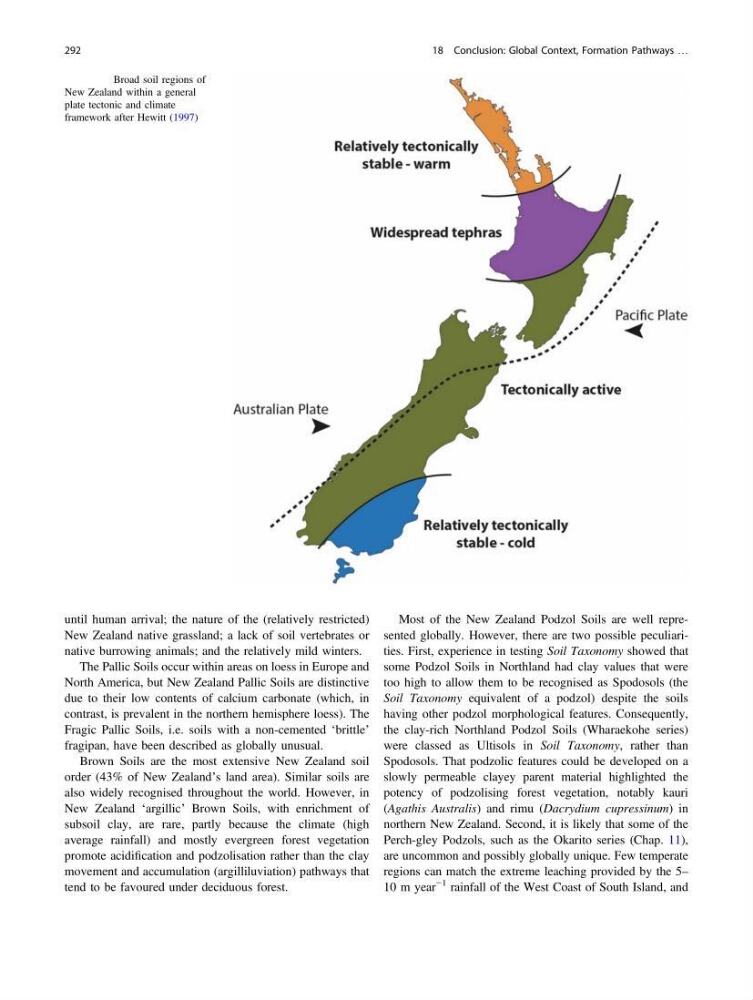
Fig. 18.1 Broad soil regions of
New Zealand within a general
plate tectonic and climate
framework after Hewitt (1997)
292
18 Conclusion: Global Context, Formation Pathways …
New Zealand native grassland; a lack of soil vertebrates or
native burrowing animals; and the relatively mild winters.
The Pallic Soils occur within areas on loess in Europe and
North America, but New Zealand Pallic Soils are distinctive
due to their low contents of calcium carbonate (which, in
contrast, is prevalent in the northern hemisphere loess). The
Fragic Pallic Soils, i.e. soils with a non-cemented ‘brittle’
fragipan, have been described as globally unusual.
Brown Soils are the most extensive New Zealand soil
order (43% of New Zealand’s land area). Similar soils are
also widely recognised throughout the world. However, in
New Zealand ‘argillic’ Brown Soils, with enrichment of
subsoil clay, are rare, partly because the climate (high
average rainfall) and mostly evergreen forest vegetation
promote acidification and podzolisation rather than the clay
movement and accumulation (argilliluviation) pathways that
tend to be favoured under deciduous forest.
Most of the New Zealand Podzol Soils are well represented globally. However, there are two possible peculiarities. First, experience in testing Soil Taxonomy showed that
some Podzol Soils in Northland had clay values that were
too high to allow them to be recognised as Spodosols (the
Soil Taxonomy equivalent of a podzol) despite the soils
having other podzol morphological features. Consequently,
the clay-rich Northland Podzol Soils (Wharaekohe series)
were classed as Ultisols in Soil Taxonomy, rather than
Spodosols. That podzolic features could be developed on a
slowly permeable clayey parent material highlighted the
potency of podzolising forest vegetation, notably kauri
(Agathis Australis) and rimu (Dacrydium cupressinum) in
northern New Zealand. Second, it is likely that some of the
Perch-gley Podzols, such as the Okarito series (Chap. 11),
are uncommon and possibly globally unique. Few temperate
regions can match the extreme leaching provided by the 5–
10 m year
−1 rainfall of the West Coast of South Island, and
Fig. 18.1 Broad soil regions of
New Zealand within a general
plate tectonic and climate
framework after Hewitt (1997)
292
18 Conclusion: Global Context, Formation Pathways …