

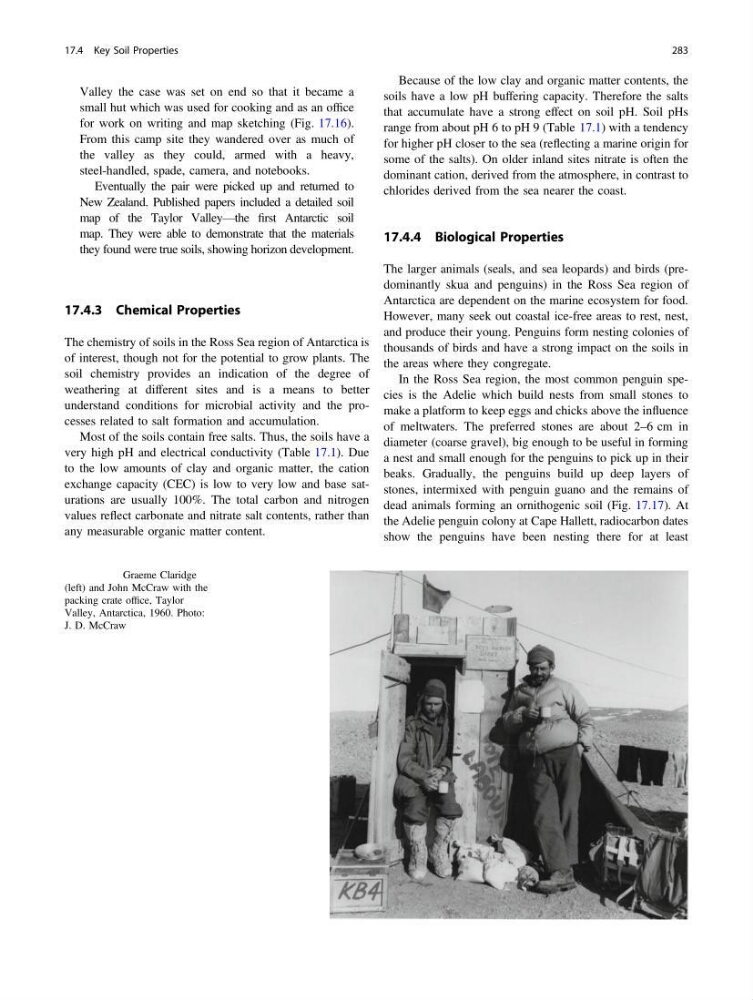
Valley the case was set on end so that it became a
small hut which was used for cooking and as an office
for work on writing and map sketching (Fig. 17.16).
From this camp site they wandered over as much of
the valley as they could, armed with a heavy,
steel-handled, spade, camera, and notebooks.
Eventually the pair were picked up and returned to
New Zealand. Published papers included a detailed soil
map of the Taylor Valley—the first Antarctic soil
map. They were able to demonstrate that the materials
they found were true soils, showing horizon development.
17.4.3 Chemical Properties
The chemistry of soils in the Ross Sea region of Antarctica is
of interest, though not for the potential to grow plants. The
soil chemistry provides an indication of the degree of
weathering at different sites and is a means to better
understand conditions for microbial activity and the processes related to salt formation and accumulation.
Most of the soils contain free salts. Thus, the soils have a
very high pH and electrical conductivity (Table 17.1). Due
to the low amounts of clay and organic matter, the cation
exchange capacity (CEC) is low to very low and base saturations are usually 100%. The total carbon and nitrogen
values reflect carbonate and nitrate salt contents, rather than
any measurable organic matter content.
Because of the low clay and organic matter contents, the
soils have a low pH buffering capacity. Therefore the salts
that accumulate have a strong effect on soil pH. Soil pHs
range from about pH 6 to pH 9 (Table 17.1) with a tendency
for higher pH closer to the sea (reflecting a marine origin for
some of the salts). On older inland sites nitrate is often the
dominant cation, derived from the atmosphere, in contrast to
chlorides derived from the sea nearer the coast.
17.4.4 Biological Properties
The larger animals (seals, and sea leopards) and birds (predominantly skua and penguins) in the Ross Sea region of
Antarctica are dependent on the marine ecosystem for food.
However, many seek out coastal ice-free areas to rest, nest,
and produce their young. Penguins form nesting colonies of
thousands of birds and have a strong impact on the soils in
the areas where they congregate.
In the Ross Sea region, the most common penguin species is the Adelie which build nests from small stones to
make a platform to keep eggs and chicks above the influence
of meltwaters. The preferred stones are about 2–6 cm in
diameter (coarse gravel), big enough to be useful in forming
a nest and small enough for the penguins to pick up in their
beaks. Gradually, the penguins build up deep layers of
stones, intermixed with penguin guano and the remains of
dead animals forming an ornithogenic soil (Fig. 17.17). At
the Adelie penguin colony at Cape Hallett, radiocarbon dates
show the penguins have been nesting there for at least
Fig. 17.16 Graeme Claridge
(left) and John McCraw with the
packing crate office, Taylor
Valley, Antarctica, 1960. Photo:
J. D. McCraw
17.4 Key Soil Properties
283
small hut which was used for cooking and as an office
for work on writing and map sketching (Fig. 17.16).
From this camp site they wandered over as much of
the valley as they could, armed with a heavy,
steel-handled, spade, camera, and notebooks.
Eventually the pair were picked up and returned to
New Zealand. Published papers included a detailed soil
map of the Taylor Valley—the first Antarctic soil
map. They were able to demonstrate that the materials
they found were true soils, showing horizon development.
17.4.3 Chemical Properties
The chemistry of soils in the Ross Sea region of Antarctica is
of interest, though not for the potential to grow plants. The
soil chemistry provides an indication of the degree of
weathering at different sites and is a means to better
understand conditions for microbial activity and the processes related to salt formation and accumulation.
Most of the soils contain free salts. Thus, the soils have a
very high pH and electrical conductivity (Table 17.1). Due
to the low amounts of clay and organic matter, the cation
exchange capacity (CEC) is low to very low and base saturations are usually 100%. The total carbon and nitrogen
values reflect carbonate and nitrate salt contents, rather than
any measurable organic matter content.
Because of the low clay and organic matter contents, the
soils have a low pH buffering capacity. Therefore the salts
that accumulate have a strong effect on soil pH. Soil pHs
range from about pH 6 to pH 9 (Table 17.1) with a tendency
for higher pH closer to the sea (reflecting a marine origin for
some of the salts). On older inland sites nitrate is often the
dominant cation, derived from the atmosphere, in contrast to
chlorides derived from the sea nearer the coast.
17.4.4 Biological Properties
The larger animals (seals, and sea leopards) and birds (predominantly skua and penguins) in the Ross Sea region of
Antarctica are dependent on the marine ecosystem for food.
However, many seek out coastal ice-free areas to rest, nest,
and produce their young. Penguins form nesting colonies of
thousands of birds and have a strong impact on the soils in
the areas where they congregate.
In the Ross Sea region, the most common penguin species is the Adelie which build nests from small stones to
make a platform to keep eggs and chicks above the influence
of meltwaters. The preferred stones are about 2–6 cm in
diameter (coarse gravel), big enough to be useful in forming
a nest and small enough for the penguins to pick up in their
beaks. Gradually, the penguins build up deep layers of
stones, intermixed with penguin guano and the remains of
dead animals forming an ornithogenic soil (Fig. 17.17). At
the Adelie penguin colony at Cape Hallett, radiocarbon dates
show the penguins have been nesting there for at least
Fig. 17.16 Graeme Claridge
(left) and John McCraw with the
packing crate office, Taylor
Valley, Antarctica, 1960. Photo:
J. D. McCraw
17.4 Key Soil Properties
283