

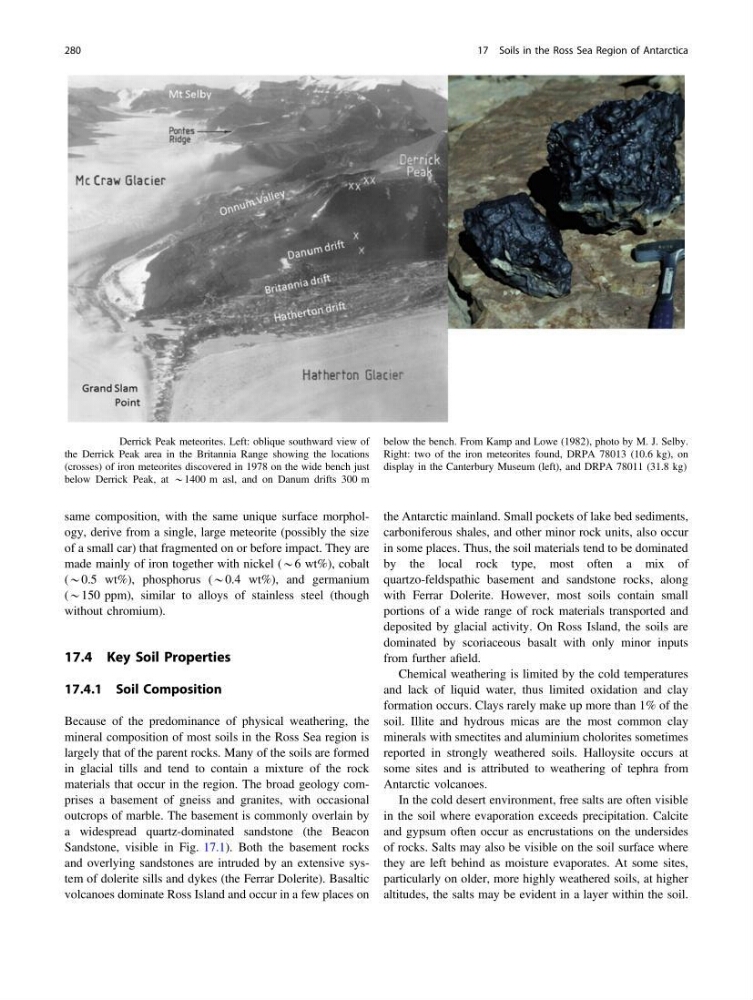
same composition, with the same unique surface morphology, derive from a single, large meteorite (possibly the size
of a small car) that fragmented on or before impact. They are
made mainly of iron together with nickel (*6 wt%), cobalt
(*0.5 wt%), phosphorus (*0.4 wt%), and germanium
(*150 ppm), similar to alloys of stainless steel (though
without chromium).
17.4 Key Soil Properties
17.4.1 Soil Composition
Because of the predominance of physical weathering, the
mineral composition of most soils in the Ross Sea region is
largely that of the parent rocks. Many of the soils are formed
in glacial tills and tend to contain a mixture of the rock
materials that occur in the region. The broad geology comprises a basement of gneiss and granites, with occasional
outcrops of marble. The basement is commonly overlain by
a widespread quartz-dominated sandstone (the Beacon
Sandstone, visible in Fig. 17.1). Both the basement rocks
and overlying sandstones are intruded by an extensive system of dolerite sills and dykes (the Ferrar Dolerite). Basaltic
volcanoes dominate Ross Island and occur in a few places on
the Antarctic mainland. Small pockets of lake bed sediments,
carboniferous shales, and other minor rock units, also occur
in some places. Thus, the soil materials tend to be dominated
by the local rock type, most often a mix of
quartzo-feldspathic basement and sandstone rocks, along
with Ferrar Dolerite. However, most soils contain small
portions of a wide range of rock materials transported and
deposited by glacial activity. On Ross Island, the soils are
dominated by scoriaceous basalt with only minor inputs
from further afield.
Chemical weathering is limited by the cold temperatures
and lack of liquid water, thus limited oxidation and clay
formation occurs. Clays rarely make up more than 1% of the
soil. Illite and hydrous micas are the most common clay
minerals with smectites and aluminium cholorites sometimes
reported in strongly weathered soils. Halloysite occurs at
some sites and is attributed to weathering of tephra from
Antarctic volcanoes.
In the cold desert environment, free salts are often visible
in the soil where evaporation exceeds precipitation. Calcite
and gypsum often occur as encrustations on the undersides
of rocks. Salts may also be visible on the soil surface where
they are left behind as moisture evaporates. At some sites,
particularly on older, more highly weathered soils, at higher
altitudes, the salts may be evident in a layer within the soil.
Fig. 17.15 Derrick Peak meteorites. Left: oblique southward view of
the Derrick Peak area in the Britannia Range showing the locations
(crosses) of iron meteorites discovered in 1978 on the wide bench just
below Derrick Peak, at *1400 m asl, and on Danum drifts 300 m
below the bench. From Kamp and Lowe (1982), photo by M. J. Selby.
Right: two of the iron meteorites found, DRPA 78013 (10.6 kg), on
display in the Canterbury Museum (left), and DRPA 78011 (31.8 kg)
280
17 Soils in the Ross Sea Region of Antarctica
of a small car) that fragmented on or before impact. They are
made mainly of iron together with nickel (*6 wt%), cobalt
(*0.5 wt%), phosphorus (*0.4 wt%), and germanium
(*150 ppm), similar to alloys of stainless steel (though
without chromium).
17.4 Key Soil Properties
17.4.1 Soil Composition
Because of the predominance of physical weathering, the
mineral composition of most soils in the Ross Sea region is
largely that of the parent rocks. Many of the soils are formed
in glacial tills and tend to contain a mixture of the rock
materials that occur in the region. The broad geology comprises a basement of gneiss and granites, with occasional
outcrops of marble. The basement is commonly overlain by
a widespread quartz-dominated sandstone (the Beacon
Sandstone, visible in Fig. 17.1). Both the basement rocks
and overlying sandstones are intruded by an extensive system of dolerite sills and dykes (the Ferrar Dolerite). Basaltic
volcanoes dominate Ross Island and occur in a few places on
the Antarctic mainland. Small pockets of lake bed sediments,
carboniferous shales, and other minor rock units, also occur
in some places. Thus, the soil materials tend to be dominated
by the local rock type, most often a mix of
quartzo-feldspathic basement and sandstone rocks, along
with Ferrar Dolerite. However, most soils contain small
portions of a wide range of rock materials transported and
deposited by glacial activity. On Ross Island, the soils are
dominated by scoriaceous basalt with only minor inputs
from further afield.
Chemical weathering is limited by the cold temperatures
and lack of liquid water, thus limited oxidation and clay
formation occurs. Clays rarely make up more than 1% of the
soil. Illite and hydrous micas are the most common clay
minerals with smectites and aluminium cholorites sometimes
reported in strongly weathered soils. Halloysite occurs at
some sites and is attributed to weathering of tephra from
Antarctic volcanoes.
In the cold desert environment, free salts are often visible
in the soil where evaporation exceeds precipitation. Calcite
and gypsum often occur as encrustations on the undersides
of rocks. Salts may also be visible on the soil surface where
they are left behind as moisture evaporates. At some sites,
particularly on older, more highly weathered soils, at higher
altitudes, the salts may be evident in a layer within the soil.
Fig. 17.15 Derrick Peak meteorites. Left: oblique southward view of
the Derrick Peak area in the Britannia Range showing the locations
(crosses) of iron meteorites discovered in 1978 on the wide bench just
below Derrick Peak, at *1400 m asl, and on Danum drifts 300 m
below the bench. From Kamp and Lowe (1982), photo by M. J. Selby.
Right: two of the iron meteorites found, DRPA 78013 (10.6 kg), on
display in the Canterbury Museum (left), and DRPA 78011 (31.8 kg)
280
17 Soils in the Ross Sea Region of Antarctica