

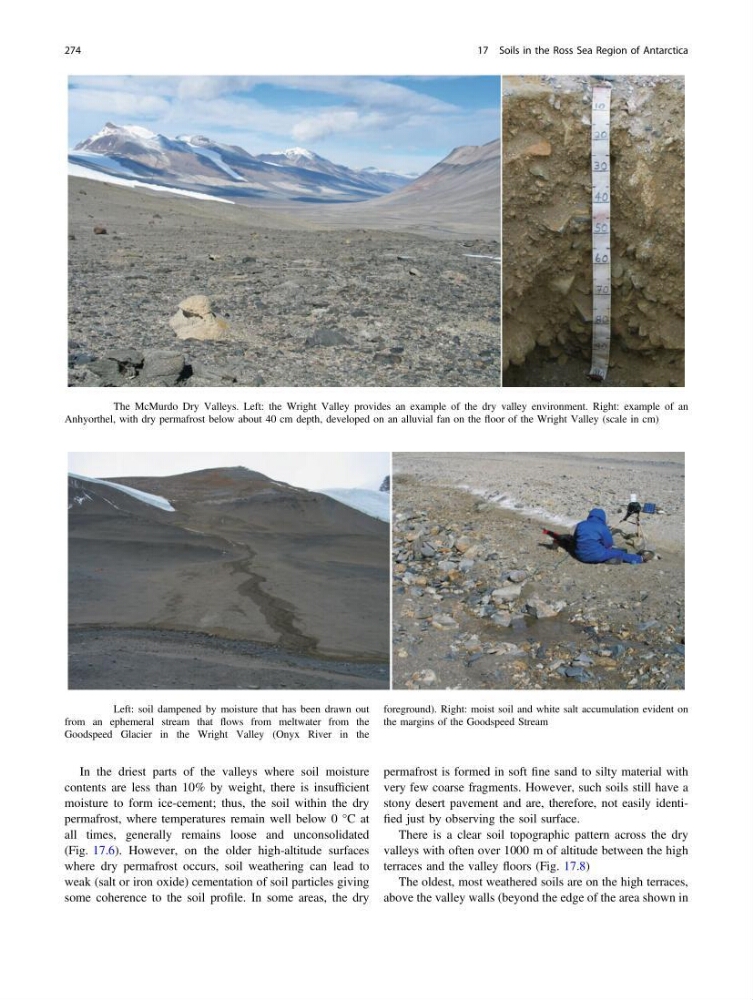
In the driest parts of the valleys where soil moisture
contents are less than 10% by weight, there is insufficient
moisture to form ice-cement; thus, the soil within the dry
permafrost, where temperatures remain well below 0 °C at
all times, generally remains loose and unconsolidated
(Fig. 17.6). However, on the older high-altitude surfaces
where dry permafrost occurs, soil weathering can lead to
weak (salt or iron oxide) cementation of soil particles giving
some coherence to the soil profile. In some areas, the dry
permafrost is formed in soft fine sand to silty material with
very few coarse fragments. However, such soils still have a
stony desert pavement and are, therefore, not easily identified just by observing the soil surface.
There is a clear soil topographic pattern across the dry
valleys with often over 1000 m of altitude between the high
terraces and the valley floors (Fig. 17.8)
The oldest, most weathered soils are on the high terraces,
above the valley walls (beyond the edge of the area shown in
Fig. 17.6 The McMurdo Dry Valleys. Left: the Wright Valley provides an example of the dry valley environment. Right: example of an
Anhyorthel, with dry permafrost below about 40 cm depth, developed on an alluvial fan on the floor of the Wright Valley (scale in cm)
Fig. 17.7 Left: soil dampened by moisture that has been drawn out
from an ephemeral stream that flows from meltwater from the
Goodspeed Glacier in the Wright Valley (Onyx River in the
foreground). Right: moist soil and white salt accumulation evident on
the margins of the Goodspeed Stream
274
17 Soils in the Ross Sea Region of Antarctica
contents are less than 10% by weight, there is insufficient
moisture to form ice-cement; thus, the soil within the dry
permafrost, where temperatures remain well below 0 °C at
all times, generally remains loose and unconsolidated
(Fig. 17.6). However, on the older high-altitude surfaces
where dry permafrost occurs, soil weathering can lead to
weak (salt or iron oxide) cementation of soil particles giving
some coherence to the soil profile. In some areas, the dry
permafrost is formed in soft fine sand to silty material with
very few coarse fragments. However, such soils still have a
stony desert pavement and are, therefore, not easily identified just by observing the soil surface.
There is a clear soil topographic pattern across the dry
valleys with often over 1000 m of altitude between the high
terraces and the valley floors (Fig. 17.8)
The oldest, most weathered soils are on the high terraces,
above the valley walls (beyond the edge of the area shown in
Fig. 17.6 The McMurdo Dry Valleys. Left: the Wright Valley provides an example of the dry valley environment. Right: example of an
Anhyorthel, with dry permafrost below about 40 cm depth, developed on an alluvial fan on the floor of the Wright Valley (scale in cm)
Fig. 17.7 Left: soil dampened by moisture that has been drawn out
from an ephemeral stream that flows from meltwater from the
Goodspeed Glacier in the Wright Valley (Onyx River in the
foreground). Right: moist soil and white salt accumulation evident on
the margins of the Goodspeed Stream
274
17 Soils in the Ross Sea Region of Antarctica