

a few sandy soils on sand dunes (Psammorthels). The soils
which form in penguin colonies with a strong influence from
bird activity are recognised as Ornithogenic soils. Erica
Hofstee suggested that the ornithogenic soils should be
recognised at the suborder level of Soil Taxonomy as an
‘Ornel’ with similar great-groups to those of the other
suborders.
If we were to apply the current New Zealand Soil Classification to Antarctic soils they would mainly key out as
Orthic Raw Soils because of their relatively minimal soil
development, although some have features pertaining to
Semiarid Soils.
17.1.4 Origin of the Soil Name
In the World Reference Base, the soils in the Ross Sea region
all classify as Cryosols. The term ‘cryo’ comes from a Greek
word jqύo (cryo), meaning ‘cold’ or frozen conditions,
along with other such terms as cryogenic.
The Soil Taxonomy term ‘gel’ is from the Latin word
‘gelare’, to freeze, that expresses the cold frozen nature of
the soils. The Gelisol order, defined by the presence of
permafrost or gelic materials (mineral or organic soil materials that show evidence of frost churning and/or ice segregation in the active layer and/or the upper part of the
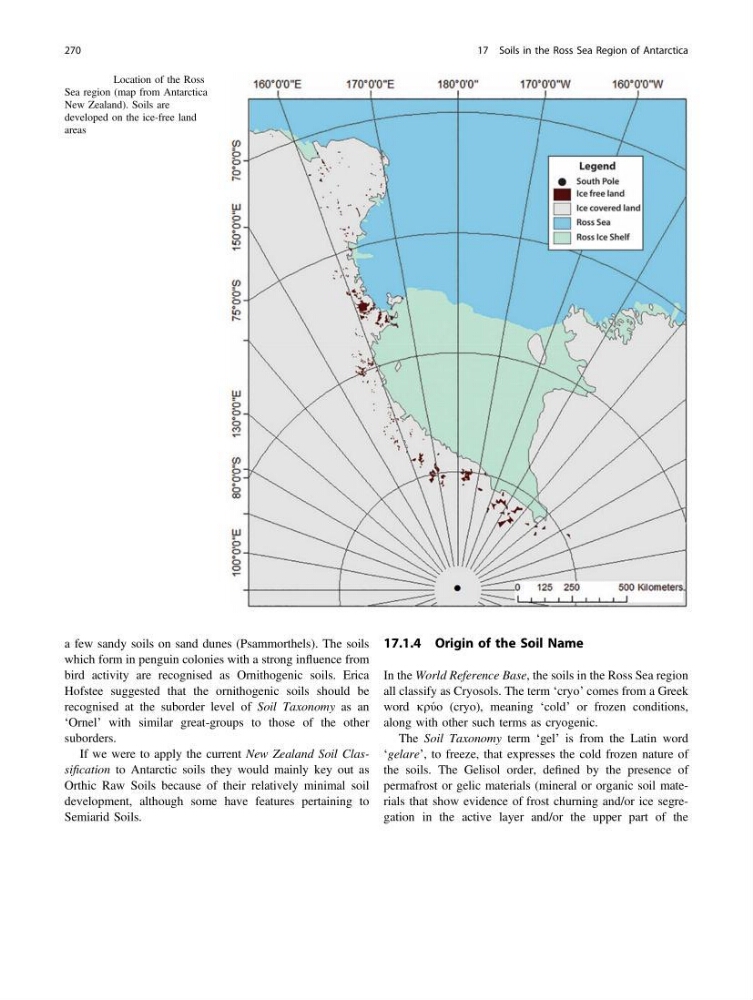
Fig. 17.3 Location of the Ross
Sea region (map from Antarctica
New Zealand). Soils are
developed on the ice-free land
areas
270
17 Soils in the Ross Sea Region of Antarctica
which form in penguin colonies with a strong influence from
bird activity are recognised as Ornithogenic soils. Erica
Hofstee suggested that the ornithogenic soils should be
recognised at the suborder level of Soil Taxonomy as an
‘Ornel’ with similar great-groups to those of the other
suborders.
If we were to apply the current New Zealand Soil Classification to Antarctic soils they would mainly key out as
Orthic Raw Soils because of their relatively minimal soil
development, although some have features pertaining to
Semiarid Soils.
17.1.4 Origin of the Soil Name
In the World Reference Base, the soils in the Ross Sea region
all classify as Cryosols. The term ‘cryo’ comes from a Greek
word jqύo (cryo), meaning ‘cold’ or frozen conditions,
along with other such terms as cryogenic.
The Soil Taxonomy term ‘gel’ is from the Latin word
‘gelare’, to freeze, that expresses the cold frozen nature of
the soils. The Gelisol order, defined by the presence of
permafrost or gelic materials (mineral or organic soil materials that show evidence of frost churning and/or ice segregation in the active layer and/or the upper part of the
Fig. 17.3 Location of the Ross
Sea region (map from Antarctica
New Zealand). Soils are
developed on the ice-free land
areas
270
17 Soils in the Ross Sea Region of Antarctica