

A simpler definition is that soil is ‘a natural, evolving,
body, formed on the land surface, which is the product of its
environment and contains mineral and organic constituents’.
This definition captures some of the key features of soil: they
are naturally occurring products of the environment and
landscape in which they form. Soils are constantly changing
as materials are added (via inputs of plant matter, animal
dung or remains, or deposits of dust, tephra, or other mineral
material), removed (by leaching, erosion, biodegradation, or
removal in crop harvests), or altered (through physical or
chemical weathering or biodegradation). Soil can be thought
of as occurring in four dimensions, the x, y, z, co-ordinates of
three-dimensional space, plus time.
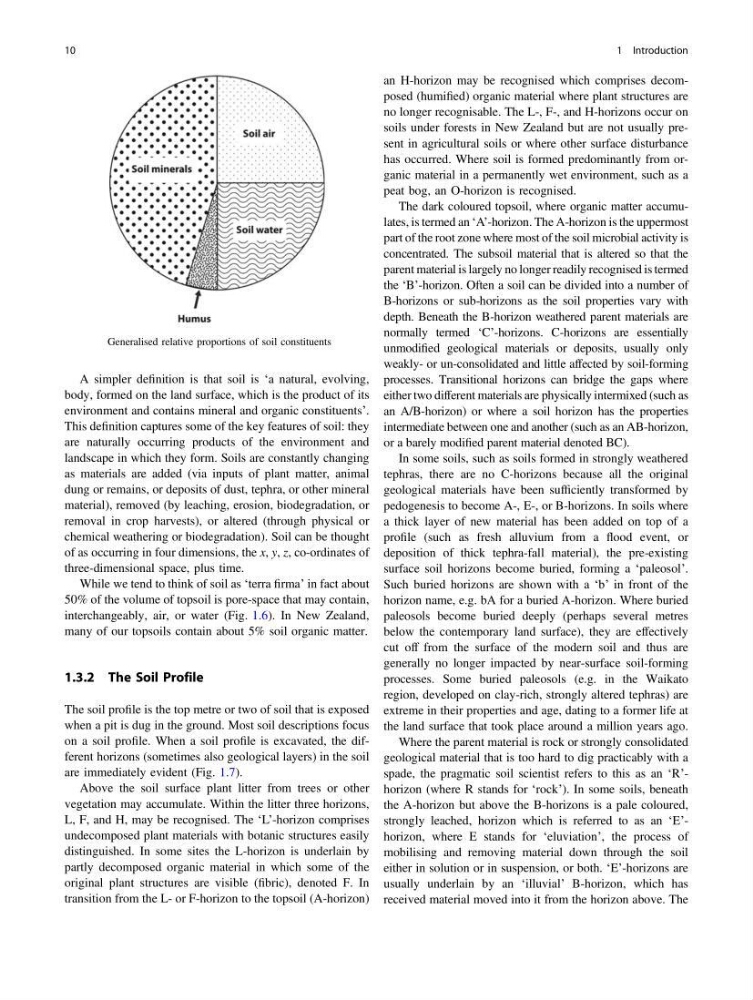
While we tend to think of soil as ‘terra firma’ in fact about
50% of the volume of topsoil is pore-space that may contain,
interchangeably, air, or water (Fig. 1.6). In New Zealand,
many of our topsoils contain about 5% soil organic matter.
1.3.2 The Soil Profile
The soil profile is the top metre or two of soil that is exposed
when a pit is dug in the ground. Most soil descriptions focus
on a soil profile. When a soil profile is excavated, the different horizons (sometimes also geological layers) in the soil
are immediately evident (Fig. 1.7).
Above the soil surface plant litter from trees or other
vegetation may accumulate. Within the litter three horizons,
L, F, and H, may be recognised. The ‘L’-horizon comprises
undecomposed plant materials with botanic structures easily
distinguished. In some sites the L-horizon is underlain by
partly decomposed organic material in which some of the
original plant structures are visible (fibric), denoted F. In
transition from the L- or F-horizon to the topsoil (A-horizon)
an H-horizon may be recognised which comprises decomposed (humified) organic material where plant structures are
no longer recognisable. The L-, F-, and H-horizons occur on
soils under forests in New Zealand but are not usually present in agricultural soils or where other surface disturbance
has occurred. Where soil is formed predominantly from organic material in a permanently wet environment, such as a
peat bog, an O-horizon is recognised.
The dark coloured topsoil, where organic matter accumulates, is termed an ‘A’-horizon. The A-horizon is the uppermost
part of the root zone where most of the soil microbial activity is
concentrated. The subsoil material that is altered so that the
parent material is largely no longer readily recognised is termed
the ‘B’-horizon. Often a soil can be divided into a number of
B-horizons or sub-horizons as the soil properties vary with
depth. Beneath the B-horizon weathered parent materials are
normally termed ‘C’-horizons. C-horizons are essentially
unmodified geological materials or deposits, usually only
weakly- or un-consolidated and little affected by soil-forming
processes. Transitional horizons can bridge the gaps where
either two different materials are physically intermixed (such as
an A/B-horizon) or where a soil horizon has the properties
intermediate between one and another (such as an AB-horizon,
or a barely modified parent material denoted BC).
In some soils, such as soils formed in strongly weathered
tephras, there are no C-horizons because all the original
geological materials have been sufficiently transformed by
pedogenesis to become A-, E-, or B-horizons. In soils where
a thick layer of new material has been added on top of a
profile (such as fresh alluvium from a flood event, or
deposition of thick tephra-fall material), the pre-existing
surface soil horizons become buried, forming a ‘paleosol’.
Such buried horizons are shown with a ‘b’ in front of the
horizon name, e.g. bA for a buried A-horizon. Where buried
paleosols become buried deeply (perhaps several metres
below the contemporary land surface), they are effectively
cut off from the surface of the modern soil and thus are
generally no longer impacted by near-surface soil-forming
processes. Some buried paleosols (e.g. in the Waikato
region, developed on clay-rich, strongly altered tephras) are
extreme in their properties and age, dating to a former life at
the land surface that took place around a million years ago.
Where the parent material is rock or strongly consolidated
geological material that is too hard to dig practicably with a
spade, the pragmatic soil scientist refers to this as an ‘R’horizon (where R stands for ‘rock’). In some soils, beneath
the A-horizon but above the B-horizons is a pale coloured,
strongly leached, horizon which is referred to as an ‘E’horizon, where E stands for ‘eluviation’, the process of
mobilising and removing material down through the soil
either in solution or in suspension, or both. ‘E’-horizons are
usually underlain by an ‘illuvial’ B-horizon, which has
received material moved into it from the horizon above. The
Fig. 1.6 Generalised relative proportions of soil constituents
10
1 Introduction
body, formed on the land surface, which is the product of its
environment and contains mineral and organic constituents’.
This definition captures some of the key features of soil: they
are naturally occurring products of the environment and
landscape in which they form. Soils are constantly changing
as materials are added (via inputs of plant matter, animal
dung or remains, or deposits of dust, tephra, or other mineral
material), removed (by leaching, erosion, biodegradation, or
removal in crop harvests), or altered (through physical or
chemical weathering or biodegradation). Soil can be thought
of as occurring in four dimensions, the x, y, z, co-ordinates of
three-dimensional space, plus time.
While we tend to think of soil as ‘terra firma’ in fact about
50% of the volume of topsoil is pore-space that may contain,
interchangeably, air, or water (Fig. 1.6). In New Zealand,
many of our topsoils contain about 5% soil organic matter.
1.3.2 The Soil Profile
The soil profile is the top metre or two of soil that is exposed
when a pit is dug in the ground. Most soil descriptions focus
on a soil profile. When a soil profile is excavated, the different horizons (sometimes also geological layers) in the soil
are immediately evident (Fig. 1.7).
Above the soil surface plant litter from trees or other
vegetation may accumulate. Within the litter three horizons,
L, F, and H, may be recognised. The ‘L’-horizon comprises
undecomposed plant materials with botanic structures easily
distinguished. In some sites the L-horizon is underlain by
partly decomposed organic material in which some of the
original plant structures are visible (fibric), denoted F. In
transition from the L- or F-horizon to the topsoil (A-horizon)
an H-horizon may be recognised which comprises decomposed (humified) organic material where plant structures are
no longer recognisable. The L-, F-, and H-horizons occur on
soils under forests in New Zealand but are not usually present in agricultural soils or where other surface disturbance
has occurred. Where soil is formed predominantly from organic material in a permanently wet environment, such as a
peat bog, an O-horizon is recognised.
The dark coloured topsoil, where organic matter accumulates, is termed an ‘A’-horizon. The A-horizon is the uppermost
part of the root zone where most of the soil microbial activity is
concentrated. The subsoil material that is altered so that the
parent material is largely no longer readily recognised is termed
the ‘B’-horizon. Often a soil can be divided into a number of
B-horizons or sub-horizons as the soil properties vary with
depth. Beneath the B-horizon weathered parent materials are
normally termed ‘C’-horizons. C-horizons are essentially
unmodified geological materials or deposits, usually only
weakly- or un-consolidated and little affected by soil-forming
processes. Transitional horizons can bridge the gaps where
either two different materials are physically intermixed (such as
an A/B-horizon) or where a soil horizon has the properties
intermediate between one and another (such as an AB-horizon,
or a barely modified parent material denoted BC).
In some soils, such as soils formed in strongly weathered
tephras, there are no C-horizons because all the original
geological materials have been sufficiently transformed by
pedogenesis to become A-, E-, or B-horizons. In soils where
a thick layer of new material has been added on top of a
profile (such as fresh alluvium from a flood event, or
deposition of thick tephra-fall material), the pre-existing
surface soil horizons become buried, forming a ‘paleosol’.
Such buried horizons are shown with a ‘b’ in front of the
horizon name, e.g. bA for a buried A-horizon. Where buried
paleosols become buried deeply (perhaps several metres
below the contemporary land surface), they are effectively
cut off from the surface of the modern soil and thus are
generally no longer impacted by near-surface soil-forming
processes. Some buried paleosols (e.g. in the Waikato
region, developed on clay-rich, strongly altered tephras) are
extreme in their properties and age, dating to a former life at
the land surface that took place around a million years ago.
Where the parent material is rock or strongly consolidated
geological material that is too hard to dig practicably with a
spade, the pragmatic soil scientist refers to this as an ‘R’horizon (where R stands for ‘rock’). In some soils, beneath
the A-horizon but above the B-horizons is a pale coloured,
strongly leached, horizon which is referred to as an ‘E’horizon, where E stands for ‘eluviation’, the process of
mobilising and removing material down through the soil
either in solution or in suspension, or both. ‘E’-horizons are
usually underlain by an ‘illuvial’ B-horizon, which has
received material moved into it from the horizon above. The
Fig. 1.6 Generalised relative proportions of soil constituents
10
1 Introduction