

streambank erosion, and reactivation of wind-blown sand
dunes.
Most Fluvial Recent Soils are naturally fertile because
they have received regular inputs of alluvial (flood deposited) material and, because of limited time, leaching has not
yet removed cations such as calcium, magnesium, and
potassium. The soil consistence is usually weak and friable,
enabling roots to explore all of the soil volume. Thus, plants
grow well and soil organic matter accumulates which provides good storage of phosphorus and nitrogen. Therefore,
the Fluvial Recent Soils are highly productive flat land and
so are some of the most intensively used soils (including
farming and horticulture, Fig. 14.9), such as on the Gisborne, Heretaunga, and Rangitaiki Plains, on the flats near
Dargaville, around Otaki and Te Horo on the Kapiti Coast,
and in the Marlborough and Tasman (Nelson) regions, including Waimea Plains. However, if products are harvested
then, to be sustainable, it is necessary to add fertilisers to
replace the nutrients removed with the crops.
Many New Zealand towns are situated, at least in part, on
Fluvial Recent Soils. Flat sites adjacent to river mouths, or
upstream where rivers were navigable, were important areas
for human settlements. Such towns include Hokitika,
Westport, and Greymouth on the West Coast of the South
Island where high rainfall in the Southern Alps makes them
particularly prone to intense flood events. Invercargill,
Mosgiel, Blenheim, Palmerston North, Whanganui, Wairoa,
Gisborne, Opotiki, Whakatane, Kawerau, Edgecumbe,
Paeroa, Thames, and Whangarei are also towns where serious flooding has occurred.
In many regions, Fluvial Recent Soils have been protected
from flooding by the construction of river stop banks that
prevent flooding, and thus further additions of alluvium
(which also has the consequence of increasing the amount of
flood water and sediment carried directly to estuaries and the
marine environment). It is easy to become complacent about
flood risk in areas protected by stop banks. However, occasional large floods may overtop or breach any flood protection, inundate the land, and deposit fresh alluvium, such as
occurred in Kawerau and Edgecumbe in 2017, in Whanganui
in 2015 (described as the worst flood on record), and in
Whangarei and Northland in 2020. Thus any infrastructure
development on flood plains needs to be carefully considered.
Buildings on alluvial plains may be constructed on stilts,
or with raised floor levels, to increase resilience to flood
events. Roads may be constructed on raised platforms, and
other infrastructure may best be installed on higher land.
New Zealand has invested a great deal in flood protection
works, including stop banks, and designed overflow mechanisms (eg. Fig. 14.6) to protect our productive, and often
intensively settled, alluvial plains. Ongoing diligence in the
maintenance and protection of flood protection works is
important. Such work sometimes meets resistance, due to the
cost, as the flood protection has been so effective that people
forget there is a hazard.
Given that flood plains contain a river or stream, there is
also a risk of stream bank erosion, as rivers naturally tend to
migrate across their flood plains, cutting into the outside of
bends and depositing material on the inside. There have been
recent incidences of stream bank erosion causing problems
with cutting into old, abandoned, rubbish dumps on the Haast
River on the West Coast of the South Island, and on the
Manawatu River in Foxton. Thus, a long-term vision needs to
be applied when siting infrastructure on flood plains.
Fluvial or Sandy Recent soils with silt or sandy substrates
and high groundwater tables are particularly susceptible to
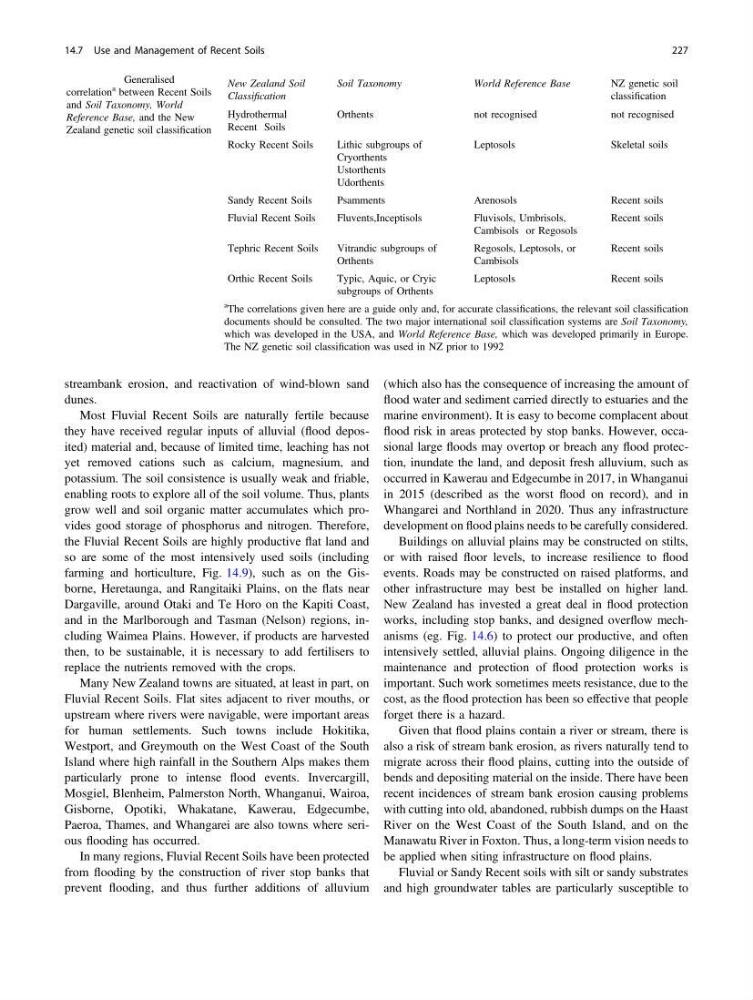
Table 14.3 Generalised
correlation
a between Recent Soils
and Soil Taxonomy, World
Reference Base, and the New
Zealand genetic soil classification
New Zealand Soil
Classification
Soil Taxonomy
World Reference Base
NZ genetic soil
classification
Hydrothermal
Recent Soils
Orthents
not recognised
not recognised
Rocky Recent Soils
Lithic subgroups of
Cryorthents
Ustorthents
Udorthents
Leptosols
Skeletal soils
Sandy Recent Soils
Psamments
Arenosols
Recent soils
Fluvial Recent Soils
Fluvents,Inceptisols
Fluvisols, Umbrisols,
Cambisols or Regosols
Recent soils
Tephric Recent Soils
Vitrandic subgroups of
Orthents
Regosols, Leptosols, or
Cambisols
Recent soils
Orthic Recent Soils
Typic, Aquic, or Cryic
subgroups of Orthents
Leptosols
Recent soils
a The correlations given here are a guide only and, for accurate classifications, the relevant soil classification
documents should be consulted. The two major international soil classification systems are Soil Taxonomy,
which was developed in the USA, and World Reference Base, which was developed primarily in Europe.
The NZ genetic soil classification was used in NZ prior to 1992
14.7 Use and Management of Recent Soils
227
dunes.
Most Fluvial Recent Soils are naturally fertile because
they have received regular inputs of alluvial (flood deposited) material and, because of limited time, leaching has not
yet removed cations such as calcium, magnesium, and
potassium. The soil consistence is usually weak and friable,
enabling roots to explore all of the soil volume. Thus, plants
grow well and soil organic matter accumulates which provides good storage of phosphorus and nitrogen. Therefore,
the Fluvial Recent Soils are highly productive flat land and
so are some of the most intensively used soils (including
farming and horticulture, Fig. 14.9), such as on the Gisborne, Heretaunga, and Rangitaiki Plains, on the flats near
Dargaville, around Otaki and Te Horo on the Kapiti Coast,
and in the Marlborough and Tasman (Nelson) regions, including Waimea Plains. However, if products are harvested
then, to be sustainable, it is necessary to add fertilisers to
replace the nutrients removed with the crops.
Many New Zealand towns are situated, at least in part, on
Fluvial Recent Soils. Flat sites adjacent to river mouths, or
upstream where rivers were navigable, were important areas
for human settlements. Such towns include Hokitika,
Westport, and Greymouth on the West Coast of the South
Island where high rainfall in the Southern Alps makes them
particularly prone to intense flood events. Invercargill,
Mosgiel, Blenheim, Palmerston North, Whanganui, Wairoa,
Gisborne, Opotiki, Whakatane, Kawerau, Edgecumbe,
Paeroa, Thames, and Whangarei are also towns where serious flooding has occurred.
In many regions, Fluvial Recent Soils have been protected
from flooding by the construction of river stop banks that
prevent flooding, and thus further additions of alluvium
(which also has the consequence of increasing the amount of
flood water and sediment carried directly to estuaries and the
marine environment). It is easy to become complacent about
flood risk in areas protected by stop banks. However, occasional large floods may overtop or breach any flood protection, inundate the land, and deposit fresh alluvium, such as
occurred in Kawerau and Edgecumbe in 2017, in Whanganui
in 2015 (described as the worst flood on record), and in
Whangarei and Northland in 2020. Thus any infrastructure
development on flood plains needs to be carefully considered.
Buildings on alluvial plains may be constructed on stilts,
or with raised floor levels, to increase resilience to flood
events. Roads may be constructed on raised platforms, and
other infrastructure may best be installed on higher land.
New Zealand has invested a great deal in flood protection
works, including stop banks, and designed overflow mechanisms (eg. Fig. 14.6) to protect our productive, and often
intensively settled, alluvial plains. Ongoing diligence in the
maintenance and protection of flood protection works is
important. Such work sometimes meets resistance, due to the
cost, as the flood protection has been so effective that people
forget there is a hazard.
Given that flood plains contain a river or stream, there is
also a risk of stream bank erosion, as rivers naturally tend to
migrate across their flood plains, cutting into the outside of
bends and depositing material on the inside. There have been
recent incidences of stream bank erosion causing problems
with cutting into old, abandoned, rubbish dumps on the Haast
River on the West Coast of the South Island, and on the
Manawatu River in Foxton. Thus, a long-term vision needs to
be applied when siting infrastructure on flood plains.
Fluvial or Sandy Recent soils with silt or sandy substrates
and high groundwater tables are particularly susceptible to
Table 14.3 Generalised
correlation
a between Recent Soils
and Soil Taxonomy, World
Reference Base, and the New
Zealand genetic soil classification
New Zealand Soil
Classification
Soil Taxonomy
World Reference Base
NZ genetic soil
classification
Hydrothermal
Recent Soils
Orthents
not recognised
not recognised
Rocky Recent Soils
Lithic subgroups of
Cryorthents
Ustorthents
Udorthents
Leptosols
Skeletal soils
Sandy Recent Soils
Psamments
Arenosols
Recent soils
Fluvial Recent Soils
Fluvents,Inceptisols
Fluvisols, Umbrisols,
Cambisols or Regosols
Recent soils
Tephric Recent Soils
Vitrandic subgroups of
Orthents
Regosols, Leptosols, or
Cambisols
Recent soils
Orthic Recent Soils
Typic, Aquic, or Cryic
subgroups of Orthents
Leptosols
Recent soils
a The correlations given here are a guide only and, for accurate classifications, the relevant soil classification
documents should be consulted. The two major international soil classification systems are Soil Taxonomy,
which was developed in the USA, and World Reference Base, which was developed primarily in Europe.
The NZ genetic soil classification was used in NZ prior to 1992
14.7 Use and Management of Recent Soils
227