

considerations are to find means to provide interesting
experiences for tourists while preventing injuries from contact with the hot, and often acidic, environment.
There is a need to protect geothermal fields from too
much water and energy extraction to protect the geothermal
features. In Rotorua City, a large number of houses and
businesses took up using geothermal waters for heating, spa
pools, and the like. The first hot water wells were drilled in
the 1920s and by 1985 around 450 wells were recorded. As a
result, the natural heat flow in the geothermal water table
was reduced by 30% and the geothermal activity at
Whakarewarewa and Kuirau thermal park declined, and
some spring activity ceased. The central Government launched the fraught ‘Bore War’ in 1987 by closing down many
of the private bores within 1.5 km of the Pohutu geyser in
1987, with subsequent recovery of the geothermal field.
Sandy Raw Soils in coastal dune systems may be subject
to wind erosion and sand deposition. Encouraging vegetation establishment, and preventing disturbance by foot and
vehicle traffic, can help stabilise dunes and prevent major
sand ‘blowout’. Mobilised sand may cause dunes to move
inland, burying everything in their path including roads,
buildings, forests, and farms. While plants such as lupin
(which fixes nitrogen) and marram have been successfully
used to stabilise sand, they tend to out-compete native
plants, and therefore encouragement of plants such as pingao
(Ficinia spiralis) and kowhangatara (Spinifex sericeus) is
favoured in many areas. Planting is often undertaken by
local ‘beachcare’ groups.
On the west coast of the North Island large areas of Raw
Soils occur on sands that are rich in iron and titanium. The
iron sands are mined at Taharoa, for export to Japan, and
near the mouth of the Waikato River where the constituents
are made into steel at the Glenbrook steel mill. The iron-rich
sand is concentrated with the remaining sand grains redeposited as tailings and stabilised by revegetation. Quartz-rich
Sandy Raw Soils at Parengarenga Harbour in Northland are
mined for use in glass making.
Tephric Raw Soils may occur in unconsolidated volcanic
ejecta on unstable slopes, and when volcanically active,
there are associated hazards of pyroclastic flows and tephra
fallout, together with the potentially dangerous emplacement
of lahars in valleys. As recently as August 2012, a phreatic
(steam-driven) eruption occurred in a new vent below the
Upper Te Māri crater, on the northern slopes of Mt Tongariro, near the Alpine Crossing Track, and blocks as large
as 1 m in diameter were deposited up to 2 km from the vent.
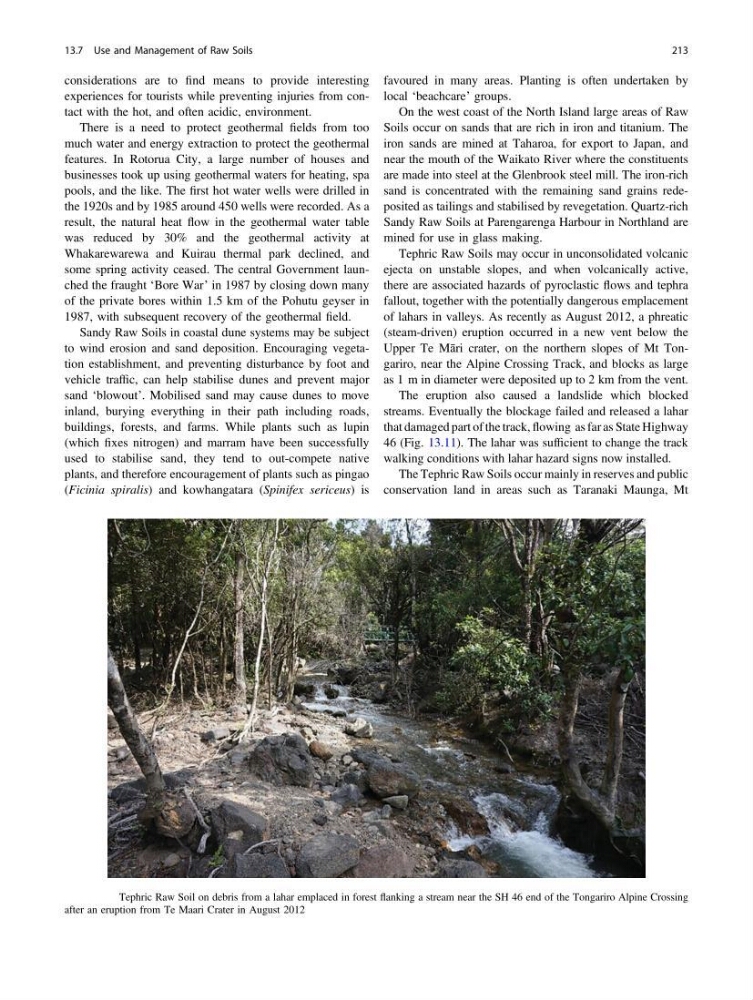
The eruption also caused a landslide which blocked
streams. Eventually the blockage failed and released a lahar
that damaged part of the track, flowing as far as State Highway
46 (Fig. 13.11). The lahar was sufficient to change the track
walking conditions with lahar hazard signs now installed.
The Tephric Raw Soils occur mainly in reserves and public
conservation land in areas such as Taranaki Maunga, Mt
Fig. 13.11 Tephric Raw Soil on debris from a lahar emplaced in forest flanking a stream near the SH 46 end of the Tongariro Alpine Crossing
after an eruption from Te Maari Crater in August 2012
13.7 Use and Management of Raw Soils
213
experiences for tourists while preventing injuries from contact with the hot, and often acidic, environment.
There is a need to protect geothermal fields from too
much water and energy extraction to protect the geothermal
features. In Rotorua City, a large number of houses and
businesses took up using geothermal waters for heating, spa
pools, and the like. The first hot water wells were drilled in
the 1920s and by 1985 around 450 wells were recorded. As a
result, the natural heat flow in the geothermal water table
was reduced by 30% and the geothermal activity at
Whakarewarewa and Kuirau thermal park declined, and
some spring activity ceased. The central Government launched the fraught ‘Bore War’ in 1987 by closing down many
of the private bores within 1.5 km of the Pohutu geyser in
1987, with subsequent recovery of the geothermal field.
Sandy Raw Soils in coastal dune systems may be subject
to wind erosion and sand deposition. Encouraging vegetation establishment, and preventing disturbance by foot and
vehicle traffic, can help stabilise dunes and prevent major
sand ‘blowout’. Mobilised sand may cause dunes to move
inland, burying everything in their path including roads,
buildings, forests, and farms. While plants such as lupin
(which fixes nitrogen) and marram have been successfully
used to stabilise sand, they tend to out-compete native
plants, and therefore encouragement of plants such as pingao
(Ficinia spiralis) and kowhangatara (Spinifex sericeus) is
favoured in many areas. Planting is often undertaken by
local ‘beachcare’ groups.
On the west coast of the North Island large areas of Raw
Soils occur on sands that are rich in iron and titanium. The
iron sands are mined at Taharoa, for export to Japan, and
near the mouth of the Waikato River where the constituents
are made into steel at the Glenbrook steel mill. The iron-rich
sand is concentrated with the remaining sand grains redeposited as tailings and stabilised by revegetation. Quartz-rich
Sandy Raw Soils at Parengarenga Harbour in Northland are
mined for use in glass making.
Tephric Raw Soils may occur in unconsolidated volcanic
ejecta on unstable slopes, and when volcanically active,
there are associated hazards of pyroclastic flows and tephra
fallout, together with the potentially dangerous emplacement
of lahars in valleys. As recently as August 2012, a phreatic
(steam-driven) eruption occurred in a new vent below the
Upper Te Māri crater, on the northern slopes of Mt Tongariro, near the Alpine Crossing Track, and blocks as large
as 1 m in diameter were deposited up to 2 km from the vent.
The eruption also caused a landslide which blocked
streams. Eventually the blockage failed and released a lahar
that damaged part of the track, flowing as far as State Highway
46 (Fig. 13.11). The lahar was sufficient to change the track
walking conditions with lahar hazard signs now installed.
The Tephric Raw Soils occur mainly in reserves and public
conservation land in areas such as Taranaki Maunga, Mt
Fig. 13.11 Tephric Raw Soil on debris from a lahar emplaced in forest flanking a stream near the SH 46 end of the Tongariro Alpine Crossing
after an eruption from Te Maari Crater in August 2012
13.7 Use and Management of Raw Soils
213