

Typic, Gley Raw Soils are recognised. No subgroups are
currently recognised for the other Raw Soil groups in the
New Zealand Soil Classification.
13.1.4 Origin of Soil Order Name
Prior to the New Zealand Soil Classification, Raw Soils were
either not recognised or included with Recent Soils. The
‘Raw Soils’ name was selected to clearly express the raw
and unformed nature of the soils.
13.2 Soil Profile Genesis
Raw Soils are the result of natural processes that expose
‘new’ materials at the land surface where weathering processes and soil formation may commence. The exposed earth
materials are diverse, ranging from hard rock, exposed by
erosion, to soft mud in a geothermal hot pool. Because of the
diversity of soil parent materials, Raw Soils are divided into
geologically based soil groups, related to rock types or deposits, landforms, tectonics, and geomorphic landscape
evolution. Thus the soil profile genesis (such as it is) is
different for each of the groups within the Raw Soil order.
The names and brief outlines of the Raw Soil groups
(Sect. 13.1.3) give a clear description of the major materials
and methods of emplacement, and hence will not be discussed further here.
Raw Soils provide a fascinating opportunity to study the
initiation of soil formation, and the interplay of incipient soil
processes in dynamic landscapes. Many Raw Soils may be
considered to have an on-again/off-again lifestyle that relates
in part to broader themes of ‘classical’ topdown pedogenesis
(on a stable site) versus upbuilding pedogenesis (where new
material is added to the land surface at varying rates). We
can recognise progressive (on-again) stable phases when the
soil is forming through topdown processes, generating soil
horizons, and regressive (off-again) phases when the soil is
disrupted, either by the removal of soil by erosion (as may
occur on steep slopes during a rainstorm or earthquake) or
by burial. The associated ecosystems are dynamic as
pioneering flora and fauna become established, or die out, in
response to changing conditions.
The basaltic lavas and scoria of Rangitoto Island, erupted
600–700 years ago, support the largest single tract of
pohutukawa (Metrosideros excelsa) forest in New Zealand.
Pohutukawa have played a critical role in colonising bare
lava as described particularly in studies by Bruce Clarkson
and Peter de Lange. As well as pohutukawa, lichens, mosses,
and liverworts on the lavas play an important role in converting lava to ‘soil’ thereby allowing other plants to become
established. Pohutukawa facilitate the establishment of a
succession of plant species on the lava by influencing the
microclimate and light regimes.
Some Raw Soils will ‘never grow old’ because the geological or climatic event that established the original Raw
Soil is likely to recur and inundate or destroy the pioneer
soil, unless something changes to enable its preservation.
For example, the dynamics of shifting sediment in a braided
river may rapidly change when the river channels change
course. At some point earlier profiles will be either eroded or
buried, re-starting the soil formation process. However,
when the river has a major change of course, permanently
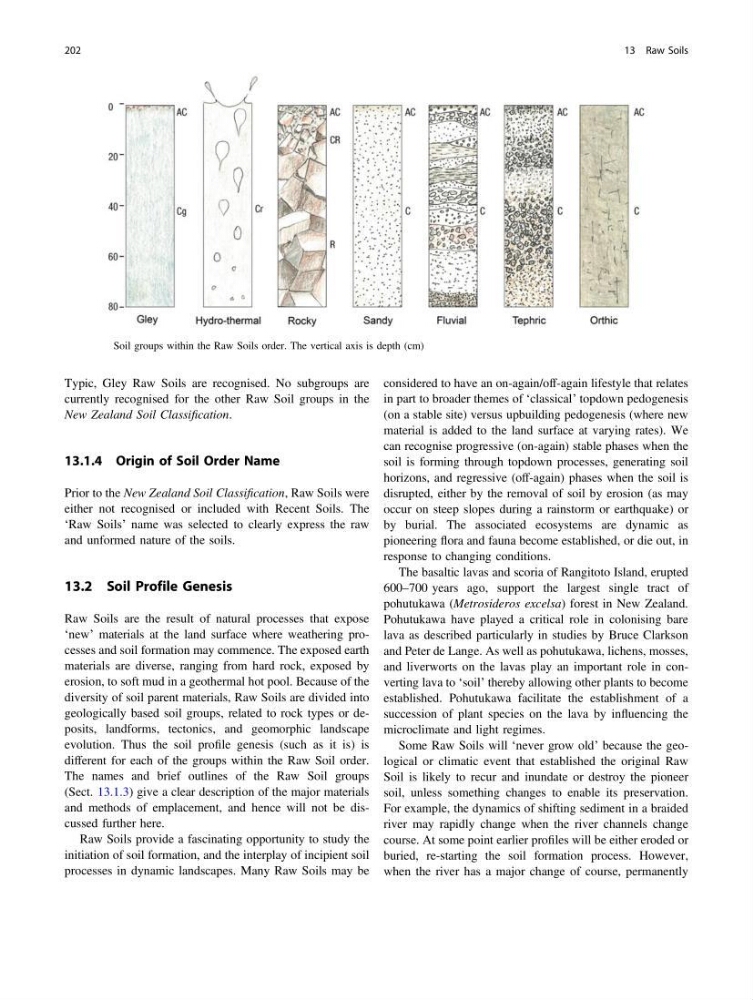
Fig. 13.3 Soil groups within the Raw Soils order. The vertical axis is depth (cm)
202
13 Raw Soils
currently recognised for the other Raw Soil groups in the
New Zealand Soil Classification.
13.1.4 Origin of Soil Order Name
Prior to the New Zealand Soil Classification, Raw Soils were
either not recognised or included with Recent Soils. The
‘Raw Soils’ name was selected to clearly express the raw
and unformed nature of the soils.
13.2 Soil Profile Genesis
Raw Soils are the result of natural processes that expose
‘new’ materials at the land surface where weathering processes and soil formation may commence. The exposed earth
materials are diverse, ranging from hard rock, exposed by
erosion, to soft mud in a geothermal hot pool. Because of the
diversity of soil parent materials, Raw Soils are divided into
geologically based soil groups, related to rock types or deposits, landforms, tectonics, and geomorphic landscape
evolution. Thus the soil profile genesis (such as it is) is
different for each of the groups within the Raw Soil order.
The names and brief outlines of the Raw Soil groups
(Sect. 13.1.3) give a clear description of the major materials
and methods of emplacement, and hence will not be discussed further here.
Raw Soils provide a fascinating opportunity to study the
initiation of soil formation, and the interplay of incipient soil
processes in dynamic landscapes. Many Raw Soils may be
considered to have an on-again/off-again lifestyle that relates
in part to broader themes of ‘classical’ topdown pedogenesis
(on a stable site) versus upbuilding pedogenesis (where new
material is added to the land surface at varying rates). We
can recognise progressive (on-again) stable phases when the
soil is forming through topdown processes, generating soil
horizons, and regressive (off-again) phases when the soil is
disrupted, either by the removal of soil by erosion (as may
occur on steep slopes during a rainstorm or earthquake) or
by burial. The associated ecosystems are dynamic as
pioneering flora and fauna become established, or die out, in
response to changing conditions.
The basaltic lavas and scoria of Rangitoto Island, erupted
600–700 years ago, support the largest single tract of
pohutukawa (Metrosideros excelsa) forest in New Zealand.
Pohutukawa have played a critical role in colonising bare
lava as described particularly in studies by Bruce Clarkson
and Peter de Lange. As well as pohutukawa, lichens, mosses,
and liverworts on the lavas play an important role in converting lava to ‘soil’ thereby allowing other plants to become
established. Pohutukawa facilitate the establishment of a
succession of plant species on the lava by influencing the
microclimate and light regimes.
Some Raw Soils will ‘never grow old’ because the geological or climatic event that established the original Raw
Soil is likely to recur and inundate or destroy the pioneer
soil, unless something changes to enable its preservation.
For example, the dynamics of shifting sediment in a braided
river may rapidly change when the river channels change
course. At some point earlier profiles will be either eroded or
buried, re-starting the soil formation process. However,
when the river has a major change of course, permanently
Fig. 13.3 Soil groups within the Raw Soils order. The vertical axis is depth (cm)
202
13 Raw Soils